Home » Posts tagged "horror fiction" (Page 39)

Musings: 2020 Is Nearly Here! The Classics Are Coming!

phantom       

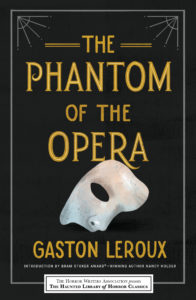
It’s been a big year for looking back, with the establishment of the Paperbacks from Hell imprint, Looking forward to 2020, it appears that it will be a big year for looking even further back.  The publication of several books of ghost and Gothic tales in 2019 looks like it was the beginnings of a return to the classics of the genre. 2020 will bring the first volume of HWA’s Haunted Library series that will be published in conjunction with Poisoned Pen Press, The Phantom of the Opera by Gaston Leroux. In addition, Crystal Lake has just announced that they’ll be publishing Crystal Classics, dark tales from the late 19th and early 20th century,  with occasional titles that “challenge” a classic title, and the covers look lovely. Their December newsletter says the first three of these are out in paperback and will also be available as ebooks: they are The Great God Pan by Arthur Machen, with an introduction by William Meikle;  Dagon Rising, a “challenge” to Lovecraft by William Meikle; and The Willows by Algernon Blackwood, with an introduction by Jasper Bark. I’ve been watching over the past several years now as some of the older or lesser-known writers are starting to be introduced to readers who may never have encountered them before, and I think we’ll continue to see this appreciation of writers from earlier times. Given the publication of books like Monster, She Wrote this year, which set a focus on lesser-known women writers (or women writers whose supernatural work was lesser-known) I think we can be sure that there will be more to uncover and appreciate! Of course, time, and literature, and our fears, move on forward, and I think we’ll see more diversity among contemporary writers in 2020 as well, if what I’m already seeing is any indication. It’s an exciting time to be a writer, publisher, librarian, researcher, and reader, and I can’t wait to see what directions the genre goes in next.


Book Review: Scavenger Hunt by Michaelbrent Collings

Scavenger Hunt by Michaelbrent Collings

Written Insomnia Press, 2019

ISBN: 978-1-699207-49-9

Available: Paperback, Kindle edition


Five strangers wake up in a room, with no memory of how they got there.  They find out they are part of a game controlled by a sinister mastermind, who wears a mask and communicates through electronic means.  The mastermind expects them to do bad things.  That’s the plot of Michaelbrent Collings’s newest thriller, and it’s a plot you’ve seen before, many times.  Collings himself used it in his previous novel, Terminal, and many authors, from King to Koontz, have also recycled it.  Unlike certain purveyors of said plot (example: the SAW and CUBE film franchises) Collings actually knows how to make an old plot seem new and fresh, due to the speed of the writing and the unseen twists that pop up throughout the book.  Scavenger Hunt is a fast ride through a familiar plot, and is worth the time to read.

Aside from the basic plot, there are elements that you can guess will show up.  The obvious one is that all the strangers were chosen for a reason.  Even though they don’t know each other, their lives were all connected at some point in the past.  Collings wisely spaces interlude chapters throughout the book, one for each character.  Each chapter fills in the backstory of one character, and it helps you see how the plot slowly ties together.  Collings also has a variety of chapters detailing police online investigations throughout the book that don’t seem related to the plot, but are, although the reasons don’t become apparent until later.  The whole story works this way: the reader gets a clue at a time to figure out the puzzle, but it’s a very difficult one to figure out, as Collings doesn’t give away anything obvious.

Therein lies the strength of this novel.  Not everything is as it seems, and the perception of the characters changes throughout the book, turning the story into a maddeningly elliptical puzzle.

The protagonists and antagonists flip roles throughout the book, and even what seems like a sick game might be perceived as salvation by the end.  Collings does an excellent job confounding expectations with this commonly used plot.   A nice touch was the creative way to keep the game players from simply running away, once they are free to go out on the streets.  Each player has a collar and wristwatch fitted with explosives, giving the game’s mastermind the freedom to blow a limb-or head-off of any of the players whenever he sees fit.  This is also one of the few stories of this type where some of the players are actually given a chance to leave the game, if they are fine with abandoning the other players to their fate.  It’s the little things that make an old plotline seem new and exciting.

Overall, this is a well-written, fast-paced story that should please fans of horror or thriller novels.  It has elements of both, but doesn’t swing too strongly one way or the other.  If you want excitement, don’t miss this one.  Recommended.


Contains: violence, profanity


Reviewed by Murray Samuelson

Book Review: Vampires of Lore: Traits and Modern Misconceptions by A.P. Sylvia

Vampires of Lore: Traits and Modern Misconceptions by A. P. Sylvia

Schiffer Publishing, 2019

ISBN: 978-0-7643-5792-3

Available: Hardcover


Vampires of Lore: Traits and Modern Misconceptions by A. P. Sylvia is a readable, concise deconstruction of vampire legends. Sylvia compares vampires in modern-day fiction to superstitious beliefs about vampires in folklore. The author describes vampires in literature and movies of the 1800s and later, such as Bram Stoker’s 1897 Dracula, the German 1922 movie Nosferatu and the 1990’s television series, Buffy The Vampire Slayer, as well as creatures in folk tales from around the world.


Sylvia defines vampires in fiction and folklore as “undead corpses of once living people, who are harming the living is some way, and are killed via taking action against the corpse itself”. The author examines 18 traits of modern-day fictional vampires, ranging from blood-drinking to transformation into bats and other animals. Surprisingly, fangs are inventions of fiction, whereas compulsive counting, exemplified by Sesame Street’s Count Von Count, is described in folklore.


The book has 120+ pages , footnotes and handsome illustrations on its cover and pages. However, it is not a dense, scholarly book. The author’s style is conversational and wry. Sylvia’s book would be a good addition to any vampire fan’s library. Highly recommended.


Reviewed by Robert D. Yee