Home » Posts tagged "horror fiction" (Page 38)

Graphic Novel Review: Harrow County Library Edition, Volume 3 by Cullen Bunn, illustrated by Tyler Crook


Harrow County, Library Edition Volume 3 by Cullen Bunn, illustrated by Tyler Crook

Dark Horse Comics, 2019

ISBN-13: 9781506710662

Available:  Hardcover, Kindle, comiXology

Emmy finds out more about her real family as she stands against supernatural entities threatening to destroy Harrow County and, ultimately, herself. Additionally, hunters from a neighboring town have heard tales of the creatures wandering the woods in Harrow County and want to prove their mettle by bringing one of them back. They may regret their decision in the end. Later, Emmy’s “haints” lead her to one of their kin who is strung up and dead. Emmy determines the killing was committed by someone familiar with how to kill them. When she finds her friend Bernice is responsible, their bonds of friendship and trust are further tested as they stand on opposing sides. Can they come together to face the evil that Emmy’s family has resurrected from the earth?

Harrow County, Library Edition Volume 3 contains volumes 5 and 6 of the series. It includes a sketchbook, art and painting process notes, a selection of “Tales of Harrow County” shorts by guest creators, and more. I love all the shorts that include the goblin, Priscilla. She’s adorably fierce.
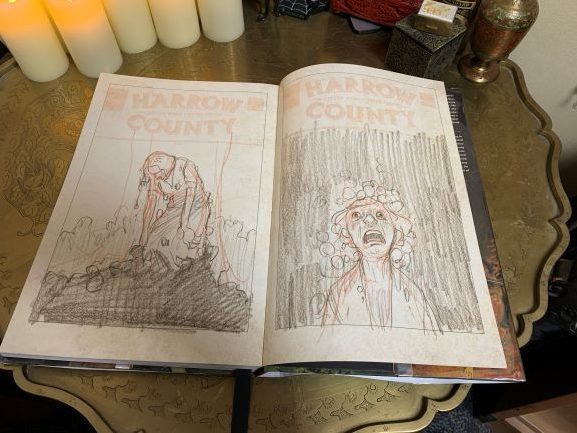
This is a great continuation of Emmy’s story. Bunn keeps the suspense and adventure going well. As with the previous volumes, this is a fast-paced story, but the artwork will keep you on a page longer than you need to read. Crook’s art is fantastic and makes a great pairing with Bunn’s story. This is first time I have reviewed a physical copy, too. The oversized hardcover book is beautiful. The photographs I have included don’t do it justice. If you can get yourself a physical copy, I recommend it. You won’t be disappointed.


Contains: blood, body horror, gore


Highly recommended


Reviewed by Lizzy Walker



Musings: Racism in Genre Fiction Is Everyone’s Problem

Courtney Milan

Recently, romance author Courtney Milan was censured by romance writers’ professional organization, the Romance Writers of America (RWA). Milan, who is half-Chinese, called out racist stereotypes of half-Chinese women in a romance novel by Kathryn Davis on Twitter. In return, Davis filed an ethics complaint that the criticism was unfair and caused her to lose a three-book deal. Suzan Tisdale, Davis’ employer, also filed an ethics complaint that Milan asked her how many authors of color she had published and was critical of Tisdale’s answer, and that she had called Davis a racist. Milan called Davis’ book a “racist mess,” but there’s a difference between personally attacking an author and criticizing her book (if honest reviews are important to you, I hope you can tell the difference). None of this was a violation of the RWA’s ethics code, but the board suspended her for a year and banned her from holding leadership positions. Milan has worked to increase diversity and inclusion in the romance community, which is majority white, cis, and heteronormative, and that appeared to have had a positive effect on the RWA. The lack of transparency in making this decision led to outrage from many in the romance community, and many officers, committee members, and paid members of the organization resigned. If you subscribe to any major newspaper, there has probably been a mention of this controversy in it this week (here’s the Washington Post’s take, and the New York Times).

Beyond the individual support for Milan, a larger problem has come to light, and that is institutional and systemic racism in the RWA and the romance community. Bestselling authors, such as Nora Roberts, have condemned the racism and homophobia that have come to light while all of this has been unfolding. For those people who don’t follow romance or know who Nora Roberts is, she’s close to being the romance genre’s equivalent to Stephen King.

I am writing about the out-of-control events in the romance writing community because racist, bigoted, and homophobic behavior and writing is not limited to one genre writing community. It’s everywhere. The horror genre and the people who participate in it do not get to wash our hands and say “well, what does racism there have to do with us?” Like it or not, one of the greats of the horror genre is well-known for racist, xenophobic vitriol. That is not opinion, it’s fact. Just because he wrote a century ago doesn’t mean we can’t criticize Lovecraft’s work. It’s even productive to do so. Some really great horror fiction has been published that critique his racism and xenophobia, like Victor Lavalle’s The Ballad of Black Tom, Matt Ruff’s Lovecraft Country, and Ruthanna Emrys’ Winter Tide.

Let’s not pretend, either, that those are things of the past and we’re too enlightened to have them appear in the horror community, or horror fiction, today. It doesn’t have to be related to your personal politics, any of us can trip over a stereotype or a dog whistle (I certainly can’t claim to know them all).  I’m pretty sure we’re all writers, reviewers, educators, librarians, or at least readers here, and that means we all know that words matter. It’s not a personal attack to point that out, it’s not being “too sensitive,” it’s an opportunity to do better for the horror genre and for ourselves.


Book Review: Violet by Scott Thomas

Violet by Scott Thomas

Inkshares Press, 2019

ISBN: 978-1-947848-36-8

Available: Paperback, Kindle, audiobook


Scott Thomas’s sophomore novel, Violet, came with a mound of high expectations attached to it.  His debut novel, Kill Creek, was one of the best horror novels of 2017.   Critics everywhere praised it, and even had some proclaiming Thomas as the possible heir to the Throne of King.  Needless to say, his second novel had a lot to live up to.  Unfortunately, the material does not meet the expectations, and judgment on whether he is the heir apparent will have to wait another book or two.  Violet showcases the author’s excellent descriptive writing, but the book is dragged down by its slow pace and lack of an exciting finish.


Kris Barlow and her eight year old daughter, Sadie, are retreating to the lake house that Kris inherited from her parents.  The goal is recovery, as her husband Jonah just died in a car accident.  Worth noting: Kris didn’t like him that much anyhow.  The setting seems perfect for a ride of suspense: the town is small, and the lake was mysteriously formed years ago when construction workers dug into a hidden chasm, releasing enough water to make a lake suddenly appear and flood half the town.  The house is in disrepair, as everyone that rented it left after a few days out of fear, and even the realtor won’t go near the place.  While there, odd happenings such as handprints all over the inside windows start to occur.  While settling into small town life, Kris learns of the mysterious disappearances of young girls in the area.  Some of the bodies were recovered, some not.  The ghostly occurrences increase, people drop mysterious warnings, and Kris soon learns that her daughter may be a target of the town’s evil forces.


As noted, Thomas is an excellent writer, with a real flair for descriptive narration.  He paints pictures with words so well you can see the whole book running on the movie screen in your mind.  The dialogue is also quite good, but it’s the narration where Thomas really shines.  He skates right up close to the edge of excess with his description, but he never crosses the line.  As a result, the story leaps right off the page at you.  The problem is, the story itself simply isn’t that compelling.  This book is an EXTREMELY slow burn, and it takes until around 300 pages before the story starts to move a little bit.  Even when it does, it doesn’t move much.  A thrilling climax might have been enough to justify the previous 400 pages, but even that gets denied.  In all likelihood, the end will leave the reader with more questions than answers.  It’s really a shame, because the setting and backstory seemed perfect for Thomas to apply his considerable skill at suspense writing.  All the elements are there: ghostly figures, mysterious neighbors, townies who seem to be hiding something, strange occurrences with animals, the list goes on.  Despite all of the available parts, for some reason, Thomas simply can’t get this one off the ground.  The best that can be said is, the talent is there, and let’s hope for better next time.

Contains: mild violence, mild profanity.


Reviewed by Murray Samuelson