Home » Posts tagged "reader’s advisory"

Book Review: Why I Love Horror: Essays on Horror Literature edited by Becky Siegel Spratford

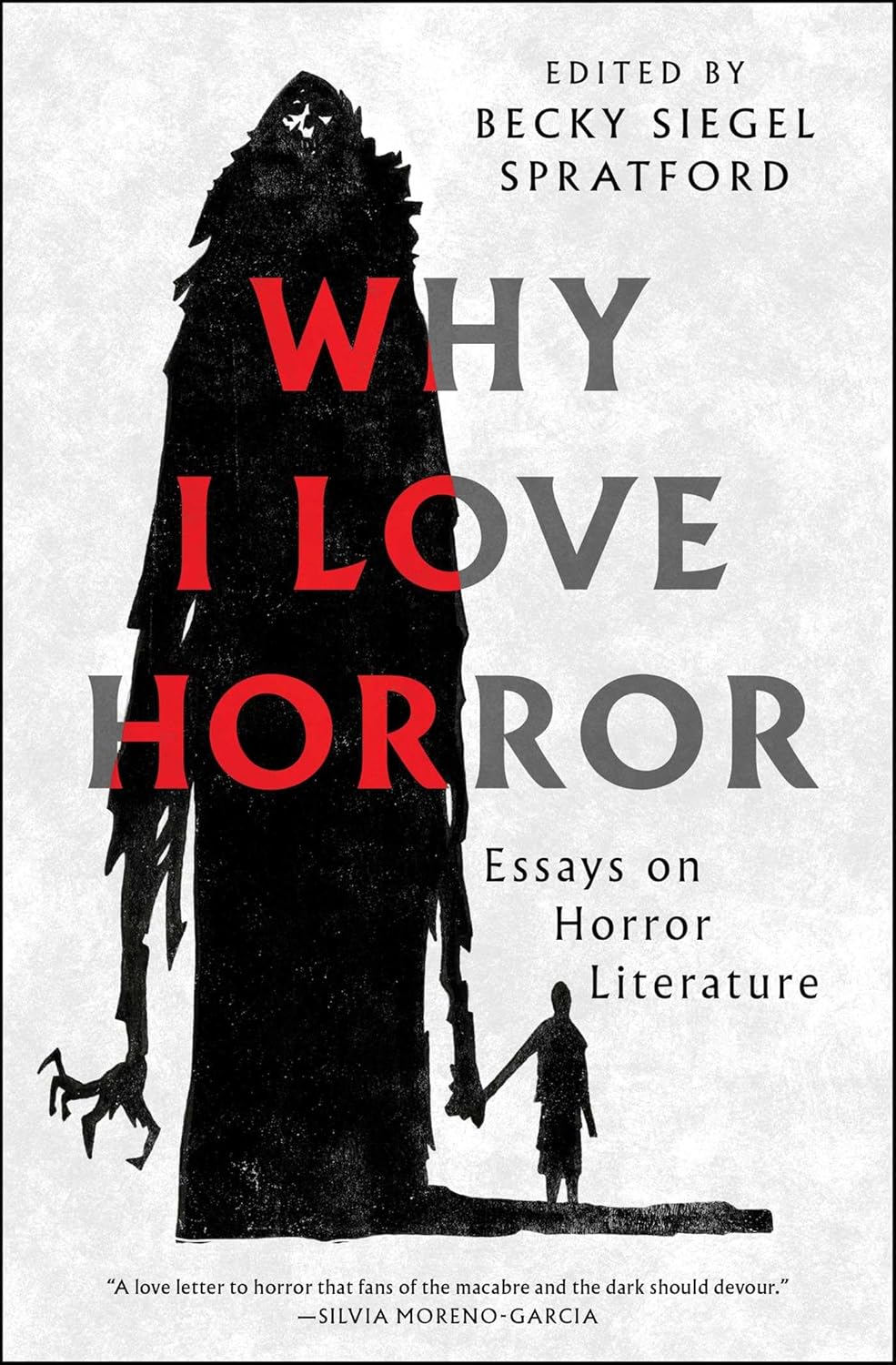
Cover art for Why I Love Horror edited by Becky Siegel Spratford

Why I Love Horror: Essays on Horror Literature edited by Becky Siegel Spratford

Saga Press, 2025

ISBN-13: 9781668205099

Available: Paperback, Kindle edition, audiobook, audio CD

Buy: Bookshop.org |  Amazon.com


Librarian Becky Siegel Spratford presents eighteen essays by current horror authors on why they love horror. The collection begins with a welcome to the reader by Sadie Hartman, followed by Spratford’s own essay, “Why Ask Why,” where she tells her story about how she found herself working with horror and curating this book full of talented horror writers. Before each essay, Spratford includes an introduction to the authors, a book recommendation to start with from their works, and a recommendation of an author in a similar vein.


My experience reading this was like opening a door to different times in my life where horror made significant appearances, despite having never really left me. Childhood memories and horror are foundational for some in this community. In “Brian Keene’s Giant-Size Man-Thing,” the author discusses his introduction to horror through comics and how horror helped him cope with dread and fear. John Langan writes of his childhood fascination with cryptids in “In the Bermuda Triangle with Sasquatch, Flesh Smoldering.” Jennifer McMahon’s “Monster Girl: How Horror Gave Me a Place to Belong” hit particularly close to home in terms of feeling out of place, being the weird girl who liked horror, and experiencing struggles at home. “My Mother Was Margaret White” by Cynthia Pelayo discusses abuse she experienced at home and at school, never feeling safe anywhere. Horror saved us both. “Permission to Scream” by Rachel Harrison and and “Tales From My Crypt” by Mary SanGiovanni specifically focus on girlhood and horror, both also speaking to similar experiences for me.


Horror providing comfort or a safe space is another thread that ties these essays together. Hailey Piper describes, in “The Giant Footprint of Horror”, how Godzilla introduced her to horror, and that there is joy in this dreadful genre. “My Long Road to Horror”, by Tananarive Due, describes horror as feeling. She writes a short but powerful history of her family and their personal horrors of racism and struggle.


Authors remind the reader that horror is more than a genre, it is an entire community. Alma Katsu’s “What You Can Learn from Horror: Don’t Run from Darkness; It’s Trying to Teach You a Lesson”, presents an essay questioning why people shy away from horror. A true crime writer I had a conversation with during my undergrad found it fascinating that there is a line in the sand between what his audience will and will not read: that line is fictional horror. Katsu states “I’m here to argue against running away from darkness,” (52) and provides personal information regarding past employment with government agencies as an intelligence analyst. Gabino Iglesias, in “Horror is Life: A Blood-soaked Love Letter,” discusses his life in Puerto Rico and discovering horror, which turns into a moving statement on how horror changed his life. In “A Day in My Psychedelic World,” Nuzo Onoh, dubbed the Queen of African Horror, reminds us there is horror for everybody.


There are so many great essays in this book. Other authors who contribute are Josh Malerman, Paul Tremblay, whose piece is accompanied by his daughter Emma, Grady Hendrix, Clay McLeod Chapman, Victor LaValle, David Demchuk, and Stephen Graham Jones. This would make a great addition to a general library collection, as well as essential reading for a course on horror. Highly recommended.


Reviewed by Lizzy Walker
WiHM: Gearing Up For Women in Horror Month? Take This Quiz!

Women in Horror Month starts tomorrow, and I thought I’d kick it off a day early to give you all the opportunity to try this quiz I made of books by women writers of horror published during this century. I looked at a lot of lists online, and as far as we’ve gone, it seems like there’s still a ways to go, particularly when we’re talking about horror for adults (the reverse is true with YA horror- it is almost completely authored by women). We need to be seeing new names on these lists, not just Mary Shelley and Shirley Jackson (as influential and talented as they are).

This is not an exhaustive list.  I couldn’t include everyone I would have liked, and some of these writers are prolific- I tried to include just one title for each author, which might not necessarily be their most well-known book. I did like seeing that there seems to be a fair amount of diversity, or at least more than there was. All of these were written since 2000, and most in the past ten years. The closer we get to the present, the more women writers of all kinds there seem to be!  At the same time, don’t be surprised if you have read fewer of these authors and books than you realize. Think of this as a jumping off point if you haven’t chosen a book yet to read for WiHM.

I’d love to see more suggestions! This is a great month to share your favorites, so tell me all about yours!


15 Years of Monster Librarian

It is hard to believe we’ve been doing this for fifteen years now. My husband Dylan, the original Monster Librarian, posted the first reviews on January 1, 2006, just three months (and a couple of days) after our first child was born, because what better time to take on a gigantic project than when you have a newborn.

He founded Monster Librarian because at the time, he was working an internship at a branch of the Indianapolis Public Library as part of completing his master’s degree in library science, and he found that the librarians there didn’t know anything about the horror genre past Stephen King and had no interest in putting in the effort to learn more about it. At the time, much of the horror fiction available was also being published only by small presses not listed in the databases of major wholesalers like Baker & Taylor, Follett, and Ingram. It required a commitment for librarians to seek out publishers and order individual titles, and the books could be expensive ( I was working as an elementary school library media specialist at the time, and Baker & Taylor provided a 40% discount. That’s a big deal for a small budget). As a longtime horror reader who started building his collection as a teenager by haunting his local used book store, the indifference the librarians had to the horror genre was something her felt he needed to do something about.

At the same time, I was working with elementary kids who were asking me for scary books while sitting on an awards committee for my state library association’s children’s choice award. The way that was supposed to work was that we read all nominated books, then met to choose a representative sample of 20 books that would cover all genres. The genre I had to fight for was horror. It went beyond indifference– some committee members actively disliked it. I had done research into reading engagement while working on my MLS and one thing Dylan and I both agreed on was how important it was to hook kids and teens with what researcher Stephen Krashen calls “home run books”. So many kids and teens get hooked through scary stories and horror that he felt it was important to reach librarians and advocate for the horror genre for readers. This was his passion and he posted reviews even after he became ill and through five years of painful migraines and chronic, life-imparing pain, until just before he died in 2014. I think he’d be delighted to see all the positive changes that have occurred in the horror genre and in librarians’ attitudes and knowledge of the horror genre and scary stories for kids since the site was founded in 2006.

I love seeing the diversity growing in the genre. There is still plenty of room for growth, but wow, things have changed a lot, and mostly for the better. I think Dylan would love to see it.

I would like to make sure we are providing useful information to you. Monster Librarian is an all-volunteer effort and I need to make sure we are at least covering our hosting costs and postage. That costs about $200  every year and we almost didn’t make it this year. Without your support, either through purchasing items through Monster Librarian’s store at Bookshop.org or contributing through Paypal, we will struggle to continue our work, and after this long at running the site, I’m not sure what I would do without it! Thanks for visiting, and I hope you’ll be back again soon!