Home » Posts tagged "body horror" (Page 13)

Book Review: Whitechapel Rhapsody by Alessandro Manzetti

A note from the editor (that’s me) :

We are midway through October and Monster Librarian still needs to raise the funds to pay for our hosting fees and postage in 2021. If you like what we’re doing, please take a moment to click on that red “Contribute” button in the sidebar to the right, to help us keep going!  Even five dollars will get us closer to the $195 we need to keep going at the most basic level. We have never accepted paid advertising so you can be guaranteed that our reviews are objective. We’ve been reviewing and supporting the horror community for 15 years now, help us make it another year! Thank you! And now our review of Whitechapel Rhapsody by Alessandro Manzetti.
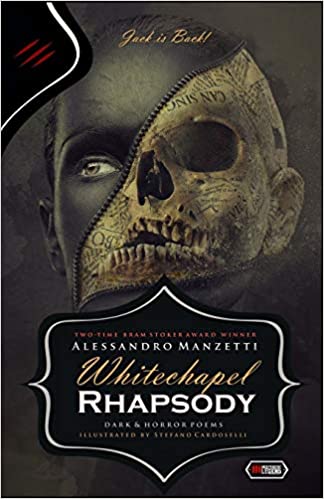
cover art for Whitechapel Rhapsody by Alessandro Manzetti

Whitechapel Rhapsody by Alessandro Manzetti   (Amazon.com)

Independent Legions Publishing,  2020

ISBN: 978-88-31959

Available: Kindle edition, Paperback

Ever since Jack the Ripper prowled the streets, he has been the worst kind of nightmare, the shockingly brutal and chilling reality that monster-men can be living among us unnoticed, watching and freely choosing fresh victims. In his new book of poetry, Whitechapel Rhapsody, Alessandro Manzetti uses words from The Ripper’s letters to the police, information about the women and their possible murderers, and even one of the autopsies to access the mind of a killer who has never been identified for certain.

In “The Lair”, which begins the book, and in the rhapsody poems (“Sick Rhapsody,” “Entangled Rhapsody,” and “Madhouse Rhapsody”) which appear at intervals throughout the collection, we are plunged into the ugly, sordid, sick environment of physical and spiritual contagion that was the setting for the murders, if not the spawning ground of the murderer. Against this background, the poems describe the killer as a macabre artist who vows to his victims, “I will make art of you” and causes them to be “carved” by his “iron brushes,” his “long-bladed knife accurate like a Mozart composition.” True to The Ripper’s artistic vision, there is a focus on color, especially shades of red blood and the textures of the organs of the human body in each “still life.” This is the portrait of a demented artist whose imagination is a “giant” that “can feel the vibrating legs of a grasshopper ready to jump on a leaf of a remote island.”

This extreme sensitivity is on display in “She Knew My Name” which riffs on Poe’s “The Raven.” Both poems are about the narrator’s mind and what is happening inside it, how each is processing his experiences. Both narrators indulge in their madness, and that has an emotional impact on the reader. Manzetti confirms that it is not the facts of blood or death that most inspire terror in a reader but the evil imagination of the poem’s speaker igniting the active imagination of the reader’s “dark side.” This fascination that ordinary people have with horror is apparent in “Madhouse Rhapsody,” a reminder of Bedlam where the English citizenry actually went to enjoy the suffering of the imprisoned mentally ill as live entertainment. Also, many of the poems mention the opium, syphilis, perversions, and abuses which were common at the time and could be the source of madness.

Even though it is unlikely we will ever know Jack the Ripper’s identity or what caused him to kill, Whitechapel Rhapsody pulls back the curtain enough for us to fully feel the evil behind the facts and sense the cold, hard facts behind the dark poetic imagination.

Recommended.


Reviewed by Nova Hadley
Book Review: Night of the Mannequins by Stephen Graham Jones

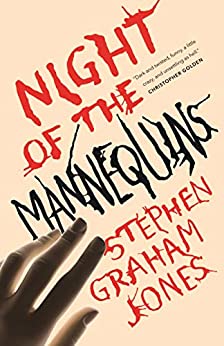
cover art for Night of the Mannequins by Stephen Graham Jones

Night of the Mannequins by Stephen Graham Jones (  Bookshop.org  |  Amazon.com )

Tor.com, 2020

ISBN-13 : 978-1250752079

Available: Paperback, Kindle edition


Night of the Mannequins is a short book, a rocket-fuel ride from beginning to end. It is narrated by teenage Sawyer, one of an offbeat, close-knit group of friends who have known each other forever and are about to graduate high school and go their separate ways. Stephen Graham Jones does a genius job with Sawyer’s narrative voice: it really feels like he is talking right to you. After they’re thrown out of a movie theater where their friend Shanna works, the friends come up with the idea of sneaking a discarded mannequin in to prank Shanna and the manager. Instead, the prank fizzles, the mannequin disappears, and Sawyer is certain he saw it walk out of the theater. After one of the Shanna is killed, along with her family, when a truck plows into her house, Sawyer is convinced the mannequin is the culprit and that he and his friends and their families are all in danger of death by mannequin. He is certain he has seen the mannequin and that the mannequin is stealing and eating Miracle-Gro to turn into a gigantic monster. Sawyer decides he has to act before the monster mannequin can. Jones takes us far down the rabbit hole in this surreal and disturbing tale as Sawyer’s perceptions become more and more skewed,  especially once he starts covering his face with a mannequin mask.

We don’t get to know the other friends well, but Sawyer’s feelings for them seem genuine, so you feel for them and their families when gory tragedy strikes. And wow, does it strike. Sawyer describes it in detail, and Jones does not pull his punches.

This is not intended to be a YA book but it very easily could appeal to YA horror readers looking for a bite-sized read. It’s short, fast-paced, and, unusual in YA horror these days, has a teenage boy as protagonist. With Night of the Mannequins you could hook someone who loves slasher movies but hasn’t shown much interest in reading.  Recommended for ages 15+


Book Review: THE PVRITAN by Birgitte Margen

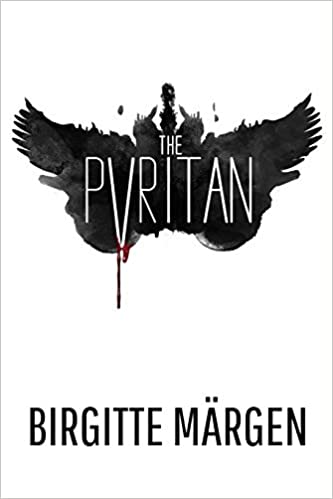
cover for THE PVRITAN by Birgitte Margen

THE PVRITAN by Birgitte Margen (  Bookshop.org | Amazon.com )

Publisher: Independently published, 2020

ASIN : B08HQ6JV85

Available: Kindle edition, paperback


THE PVRITAN by Birgitte Margen is a crime novel about horrific serial murders in Boston. Martina Zucco is a deadly serious homicide detective. Her mother died in childbirth, and she was raised by a distant father, whom she followed into the police force. Her partner, Neil Cavanaugh, balances out the team with his irreverent, male humor. They investigate the murders of a M13 gang member, a teenage Satanic cultist, and an incel (“involuntary celibate”). Each victim is hanged, mutilated, and publicly displayed. The eyes, tongue, or hand are cut out. Skin from the abdomen is flayed away and glued to outstretched arms like wings.

What is the motive? The author gives readers clues. She begins each chapter with an excerpt from the Geneva Bible used by the Puritans, and inserts sacrifices from the Salem witch trials between the present-day murders. The only clues for Zucco and Cavanaugh, however are small pieces of the Geneva Bible stuffed into the victims.

The author describes the Boston area well, including the Boston Commons and neighborhoods burdened with gangs or crime (Mattapan aka “Murderpan” and Dorchester aka “Deathchester”). The plot moves along quickly, keeping the reader engaged. The author gives interesting background information about the M13 gang, satanic cults and the incel community. However, the novel ends too abruptly. As in many novels about serial killers, the detective and psychopathic killer struggle to the death. However, the author does not give enough details about the murderer’s family and childhood to satisfactorily explain his psychopathy.

Birgitte Margen also wrote The Red Death, about a deadly ancient plague, previously reviewed and recommended by Monster Librarian.

Contains: violence, extreme gore, body horror, and sexual content


Contains: violence, gore, sex


Reviewed by Robert D. Yee