Home » Posts tagged "body horror" (Page 12)

Book Review: The Grace Year by Kim Liggett


A note from the editor:

We are getting near the end of November and Monster Librarian still needs to raise the funds to pay for our hosting fees and postage in 2021. If you like what we’re doing, please take a moment to click on that red “Contribute” button in the sidebar to the right, to help us keep going!  Even five dollars will get us closer to the $45 we still need to keep going at the most basic level. We have never accepted paid advertising so you can be guaranteed that our reviews are objective. We’ve been reviewing and supporting the horror community for 15 years now, help us make it another year! Thank you! And now our review of The Grace Year by Kim Liggett.


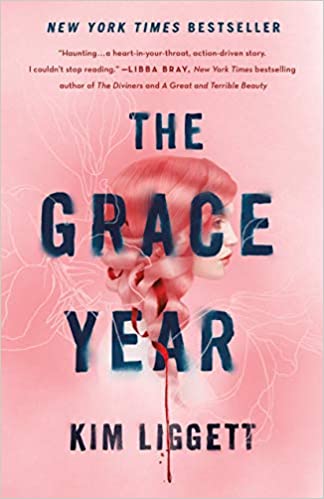
cover art for The Grace Year by Kim Liggett

The Grace Year by Kim Liggett (   Bookshop.org  | Amazon.com  )

Wednesday Books, 2019

ISBN-13 : 978-1250145444

Available: Hardcover, Kindle edition, audiobook


At first glance, The Grace Year seems like a YA take on The Handmaid’s Tale crossed with The Lord of the Flies. It takes place in an alternate society where women and girls are divided into groups by the colors of their hair ribbons: white for girls, black for wives, and red for grace year girls. Grace year girls are sent to an isolated camp as a group when they turn sixteen, after boys and men their age and older have an opportunity to choose one to marry from among them. Some girls are “veiled” and the rest know they will be assigned to manual labor tasks. The younger sisters of the girls who don’t return run the risk of being sent to the outskirts, where they will struggle to survive and are expected eventually to sexually service men no longer satisfied with their wives.

Protagonist Tierney is about to begin her grace year. She does not aspire to be veiled, but would rather labor outside when her grace year is done, as wives’ movements and speech are very restricted and she has always enjoyed spending time outdoors, learning useful skills from her father and spending her time alone and with her friend Michael, whose family is very high status. Rather than choosing Kiersten, the girl his family has picked out for him, though, Michael chooses Tierney to keep her safe, not realizing that he has actually made her a target during the grace year.

The supposed purpose of the grace year is for girls to come into their magic and work it out of themselves without risking the men, so the girls are “safe” to be around, but girls know that things too terrible to talk about must happen, because of each group of girls that leaves, fewer come back, and the ones who do are traumatized and refuse to speak about it. In addition to their isolation, the girls must stay within a fence, because they are being hunted by “poachers” who will skin them alive, dissect them, bottle the parts, and sell them back to the men in town as aphrodisiacs. There is the obligatory section of a YA speculative survival novel where a character whose job it is to exterminate a girl actually saves her and heals her and they fall in love, but it is particularly gruesome because there is no hiding the fact that he’s there to skin, dissect, and bottle her for consumption– he even has diagrams. The body horror is strong in this book, although most of the actual damage is done offscreen.

It is difficult to write about the characters and society in this book, both women and men, because from best to worst every one of them is so poisoned by patriarchy. The gaslighting of women and girls is so extensive and ingrained that it can’t really be separated out. Would Kiersten be so cruel if she hadn’t been trapped by society’s constraints since she was a child? Would so many of the girls have been so eager to believe in their magic if they hadn’t been powerless their entire lives? Even “good” men like Michael, with the best of intentions, can’t undo the damage. In 800+ pages (Amazon says there are 416, my Kindle says 815) there was not a single character in this book whose decisions could be trusted, including Tierney’s. The ending was absolutely crushing to me. I have to hope that YA readers who get all the way through to the end will develop a strong desire to examine their decisions and choices in light of the damage patriarchy does to all of them in the present, rather than waiting for the next generation. Whether they do or not, given the number of comparisons to The Hunger Games, I am sure many will find it a compelling read. Recommended.


Book Review: SLAY: Stories of the Vampire Noire edited by Nicole Givens Kurtz

A note from the editor:

We are midway through October and Monster Librarian still needs to raise the funds to pay for our hosting fees and postage in 2021. If you like what we’re doing, please take a moment to click on that red “Contribute” button in the sidebar to the right, to help us keep going!  Even five dollars will get us closer to the $195 we need to keep going at the most basic level. We have never accepted paid advertising so you can be guaranteed that our reviews are objective. We’ve been reviewing and supporting the horror community for 15 years now, help us make it another year! Thank you! And now, our review of SLAY: Stories of the Vampire Noire edited by Nicole Givens Kurtz.

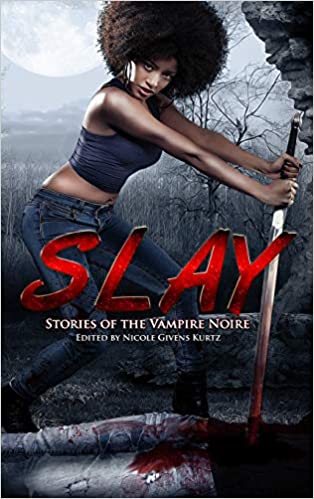
cover art for SLAY: Stories of the Vampire Noire

SLAY: Stories of the Vampire Noire edited by Nicole Givens Kurtz (   Bookshop.org  | Amazon.com )

Mocha Memoirs Press, 2020

ISBN-13 : 978-1735219554

Available: Hardcover, paperback, Kindle edition


The late L.A. Banks’ Vampire Huntress series, and her ability to transform common tropes of vampire fiction into stories that reflected the African-American experience, inspired many of the authors in SLAY: Stories of the Vampire Noire. Anthology editor Nicole Givens Kurtz continues that tradition here by showcasing Black writers and their imaginings of vampires, slayers, and hunters through their stories, giving Black readers the opportunity to be seen in vampire fiction that takes on the standard Eurocentric tropes and transforms them in a way that is uniquely relevant to Black people and also provides a window for other readers into what they have been missing because of the limited perspective of most vampire fiction. The stories come from all over the African diaspora, but the majority of them are by authors from the United States and Britain. Authors take various approaches to the concept of vampirism, inspired by Black culture, mythologies, history, and experiences, but there is nothing boring here. Interspersed between stories are beautifully calligraphed obituaries.

In the section of stories from the United States and Britain, strong stories include “Dessicant”, by Craig Laurance Gidney, takes place in a badly-kept up low-income apartment building that has red dust in the vents that is making its occupants sick and draining them of fluids. The negligent landlord can’t be reached and the protagonist, a Black trans woman ostracized by other residents, has to find a way to combat the dust, or whatever it is, on her own. “The Retiree”, by Steven Van Patten, is a funny, heartbreaking story that will give readers a new perspective on what goes on in a retirement home In “The Dance”,  by L. Marie Wood, the protagonist is surprised to learn there is more to her sexuality than she realized. In “A Clink of Crystal Glasses Heard”, by LH Moore, Neeka and her friends have a coming-of-age ceremony planned by their mothers that is not what they expected. “Diary of a Mad Black Vampire”,  by Dicey Grenor, puts the reader in the head of a bored, lonely and vicious Black vampire who finds herself intrigued by a fragile-seeming albino white girl. “The Last Vampire Huntress”, by Alicia McCalla, remixes the story of Kendra the Vampire Slayer, with Kendra the reluctant, prophesied, last vampire huntress who must accept her destiny and kill her vampire boyfriend after he attacks her friends. “Unfleamed”, by Penelope Flynn, tackles race and violence in the Victorian era with its take on the Dracula story. “Di Conjuring Nectar of di Blood” , by Kai Leakes, is a gorgeously written historical story of love and generational trauma. In “Snake Hill Blues”, set in 1927,  conjure woman Mamma Lucy eliminates a vampire who has been preying on dancing girls. I hope this author will bring her back in other stories!

The stories from African authors are also strong.  A few that stuck out to me included Oghenechovwe Donald Ekpeki’s “Attack on University of Lagos Law Faculty”, an entertaining story narrated by a pompous, egotistical law student who finds himself in the surprising position of vampire slayer, and “His Destroyer”, by Samantha Bryant, is a powerful rendering of the Passover story from the point of view of  the avatar of the Angel of Death. “Quadrille” is an engaging and occasionally darkly humorous story about friendship narrated by a vampire who has become a reporter in conflict zones in order to cover up his feeding habits, abetted by a djinn and a shapeshifter.

A last section contains stories about the future. These stories aren’t really horror, but they are compelling. In “Bloodline” scientists make a terrible mistake, enhancing a vampire’s powers.  “Message in a Vessel” is a science fiction story about the consequences of human enslavement to vampires, and “Blood Saviors” is a more fantasy-oriented tale in which an investigator for the vampires’ council discovers that a vampire has been enslaving and draining earth elementals to make a rejuvenating serum for humans, whose blood has become polluted, leading to vampires getting sick.

This is a great collection overall, with fresh takes on vampire lore that I really haven’t seen elsewhere, informed by Black experiences and perspectives. There’s enough here to love that it has taken me much longer than I expected to write this review. If you love vampire fiction or horror anthologies, and want to support Black authors, publishers, and readers of horror you should definitely pick this up. It’s a great way to discover some really talented Black writers, if you haven’t already. Highly recommended.

Contains: Animal killing, body horror, blood-drinking, torture, scientific experimentation, mutilation, murder, gore, violence, sexual situations, racism, sexual assault, rape, dehumanization, insects, genocide.

Book Review: Whitechapel Rhapsody by Alessandro Manzetti

A note from the editor (that’s me) :

We are midway through October and Monster Librarian still needs to raise the funds to pay for our hosting fees and postage in 2021. If you like what we’re doing, please take a moment to click on that red “Contribute” button in the sidebar to the right, to help us keep going!  Even five dollars will get us closer to the $195 we need to keep going at the most basic level. We have never accepted paid advertising so you can be guaranteed that our reviews are objective. We’ve been reviewing and supporting the horror community for 15 years now, help us make it another year! Thank you! And now our review of Whitechapel Rhapsody by Alessandro Manzetti.

cover art for Whitechapel Rhapsody by Alessandro Manzetti

Whitechapel Rhapsody by Alessandro Manzetti   (Amazon.com)

Independent Legions Publishing,  2020

ISBN: 978-88-31959

Available: Kindle edition, Paperback

Ever since Jack the Ripper prowled the streets, he has been the worst kind of nightmare, the shockingly brutal and chilling reality that monster-men can be living among us unnoticed, watching and freely choosing fresh victims. In his new book of poetry, Whitechapel Rhapsody, Alessandro Manzetti uses words from The Ripper’s letters to the police, information about the women and their possible murderers, and even one of the autopsies to access the mind of a killer who has never been identified for certain.

In “The Lair”, which begins the book, and in the rhapsody poems (“Sick Rhapsody,” “Entangled Rhapsody,” and “Madhouse Rhapsody”) which appear at intervals throughout the collection, we are plunged into the ugly, sordid, sick environment of physical and spiritual contagion that was the setting for the murders, if not the spawning ground of the murderer. Against this background, the poems describe the killer as a macabre artist who vows to his victims, “I will make art of you” and causes them to be “carved” by his “iron brushes,” his “long-bladed knife accurate like a Mozart composition.” True to The Ripper’s artistic vision, there is a focus on color, especially shades of red blood and the textures of the organs of the human body in each “still life.” This is the portrait of a demented artist whose imagination is a “giant” that “can feel the vibrating legs of a grasshopper ready to jump on a leaf of a remote island.”

This extreme sensitivity is on display in “She Knew My Name” which riffs on Poe’s “The Raven.” Both poems are about the narrator’s mind and what is happening inside it, how each is processing his experiences. Both narrators indulge in their madness, and that has an emotional impact on the reader. Manzetti confirms that it is not the facts of blood or death that most inspire terror in a reader but the evil imagination of the poem’s speaker igniting the active imagination of the reader’s “dark side.” This fascination that ordinary people have with horror is apparent in “Madhouse Rhapsody,” a reminder of Bedlam where the English citizenry actually went to enjoy the suffering of the imprisoned mentally ill as live entertainment. Also, many of the poems mention the opium, syphilis, perversions, and abuses which were common at the time and could be the source of madness.

Even though it is unlikely we will ever know Jack the Ripper’s identity or what caused him to kill, Whitechapel Rhapsody pulls back the curtain enough for us to fully feel the evil behind the facts and sense the cold, hard facts behind the dark poetic imagination.

Recommended.


Reviewed by Nova Hadley