Home » 2021 (Page 9)

Book Review: The Kindly Ones by Cliff James

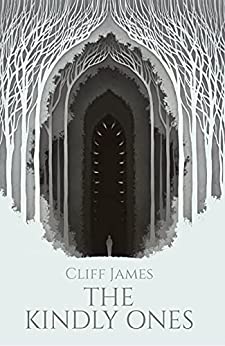
cover art for The Kindly Ones by Cliff James

The Kindly Ones by Cliff James

Lethe Press, 2021

ISBN: 2370000883131

Available: paperback, Kindle


The Kindly Ones is not your standard horror novel.  No fast pacing.  No big thrills.  No wild climax, where all is explained.  Instead, it’s a dark, brooding tale that relies heavily on atmosphere, a methodical pace, and excellent writing to pull the reader in, and it does it very well.  Fans of Robert Eggers’s films (The Witch, The Lighthouse) will love this book, as well as anyone who enjoys a story outside the norm.


After The Calamity, (world apocalypse) the story centers on two small groups of people trying to eke out an existence in a remote forest, away from the remains of humanity.  One is the uber-religious Mann family, consisting of Mother and her sons.  The other is a group of more socially permissive people: Rhea, Fran, Ky, (female) and the youngest, teen-age Lugh (male).  Conflict eventually ensues, since the groups have very contrasting worldviews, especially when it concerns the intimate relationship between Lugh and Abel, one of Mother’s sons.  There’s another plot thread concerning the reclusive Father Ambrose, who lives alone in a mansion nearby.   It becomes clear that one group must prove superior, so the other group has to be driven out, or eliminated.


Instead of opting for a story arc with peaks and valleys, the book opts for a slow, calculated pace, and relies on creating an overall atmosphere of unease that persists throughout the story, and it does it extremely well.  Much of it is due to the author’s phenomenal way with words; the writing is art in story form.  If the 19th century masters of British literature had decided to go wild and write horror, The Kindly Ones is what one of them might have produced.  However, like reading Dickens, this is best read slow, so nothing is missed and the author’s meaning is understood.  Example: “and power was given to kill with sword, and with hunger, and with death”, he said, heaving the axe into the air, over his head, onto hers, “and to kill with the beasts of the earth.”  It’s easy to miss that someone just got an axe slammed into their head, if you are turning the pages too fast!  The book is an AP course on how to write well, and could be enjoyed for that alone.


Incredible writing aside, The Kindly Ones is still a good enough story that most readers should enjoy and appreciate it.  As noted, the plot isn’t fast, but moves at a measured, steady pace, although it might be too slow for thrill readers.  It relies upon small happenings to move the story, and leaving parts deliberately vague helps add to the mystery of the story.  For example, are The Kindly Ones real monsters in the woods, or are the Mann family members the actual monsters?  How did Father Ambrose wind up in the mansion by himself?  What’s with the wild-haired guy with goats who shows up on rare occasions?  Instead of answering, the author chose to provide the situations and let the reader draw their own conclusions.  Leaving plot threads open-ended can help or hurt a story, in this case it enhances it.  There’s no real conclusive ending, it just…ends, leaving open possibilities for the reader to think about.


If you’re looking for an unusual book that paints a picture instead of just telling a story, The Kindly Ones is for you.  Recommended.


Reviewed by Murray Samuelson
Haunted Travels: North Bennington, Vermont: Shirley Jackson’s Hometown

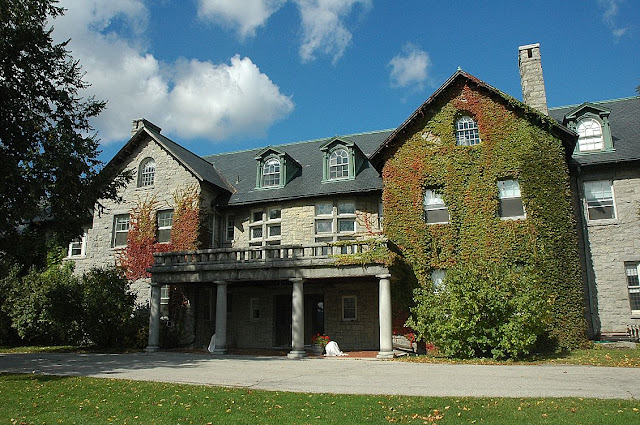
Photo of Jennings Hall at Bennington College

Photo of Jennings Hall at Bennington College in North Bennington, Vermont, courtesy of J.W. Ockler.

America is a haunted country, and as we count down the days till Halloween, Monster Librarian plans to share some destinations for travelers looking to travel someplace special for the Halloween season.

North Bennington, Vermont might seem like a peaceful village, but it’s also where author Shirley Jackson, best known for her novel The Haunting of Hill House and her short story “The Lottery”, lived for most of her married life.  Jackson’s husband, Stanley Hyman, was a professor at Bennington College, and it is speculated that the inspiration for Hill House is the Jennings Music Building on the Bennington College campus. In her book Shirley Jackson: A Rather Haunted Life biographer Ruth Franklin suggests that the Everett Mansion near Old Bennington is a better candidate, but two creepy, potentially haunted buildings in the same area means she could have been inspired by both.  This article from Vermont news station NBC5 has some great photos of Jennings Music Building matched to quotes from The Haunting of Hill House, in case your only option for travel is via armchair.

There’s also a story that Jackson based the town square, where a truly monstrous community ritual occurs, in “The Lottery” on Lincoln Square in North Bennington. According to her, while walking through the square on her way home from the post office, she had the idea for the story and immediately wrote it down.  The Fund for North Bennington quotes Jackson’s writing to the San Francisco Chronicle about the story. Jackson writes:

Explaining just what I had hoped the story to say is very difficult. I suppose, I hoped, by setting a particularly brutal ancient rite in the present and in my own village to shock the story’s readers with a graphic dramatization of the pointless violence and general inhumanity in their own lives.

J.W. Ockler has written a little about both locations here.

Jonah Daniell has written up a walking tour of Jackson-related locations for Literary Bennington: in addition to visiting Jennings Hall and Lincoln Square, Jackson and her family lived in a house at 12 Prospect Street at first and later bought a house at 66 Main Street. Both of these are now private residences. Powers Market, where Jackson did her shopping, is still there, and if you visit the library, you can see a cat statue she used to own.  For such a noted writer, the town where she lived and wrote hasn’t done much to recognize her, although recently the local literary festival was renamed for her and the date moved to June 27, the date of the events in “The Lottery.” If you’re a Jackson fan and in or near Vermont, put North Bennington, Vermont on your bucket list.


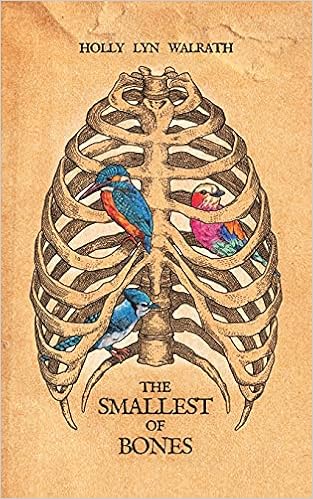
Book Review: The Smallest of Bones by Holly Lyn Walrath

The Smallest of Bones by Holly Lyn Walrath

Clash Books, 2021

ISBN-13: 978-1944866952

Available: Paperback Bookshop.org |  Amazon.com )


“If you strip me down to my bones / am I yours?” the speaker asks, in Holly Ryn Walrath’s poetry collection The Smallest of Bones. Groups of poems divided into sections called Cranium, Mandible, Sternum, Sacrum, Spine, Calcaneus, and Temporal provide a larger osteo-literary structure into which the poems slip like so many small bones surrounding the artistic organs of thought and emotion.


Sometimes surprising, often disturbing and provocative, these poems are the life-blood emerging from the marrow of meaning. There are vivid images of “ocean eyes” and “demon’s tongue,” a couple symbolized as “the tree burning after” and “condemned women” as metaphorical “rare birds” who should be studied. One speaker asks, “hold me under your tongue / like unspoken regret,”  another confesses, “I carry my face in my pocket.”


There are many memorable lines to savor throughout the collection. Some of these rhyme: “the smallest of bones / is a part of the hammer in your ear / love is a heartbreak you can hear.” Some are startling: “ask me, where is your wild woman? I shot her in the face” and “wouldn’t you rather be something violent if you had the choice?”


Walrath also considers love, but it is not in the usual terms. In the moment of connection, “his hands tensile slipping under my radar my heart was sonar,” the speaker remembers, and “to love so much your body changes / curving together like two halves of the taijitu or the earth and the moon / must be dreadful and excruciating,” reflects another.


Walrath also comments on many other topics like sex and gender, physical attraction, memories, science, ghosts, birds, parasites, the nature of women, death, dreams, pain, bodies, flowers and writing. Even the Table of Contents, composed of the section headings and first lines of the poems, can be read as a poem. Try it!


“I wrap bone chains around your head,” Walrath writes. Yes, she does, and I recommend it.


Reviewed by Nova Hadley