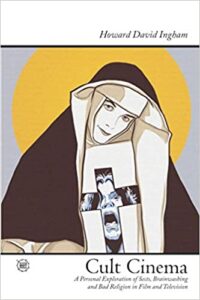
Cult Cinema: A Personal Exploration of Sects, Brainwashing and Bad Religion in Film and Television by Howard David Ingham
Room 207 Press, 2020
ISBN-13: 9781684055982
Available: Paperback, Kindle edition ( Amazon.com )
Howard David Ingham follows up We Don’t Go Back: A Watcher’s Guide to Folk Horror with Cult Cinema: A Personal Exploration of Sects, Brainwashing and Bad Religion in Film and Television. In this book, Ingham posits that religious extremism has dogged humanity’s heels from the formation of Christianity up to the current era. Ingham does not solely focus on horror, looking at other genre sources such as situational comedy, drama, and more. The author looks at why and how people join abusive religious groups, the process of and what it means to brainwash, and at times eventual escape. He frames his book in terms of his personal experience belonging to the evangelical Christian church. Ingham’s time in this group gives Ingham’s analysis a firsthand account of what occurs with cults and cultish behavior. Ingham provides a look into what makes the cult “work”, or not. Just as fair warning from Ingham, and myself, if you are one to shy away from material regarding abuse in a myriad of forms, including child abuse, sexual abuse, rape, and others, avoid this one. However, if those sensitive topics are not triggering for you and you are interested in religious cults, carry on reading this review (and, of course, consider picking up this book).
In the first chapter, “God Only Knows What You’re Missing”, Ingham frames their conversion to evangelical Christianity with a discussion of their experience at a Polyphonic Spree concert in 2003 that felt like a religious experience, and how even an ardent sceptic can be converted in the film The Sound of My Voice. The second chapter, “The Opposite of Brainwashing”, begins with a discussion of four stages of conversion and subsequent brainwashing and the Moonies. All of this leads to a further discussion on cult deprogrammers. Films include Ticket to Heaven, Split Image, Holy Smoke, and Faults to show different applications and results of brainwashing and subsequent deprogramming. In chapter three, “Exiles” Ingham writes about how difficult it is to leave extreme religious groups, analyzing The Passion of Darkly Noon, Martha Marcy May Marlene, The Unbreakable Kimmy Schmidt, and The Endless. “The Atrocity Tour” covers the Big Ones. A book on cult activity would not be complete without mentioning the big events: Jonestown, the siege of the Branch Davidians in Waco, the Heaven’s Gates’ mass suicide, Aum Shinrikyo’s attacks on the Tokyo subway, and the Manson family murders are presented. Ingham covers film and television including Manson Family Vacation, Charlie Says, Mandy, The Sacrament, Red State, and American Horror Story: Cult. In chapter 5, “Live Together or Die Alone” Ingham describes the fictional popular culture theme of what they call the “Pagan Village Conspiracy,” emphasizing that there is no such thing in the real world of cults. The Wicker Man, Kill List, Midsommar, and Doomsday are the films in which this theme is strong. The Church of Scientology is the focus of chapter 6, titled “Clear”. Ingham looks at The Master and The Path for this section.
“You Can Be a Person by Being A Person”, chapter 7, focuses on cults that don’t necessarily have a religious component, but have more of a philosophical and sociopolitical center, such as fascist groups. Films Ingham includes in this chapter include Seven Stages to Achieve Eternal Bliss by Passing through the Gateway Chosen by the Holy Storsh, Safe, The Invitation, and Fight Club. The latter is explored at length in this chapter. In the eighth chapter, “Sects Education”: Ingham discusses different sects of Christianity, focusing on Jehovah’s Witnesses and Mormons extensively, looking at the films Apostasy, The Children Act, Son of Rambow, September Dawn, and Gentlemen Broncos. “Praise Be to He” presents an extensive discussion of American conservative evangelical Christianity. Ingham writes at length of their time as an evangelical, discussing the prosperity gospel, gay conversion therapy, what it is like to attend Christian conventions, and more. Ingham uses media such as The Righteous Gemstones, Don Verdean, But I’m a Cheerleader, and The Miseducation of Cameron Post to frame their discussion.
In the closing chapter, “Chastity, Poverty, Obedience, Pain”, Ingham tells the story of Father Stephen, the chaplain at their secondary school. He mentions the “cloistered divine” in Catholic circles, and looks at films including The Magdalene Sisters, Black Narcissus, The Devils, Mother Joan of the Angels, Flavia the Heretic, and Martyrs.
The book includes an index of film and television programs the author discussed in the book.
Original versions of many of the essays in this book were written between January 2017 and December 2020, and were published by Room 207 Press. Highly recommended.
Contains: spoilers
Reviewed by Lizzy Walker
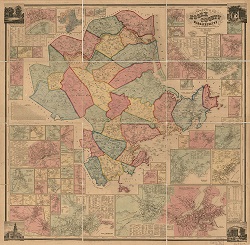 If you’re visiting Salem already, you can take your haunted travels further; it is a county seat for Essex County, Massachusetts, frequently referred to as “Lovecraft country” (not to be mistaken with the novel by Matt Ruff or the HBO show). While not all of his tales were set here, many of horror master H.P. Lovecraft’s stories are set in the area, and while the locations and geography have been fictionalized and altered, Marblehead, Salem, Gloucester, and Newburyport in particular have been suggested as inspirations for the towns of Kingsport, Arkham (home of Miskatonic University), Innsmouth, and Dunwich (although not necessarily in that order). In an article for The Toast, Rebecca Turkewitz writes:
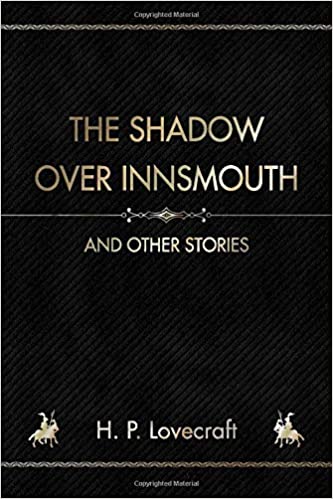 Arkham in different places in his stories. Luckily, there are fans of Lovecraft who have done the work of mapping out the inspirations and possible locations of his tales. Donovan Loucks of the H.P. Lovecraft Archive has researched Massachusetts sites tied into Lovecraft’s stories: while his short tour of Lovecraftian Massachusetts sites includes Boston and Cambridge, most are in Essex County.
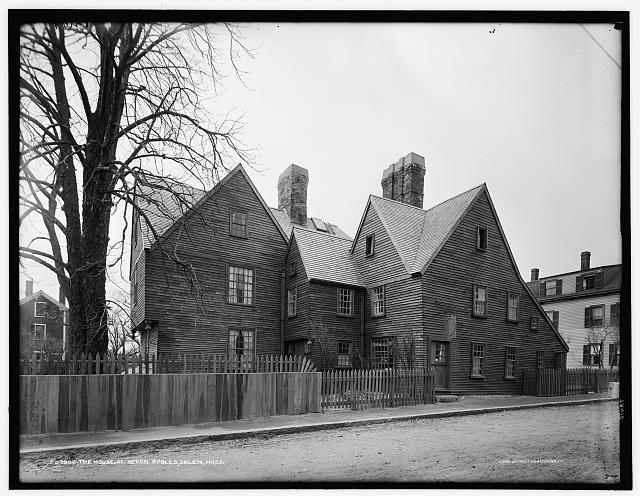
 Salem is also the hometown of Nathaniel Hawthorne, best known for that required reading we all had to do in high school, The Scarlet Letter. Hawthorne also wrote The House of Seven Gables, named for a real place, the House of Seven Gables (which actually does not have seven gables, but does have some unique architectural features, according to Duncan Ralston, the author of Ghostland). It has also been a settlement house for immigrants and is now a historic site and community resource. The



Follow Us!