Home » 2021 (Page 42)

Women in Horror Month: Book Review: Coralesque and Other Tales to Disturb and Distract by Rebecca Fraser

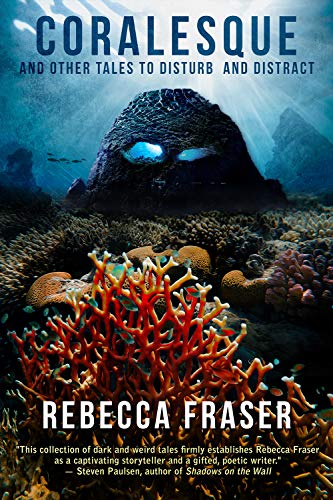
cover art for Coralesque by Rebecca Fraser

( Bookshop.org | Amazon.com )

Coralesque and Other Tales to Disturb and Distract by Rebecca Fraser

IFWG Publishing Australia, 2021

ISBN-13: 9781925956702

Available: Pre-order: paperback, Kindle edition


Coralesque and Other Tales to Disturb and Distract includes 25 stories and poems of Australian horror by Rebecca Fraser, set in the harsh terrain of the Outback, the mysterious depths of the Pacific Ocean, and the wilds of Tasmania. This collection has so many good stories in its pages. I want to write this review about all of them. However, just to give you a sample of what Fraser brings to horror, I will highlight some of the best ones.

In the titular story, “Coralesque,” we meet Brett and Saxon, two surfers who head out for some epic waves after a massive storm. Saxon ends up with a severe head injury. After a trip to the hospital, the wound doesn’t heal and something in the wound starts growing. “Don’t Hate Me ‘Cause I’m Beautiful” is a Bradbury-esque story of a woman wanting the recent model of the iMaid. The problem is the iMaid takes care of the household too well. “Never Falls Far” is a particularly effective tale of the Stockton family who grows the sweetest apples in their orchard. Boys Kyle and Mitchell soon find out why over a campfire tale told by one of the Stockton descendants. In “Casting Nets,” Delice and Tino are in love, but are of two different worlds. Tino, sick of being exiled from Delice, talks with someone who works in hexes about obtaining a means of passage into her family’s well-guarded house without her overbearing father knowing, but discovers too late that the cost is too high. In “The Skylar Solution,” Mayor Regina Carter and her team meet with Verne Hoffman, who has discovered a permanent solution to the “problem” of the increasing homeless population, with an unexpected consequence.

“The Little One” is the longest piece in the book. Sable witnesses the rape of her sister Carmine by the prince of the realm. Carmine later becomes pregnant, which the Queen discovers as he is attempting a second rape. Lizbette, Carmine’s lover, threatens the prince. Sable witnesses the Queen murder Lizbette, then the prince murders Carmine. Sable searches for the Flay Sisters and their witchcraft to enact revenge for the deaths of two of her closest companions. This is an incredibly effective rape revenge story.

This collection makes me want to pick up more work by Fraser. There are so many stories that are short, yet provide some spine tingling, thought-provoking horror. Highly recommended for anyone wanting to read international horror.

Contains: body horror, sexual assault, sexual content


Reviewed by Lizzy Walker
Women in Horror Month: Drive, She Said: and Other Stories by Tracie McBride

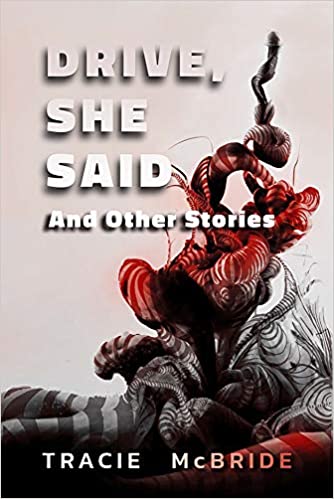
cover art for Drive, She Said by Tracie McBride

(  Bookshop.org |  Amazon.com )

Drive, She Said and Other Stories by Tracie McBride

IFWG Publishing Australia, 2020

ISBN-13: 9781925956689

Available: Paperback, Kindle


This book contains eighteen short stories of horror and dark fantasy written by the author. The tales feature women as protagonists, doomed heroines, and villains. While all the stories in this collection are well executed and well written, a few of them stood out above the others for me.


The tale “Breaking Windows” treats possession as a virus transmitted somehow through sight. Treatment is an ocular prosthesis that are programmed with demonic spectrum detectors. Jess’ partner, Leo, opts to get them implanted and he does his best to persuade her to do the same. As the statistics look grimmer, and a pregnancy test comes out positive, Jess must make her choice.


In “Ugly”, Janine has a growth on her face that, after treatment, continues to grow…and grow…and grow. This story in particular has some gruesome body horror involved.


In “The Changing Tree”, Sten, Liath, and the other boys of age are counting the days until ‘Changing Day’. The priestesses who guard the Changing House don’t allow anyone in the grounds unless they are chosen. All that Sten knows is that the chosen walk in boys and walk out as women. All of the women of the village had the same origin. What unfolds is a touching story of the two friends as they grapple with the changes of identity, gender, and sexuality.


Lara and Maxine are sisters who share a dark secret in “Slither and Squeeze”. The story opens on a subway with Lara trying to calm down an old homeless man who is yelling about a snake, disrupting other passengers. After she gets him calmed down, the sisters have a conversation about what to do about the situation. He witnessed the Change, something the sisters can’t abide. However, they are at odds about what to do: kill him or leave him as his words are only the drivel of a deranged old man.


In “Life in Miniature”, Michael is picked up by a middle-aged woman, thinking this will be some kind of favours traded for a meal and a shower kind of thing, but discovers too late that she has a more specialized use for him. She has so many realistic dolls in the house, but they do not look quite right around the faces.


This is just a small offering that Tracie McBride offers in her book. She has a concise way of writing her short stories that did not leave me wanting more at the end. I don’t want to say she ties everything up nicely at the end. That does not quite fit. It’s more like she provides just enough in each tale for the reader to digest. I will definitely be picking up more of McBride’s work. Recommended.

Contains: blood, body horror, sex


Reviewed by Lizzy Walker

Women in Horror Month: Book Review: Black Cranes: Tales of Unquiet Women edited by Lee Murray and Geneve Flynn

cover art for Black Cranes: Tales of Unquiet Women edited by Lee Murray and Geneve Flynn

( Bookshop.org  |  Amazon.com )

Black Cranes: Tales of Unquiet Women, edited by Lee Murray and Geneve Flynn

Omnium Gatherum 2020

ISBN: 9781949054279

Available: Paperback, Kindle


Black Cranes: Tales of Unquiet Women is an anthology of stories by Southeast Asian women writers of horror. No one questions that the dangers cultures try to warn against in their ancient stories exist, but should we take the stories themselves as fact or fiction? The “unquiet” Southeast Asian mothers, daughters, wives, and girlfriends in Black Cranes ask this very question as they experience the the disturbing intrusion of these supernatural stories into their modern lives. Many of these characters think that by leaving home or separating themselves from their cultural roots, they can learn to forget, discount or even reject the stories they have grown up with about ghosts, terrifying beasts, bloodthirsty demons, deadly tricksters, and zombies only to find out that is impossible.


Several of the stories in this collection are built around characters from Asian myths and legends. The kapre, a tree demon, protects an infant and loves her for life, as kapres do, in “A Love Story” by Rin Chupeco. In Gabriela Lee’s “Rites of Passage,” no matter how an unmarried pregnant girl from Manila tries to escape, the demon child or tiyanak that she has killed will eventually make her pay. Nadia Bulkin asserts that “Truth Is Order and Order Is Truth” in her tale of a conquering Demon Queen who retakes her kingdom from the “fish people,” while the wily fox spirit of Rena Mason’s “Ninth Tale” masquerading as a beautiful woman vies for a tricky bride-to-be’s young man. There is also a daughter who is shocked into believing in a kwee-kia, a dead or miscarried child brought to life again, by catching her mother breastfeeding her own in “Little Worm” by Geneve Flynn. There is even a take on what started as a 1970’s Japanese urban legend involving the kuchisake-onna, or “slit-mouthed woman” in “A Pet Is for Life,” also by Geneve Flynn.


A few of these tales read like modern updates of older stories. Their focus is the clash of cultures within an individual’s psyche. Grace Chan’s “Of Hunger and Fury” explores the separation between a daughter and the mother who sent her into a foreign world for a better life. Chan’s poetic descriptions and strong sense of place enhance this tale of the superstition and deeply held beliefs that hold the old generation captive and threaten to erase those in the new who dare to ignore their roots or move beyond the past. The resulting sense of loss is revealed from the mother’s perspective in “Frangipani Wishes” by Lee Murray, in which the mother destroys her own life to forge a future for her daughter. In “Phoenix Claws”, also by Lee Murray, a young woman’s boyfriend is culture tested when he is offered chicken feet at a family meal. When she covers for him by eating the feet herself, she is given a supernatural punishment.


The remaining science fiction stories suggest what could happen when culture, relationships, and conflict reach the mythological future. Elaine Cukegkeng predicts the next iteration of overbearing mothers as those who can genetically alter their daughters. A “cosmetech” surgeon can upgrade his wife’s appearance in “Skin Dowdy” by Angela Yuriko Smith, but will she or he ever be satisfied? In Smith’s “Vanilla Rice,” a daughter threatens to undo her mother’s work by removing her physical trait chip. Finally, in “Fury” by Christina Sng, we find out what new horrors  a pandemic will unleash and ask ourselves why the husband in “The Mark” by Grace Chan has a zipper on his chest.


There are so many ways into this horror collection: mythology, science fiction, legend, women’s issues, and cultural issues. Readers will appreciate the variety and be drawn in by the storytelling that leads us to believe that the horrors of the past are real, have not died, and are waiting to be reborn in the present. Recommended.

Contains: violence and sexual situations


Reviewed by Nova Hadley