Home » 2021 (Page 44)

Book Review: The Forest by Michaelbrent Collings

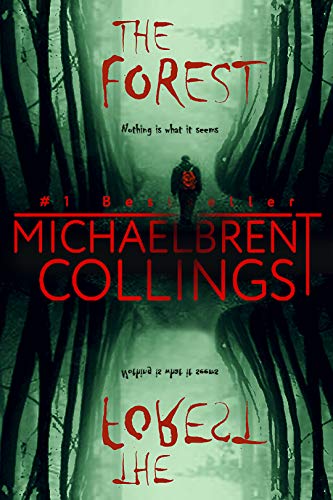
cover art for The Forest by Michaelbrent Collings

( Amazon.com )


The Forest by Michaelbrent Collings

Written Insomnia Press, 2020

ISBN: 9798670345958

Availability: paperback, Kindle


The Forest is a bit different from the last few releases by Michaelbrent Collings.  His recent titles (Terminal, Scavenger Hunt, Stranger Still) were combination thriller/horror novels that relied on a fast pace and a lot of action.  The Forest relies less on action, and more on creating an atmosphere of helplessness and dread.  As usual with Michaelbrent’s writing, it’s a mystery also, and any reader will have a very difficult time unraveling the puzzle before the last few pages.  It’s a good plot and a decent read, and parts of it are excellent.   However, it does drag a bit at times and might have been better served by trimming some pages.


Tricia and Alex are the two main characters. They were students at the same school, and later got married.  The whole book revolves around their time interacting with the Forest, a place known to all the kids to be haunted, and of course it contains the proverbial “cabin in the middle of the woods”.


As kids, Tricia and Alex went into the forest to try to rescue their friend Sam from his crazy mother, and they came out having failed to rescue Sam, and with no memory of what happened.  All they know is the Forest is a bad place.  As adults, they drive by the Forest one day, and their only child vanishes into the Forest.  Later, at the advice of their therapist, they re-enter the Forest to face their fears and achieve some closure over what happened to Sam and their kid.  Needless to say, the Forest is NOT kind to visitors, and Tricia and Alex are treated to a kind of dimension-bending hell where time doesn’t exist, entities want to kill them (or save them) and nothing makes any sense.


Although Tricia and Alex are the primary protagonists, the true star of the book is the Forest itself.  Collings does a nice job of making it seem to be a living, breathing entity in its own right.  The use of  never-ending fog, various shapes that appear, and flashing lights do a good job of piling on the spooky atmosphere, and the secondary characters that drop in and out (some offering hints as to the nature of the Forest) only serve to enhance the effect.  Again, this book isn’t written in the usual 100 mph fashion of Collings’s past few novels, it’s more of a grim, spooky atmosphere that relies on vagueness and a fear of the unknown to make its point.  Think the 2016 Naomi Watts film The Forest (no relation to this book) and you’ll get the idea.  When it works, it’s done very well.  The sequence with Trish and Alex going crazy trying to unravel the mystery of the stream that keeps switching flow direction is the best part of the book, and may be one of the best sequences Collings has ever written.


As good as the writing is, there are times when it feels like Collings went just a bit too over the top with the descriptions, and it does slow the book down a bit.  There are times when the reader might find themselves skimming pages a bit, just to get to the next part.  A bit more dialogue and a bit less exposition could have pushed this book to the next level.  It’s still a good read, just a bit of a notch down from his usual work.  Also worth noting is the explanation for the mystery of the Forest may be a bit difficult for some readers to comprehend.  It’s best not to think about it too much, just take it at face value.


Overall, another decent one from one of the most consistent authors out there today.  Recommended.


Contains: violence, limited gore, profanity


Reviewed by Murray Samuelson
Book Review: The Crying Forest by Venero Armanno

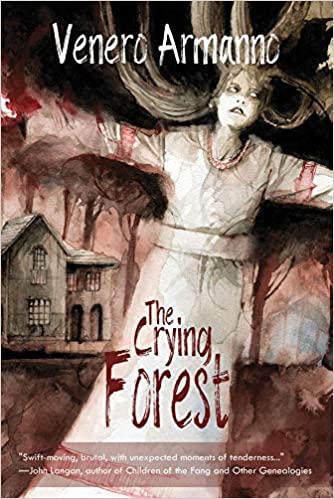
Cover art for The Crying Forest by Veneno Armanno

Bookshop.orgAmazon.com )

The Crying Forest by Venero Armanno

IFWG Publishing Australia, 2021

ISBN-13: 9781925956559

Available: Paperback, Kindle


Paul Munro and his young daughter Lía move from Hong Kong into a large country house in Australia. It becomes clear early on that Lía is more than what she appears. She sees things and has a power that others want to harvest for themselves. Agata Rosso, an ancient Italian witch, is one such individual. She used to hold so much power, but that power, and her youth, are long gone for her and her ailing husband, Giancarlo. Another party interested in restoring his vitality and power is the lecherous and wealthy Karl Haberman. After Agata Rossa endears herself to Karl by way of offering him something of a youth elixir, presented to him by a mutual acquaintance, Donatello Zappavigna. The old wretch and the aged witch join forces to track down the rich source of power in their midst.


Venero Armanno’s folk horror combines a good mystery, interesting characters, and both inhuman and very human monsters. I found myself unable to put the book down, while at the same time needing to take breaks to properly digest the chapters. Most of the characters are multifaceted, especially Donatello. I could go from having immense sympathy for him in one chapter, and absolutely hating him in the next. I liked discovering more about Lía as the story progressed, including details about her previous schooling and why she had to leave the hallowed halls of that school. She’s full of mystery and surprises, and a strength that shines through even from the first pages. I would recommend this for adult readers who enjoy folk horror works.

There is a content warning that needs to be addressed. Karl Haberman has certain sexual appetites that are disturbing. When Agata Rossa tells him what kind of person he needs to look for to pinpoint their target, it is revealed Karl has a liking for young girls.

Contains: blood, sex, pedophilia


Reviewed by Lizzy Walker

Book Review: It Came From: …The Stories and Novels Behind Classic Horror, Fantasy, and Science Fiction Films by Jim Nemeth and Bob Madison

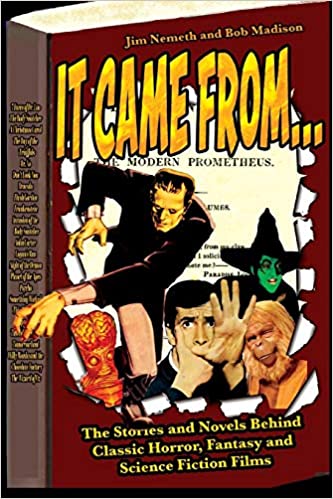
cover art from It Came From... by Jim Nemeth and Bob Madison

(  Bookshop.org )

It Came From:  …The Stories and Novels Behind Classic Horror, Fantasy and Science Fiction Films by Jim Nemeth and Bob Madison

Midnight Marquee Press, Inc., 2020

ISBN-13: 9781644300916

Available: Paperback

In this book, critics Jim Nemeth and Bob Madison explore genre films and the written works that inspired their creation,  Each is presented in its own section, chronologically, and the written works that inspired them. While this book primaritly covered fantasy and science fiction films, this review will concentrate on the aspects of  the horror genre presented. The authors include information on the production of the films, as well as the differences between the texts and the movies. At times they also posit the view that the film may be better than the books, a controversial opinion among some audiences.

The author of the horror section introduction argues that horror is the most difficult genre to adapt because movies “that merely provides a book’s ‘Boo!’ moments are but empty shells, lacking the underlying background and context that frequently makes the literary piece the more satisfying experience” (p. 12). He then moves to his example of The Shining. While I do not necessarily agree completely with the author, he does make some interesting points. Films included in the horror section include The Body Snatcher, Invasion of the Body Snatchers, Night of the Demon, Psycho, The Day of the Triffids, and Don’t Look Now.

Two titles receive special treatment in that they each have a significant chapter devoted to them: Dracula and Frankenstein. The authors look at “several of the best, worst, and most popular of their cinematic incarnations” (p. 11). Dracula films covered range from Nosferatu (1922) to Bram Stoker’s Dracula  (1992), while the Frankenstein films range from the first film version of Frankenstein (1910) to Victor Frankenstein (2015).

My primary criticism of the book is focused more on the overall contents rather than specific chapters. The authors interject their own opinions into the chapters in a way that can be a bit heavy handed. For instance, when it comes to science fiction, one of the authors makes it abundantly clear that he does not like the gritty, darker, current sci-fi storylines. Additionally, while it seems that each chapter is written by an individual author, it is difficult to tell who wrote which one.

This could be a good resource for anyone interested in exploring the literature upon which genre films are based, as long as readers are aware that the authors’  strongly expressed opinions are interspersed throughout.

Recommended with reservations.


Reviewed by Lizzy Walker