( Amazon.com )
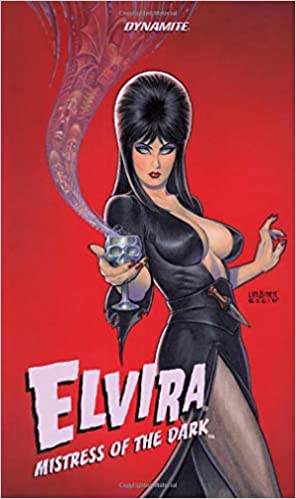
Elvira: Mistress of the Dark, vol. 1: Timescream by David Avallone, art by Dave Acosta
Dynamite, 2018-2019
ISBN-13: 9781524108533 (vol.1)
Available: Paperback, Kindle, comiXology (for single and TPB digital issues)
I grew up watching Elvira, Mistress of the Dark introducing wonderful and often terrible horror movies, and then starring in a few of her own. I fell in love with her humor and sass, not taking anyone’s crap and going after what she wanted. She holds a special place in my horror-loving heart. When Dynamite announced Elvira would be getting her own comic series starting in 2018, I knew I had to pick it up. I have been collecting the single issues, and what follows is a review of all of them to date. They have now been published as graphic novels, in two volumes. Volume One collects issues 1-4.
#1: Timescream, Chapter 1: Frankenstein is the Name of the Doctor: After the leading man in Elvira’s new movie has a wardrobe malfunction (don’t worry, it’s only his dentures falling out), she goes back to her trailer for a long-needed break. After being sucked into a mysterious coffin in her trailer, the Mistress of the Dark meets Mary Wollstonecraft, Percy Shelley, and Lord Byron during the infamous weekend that led to Mary’s penning Frankenstein. They find themselves on the run when Vlad the Impaler crashes the party. Elvira’s journey doesn’t end there, as she finds herself meeting another horror legend after she once again falls into the time traveling coffin.
#2: Timescream, Chapter 2: Nevermore!: Elvira is transported to 1838 Philadelphia, coming face to face with one of the greatest poets of horror, Edgar Allan Poe. While are sharing some absinthe at Poe’s favourite pub, Vlad busts in the door and demands that Elvira, who he addresses as Witch, return him to his own time. Will she and Poe come up with the perfect plan to get everyone back to their respective timelines? No, but they’ll sure have fun trying.
#3: Timescream, Chapter 3: Stoker? I Hardly Know ‘er!: Elvira time-traveling adventures take her to the author of Dracula himself, Bram Stoker. His wife, Florence, is less than impressed with the Mistress of the Dark upon their meeting. Vlad bursts onto the scene and soon mesmerizes Florence, running away with her. When Bram and Elvira attempt to rescue her, Dr. Faust appears to reveal his part of the story.
#4: Timescream, Chapter 4: Fauster, Pussycat! Kill! Kill!: Elvira finally gets back to Los Angeles, but unfortunately to the wrong time. She’s dropped right in the middle of the filming of the iconic Frankenstein with the mysterious Dr. Faust and Vlad in pursuit. What ensues is a chase through various Hollywood film lots, much to the frustration of the directors and actors everywhere. One of them is running out of time…
( Bookshop.org | Amazon.com )
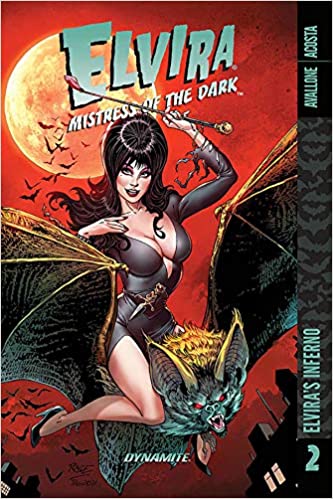
Elvira, Mistress of the Dark, vol. 2: Elvira’s Inferno by David Avallone, art by Dave Acosta
Dynamite, 2019-2020
ISBN-13: 9781524112677
Available: Paperback, Kindle edition, comiXology
#5: Elvira’s Inferno: Canto One: Elvira and Faust are both dumped in Hell after running into Mephistopheles. Dr. Faust, living with an angry, drunk, and violent Helen of Troy, is left to his personal hell when Mephistopheles agrees to lead her to talk with the Devil himself to get out of Hell.
#6: Elvira’s Inferno: Canto Two: Elvira makes her way down to the manager of Hell. Literally. She talks to a demonic whip wielding task master dressed in business attire looking for the way to her destiny. Her journey to Cerberus is fruitful, and she discovers a way to tame the beast to gain passage. She is finally met by her guide through the remaining circles of Hell, a man dressed in plain robes named Glenn.
Spring Special: Elvira in…Drive-In of the Dead: Elvira is the horror hostess at a genre film festival at the local drive-in when she discovers the opportunity to star in a film produced by the famous George Rottmero, who makes extremely most realistic horror movies. She finds out the disturbing secret behind the producer’s success, but it may cost Elvira her life. The second story in the Spring Special is “Elvira in…The Satan 500”. After an eventful trip to the grocery store, Elvira is greeted by outside by Satan who challenges her to a car race. If she loses, she must marry him. She’s got one hope, and he’s sitting in her vehicle and calls himself Jason Voorhees.
#7: Elvira’s Inferno: Canto Three Elvira and Glenn, with Faust on their heels, travel further into Hell. Elvira and Glenn face the Minotaur, the traffic jam of the damned, and other unthinkable horrors before they can deal with the Devil.
#8: Elvira’s Inferno: Canto Four: Elvira finally meets Satan himself, with the watchful guidance of Glenn at her side, and her journey reaches its amazing conclusion. Our beloved Queen of Halloween must plead her case to the Devil to get out of Hell. Armed with her sassy wit and with Glenn and his secret identity by her side, it shouldn’t be a problem, right?
#9: Vroom Vroom, Witches!: Elvira, back in her own time and back on the movie set, she thinks she can finally get back to normal (well, normal for her) life. Little does she know that an evil coven of warlocks is attempting to enact a ritual that may mean her doom.
#10: Witches Get Stitches: A cult has taken Elvira to a hospital and has stolen her Darkness, her source of power. Her iconic dress and roadster even fall to the effects. At her time of need, she meets the mysterious superhero, Soul Survivor, who has also been on the chase for the cult. Together, they head out to face the cult members and regain the Queen of Halloween’s Darkness.
#11: Witch Way to the Apocalypse?: In the last issue, Elvira became separated from Soul Survivor and found herself magicked back to her house, Gonk greeting her upon arrival. She hops in her white roadster and tracks the cult to the Dark Ages Dinner Theatre where she faces her most frightening challenge yet: amusement park mascots! Can she get to the Soul Survivor in time?
#12: Vlad to See You Again: What, did you think Elvira was safe from the Impaler? Elvira and Soul Survivor are ready to vanquish the cult, but the cult is successful in summoning Vlad from Hell. He’s not having it. He captures our Mistress of the Dark but may not like the results when Elvira discovers the way she can regain her darkness.
Avallone and Acosta make a fantastic team on the Elvira: Mistress of the Dark series. Avallone captures the campy sass of Elvira, which of course is full of double entendres and terrible puns, all while weaving a compelling tale that keeps the reader’s interest through each issue. Acosta’s art is a great complement to the stories. He is able to depict the likeness of Elvira perfectly. Both volumes are highly recommended.
Reviewed by Lizzy Walker






Follow Us!