Home » Posts tagged "interview" (Page 6)

Interview with Steph Post

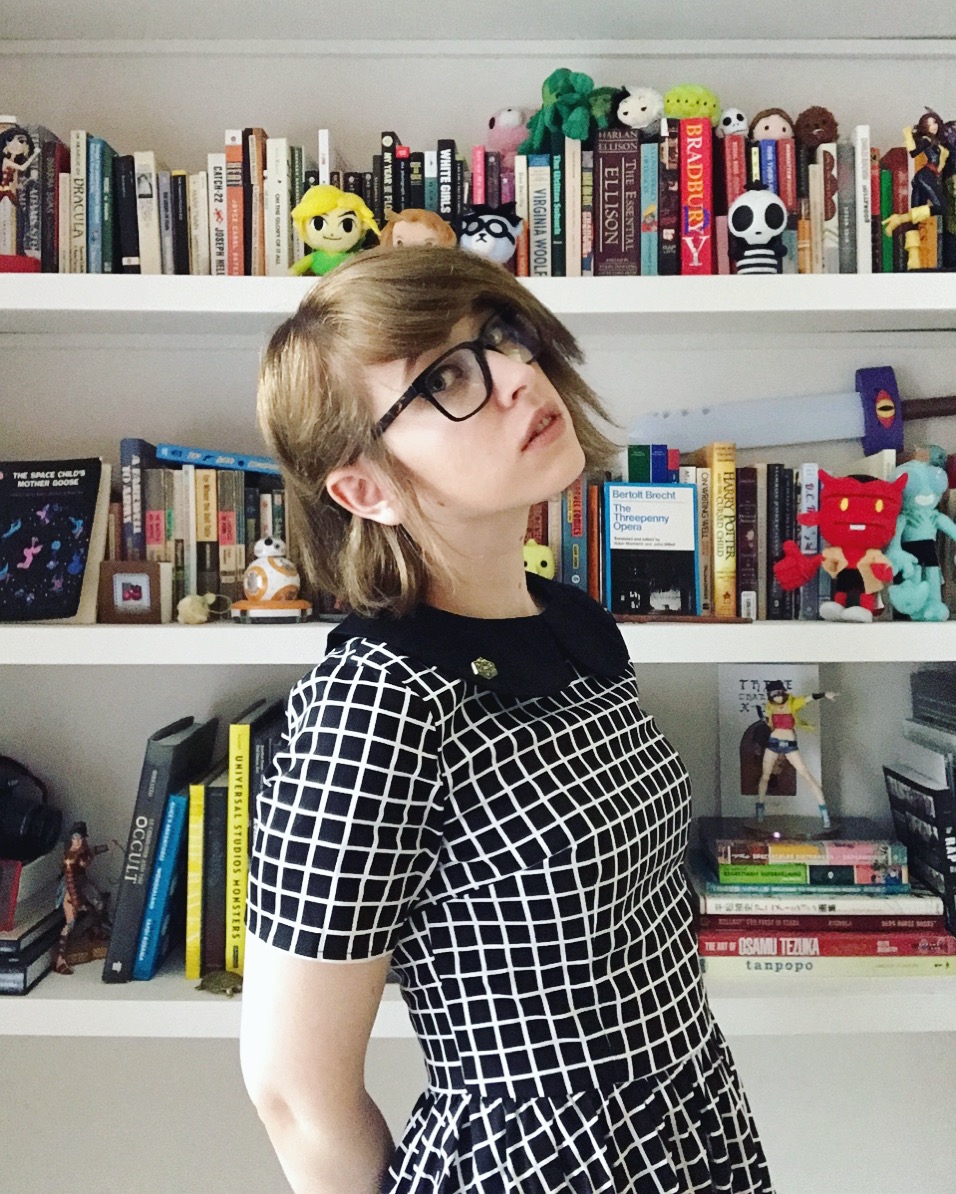
Steph Post

Monster Librarian reviewer Dave Simms recently had the opportunity to interview Steph Post, the author of the recently published book Miraculum, reviewed here.

Steph is also the author of A Tree Grown Crooked (Polis Books, 2018), a semifinalist for the Big Moose Prize, and the Judah Cannon crime novels Lightwood (Polis Books, 2017) and Walk in the Fire (Polis Books, 2018). Her short fiction has appeared in a number of publications and anthologies, and her short story “The Pallid Mask” was a nominee for the Pushcart Prize. She has published many book reviews and author interviews and is currently the writing coach at Howard W. Blake High School in Tampa, Florida.  You can visit her website at stephpostfiction.com.

This is a really fun interview, so definitely take the time to read it and enjoy! You also might want to check out her website now, as she is running a contest for art from the book through March 31st.

******************

DS: Miraculum was written between two of your Judah Cannon books  Why is this your third/fourth book and not second? Crazy publishing world or by design– or both?


SP: Definitely the crazy ins-and-outs of the publishing world, but I think the timing actually worked out perfectly. I sort of exist between different genres, so I think it worked out in my favor to establish a base with the crime fiction community before jumping over to fantasy/literary/historical/whatever we’re calling Miraculum today. Also, from the writing standpoint, I like to switch genres with every book I write. That way, there’s no chance of getting bored! I just finished up the last of the Judah Cannon books this past year and now I’m back to a novel that much more resembles the style of Miraculum, so I’m sticking to my zig-zagging path.


DS: Your art related to Miraculum is fascinating. Any thought to doing something professional with this? Art show? Illustrated version of the book? Booth at a local carnival?


SP: Thank you! I don’t consider myself a professional artist by any means, but I do love painting and printmaking. I especially love that it’s not a career in the way writing is for me. I can just mess around, without any of the pressure I put on myself when it comes to my novels. I’ve sold paintings in the past, and will be selling these Miraculum pieces as well, but mainly this project was a way for me to reconnect with a book I wrote three years ago, and also to connect with readers and fans. I wanted folks reading Miraculum to see some of the additional layers in the story that might not be obvious between the actual covers of the book. In a way, the paintings are a peek behind the curtain. I’m running a contest on Instagram right now— anyone who sends in a photo of the book (audio, Kindle, library book, doesn’t matter)—is entered in a drawing to win their choice of paintings. The contest ends March 31st and once the two winners (plus a winner of a custom piece) have chosen their paintings, I’ll put the rest up for sale. The contest is also a way to interact with readers and so I’m loving the project all around.


DS: I absolutely love your tattoos – and Ruby’s. The symbolism of her ink gives the novel a very cool dimension of character. Which of yours means the most to you?  I intend on getting one for every novel  published. Two down so far.  What’s your view on them?


SP: Well, thank you again. Speaking of… that reminds me. I need to make a tattoo appointment…. There’s no way I could pick one tattoo of mine that means the most to me—I don’t even know how many I have! My most recent tattoo is a quote from ‘The Little Prince’ in honor of all the dogs I’ve loved who have passed away. Every tattoo is hugely important to me, whether in what it means or in where I got it (I like to get tattooed when I travel), or in why I got it. I think everyone has different reasons for getting tattoos, no one reason better than another, but for me, it’s like a record of my life. A visual story, in a way, that only I understand, but that keeps me grounded.


DS: Ruby reminds me of a badass version of Ray Bradbury’s The Illustrated Man. Where did the inspiration for her come from?


SP: See above…. I think the tattooed part of Ruby comes from me. What I love about her tattoos, though, is that they are a doorway to discovering herself and her power. They’re a mystery, but a Pandora’s box once unlocked and opened.


DS: A Tree Born Crooked, Lightwood, and Walk in the Fire live in the crime genre. Was there a conscious decision to jump back in history for Miraculum‘s semi-historical realm? I understand that you’re going further back for the next novel. Do you think this could be a trend for you?


SP: Oh yes. The novel I’m currently working on is set in the 1890s. I love studying history and I think time periods of great change (such as the 1920s, the 1890s, etc.) are especially fascinating. Above all, though, the story has to rise above the setting of the novel, and this is something I’m really having to learn to balance, the farther I go back in time to write. I’ve got a long way to go on this new book, so I haven’t yet seen the book that will follow it. But I really like playing around on the fringes of fantasy/history/horror/adventure etc., so we’ll see how it goes.


DS: Influences? Who has shaped your writing, personality, and soul? Beyond writers, what musicians or artists impacted your creativity?


SP: Oh wow, that’s a weighted question. I’m going to just stick to those who have influenced my writing: definitely Michael Ondtje, David Eddings, Sheri Reynolds and Dorothy Allison. I’m sure there a million more, but I was reading those writers back when I first started to consider the idea of one day becoming an author myself, and so I think they had a huge impact on defining my direction.


DS: What’s next for you? Don’t feel obligated to stop at books, although what I read about the story set in 1890 sounds intriguing.


SP: While I’m still promoting Miraculum, of course, most of my energy is now going into the new book, which will most likely consume me for the next nine months. When I’m working on a book, I tend to get hyper-focused, and so I’m not one of those talented authors who can juggle a dozen creative endeavors at once. But when I do come up for air, I’m busy with dogs, chickens, gardening and, of course, art projects.


DS: You are very active on social media promoting other writers, both new and established. That is amazing – and not something that’s common enough in writing. We’re good with the support overall, but to publicly do so is refreshing. Writers’ groups and organizations rarely help much (although ITW has done wonders for me and others).  Your thoughts on this?


SP: When I was first starting out, I reached out to a few other writers, on social media, because I had absolutely no physical writing community. I don’t have an MFA, I’ve never been part of a writing group, I’m a very lone wolf when it comes to the actual writing process. I didn’t know the ropes at all and I started asking to interview writers as way of making connections and trying to learn what the hell I was doing. And I was stunned by how many writers, famous writers, were so warm and kind and open. They instilled in me the need to always, always, support other writers first. Not just because it will usually come back around to help you one day (and it has for me), but because it’s the right thing to do. There is not a finite amount of author success out there in the world that we need to scrabbling over. When one of us succeeds, we all succeed. And we should use any bit of success we might be fortunate enough to find to help pull up other writers, just as we ourselves were pulled up.


DS: What do you want readers to take away from Miraculum?


SP: I hope they get lost a little bit in the magic of storytelling. There’s a million layers to Miraculum and from what I’ve seen, all types of readers are taking away different things. But I hope everyone who reads it is reminded of why storytelling in and of itself is so vital. And so much fun.



Interview: Ivy Noelle Weir and Christina “Steenz” Stewart, Creators of Archival Quality

It wasn’t too long ago that we reviewed the graphic novel Archival Quality by Ivy Noelle Weir and Christina “Steenz” Stewart. Monster Librarian reached out to the creators, both professionally qualified librarians, through reviewer Lizzy Walker. Check out their interview, read our review, and then get your library card and check out Archival Quality!


Interview with Christina “Steenz” Stewart and Ivy Noelle Weir 


Christina

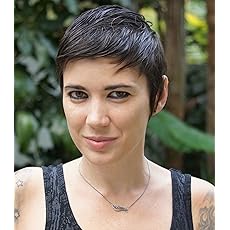
Christina “Steenz” Stewart


LW: Tell Monster Librarian readers about yourselves.

CS: My name is Steenz! It’s short for Christina. I work at Lion Forge as the social media and community manager. I used to be a manager of a comic shop and a comics focused librarian. I live with my fiancé Keya and my cat Marko. We are currently going through Arnold Schwarznegger’s entire filmography.


Ivy Noelle Weir

Ivy Noelle Weir


IW: I’m Ivy Noelle Weir, I’m a writer and an MLS-holding former librarian who now works in book publishing.

LW: What attracted you to working on this book?

CS: We became friends through The Valkyries. As I moved on to working in a library after comics retail, I reached out to Ivy to talk about the switch. And then we just started talking every day, every hour, from morning till night and became besties. It was soon after best friend status Ivy asked if I wanted to illustrate a webcomic with her and of course since I’d been itching to do a longform story for so long, I said yes! Also, the story is really good, so I was 100% on board after reading her summary.

IW: As Steenz said, we met in The Valkyries, and I just immediately loved her art from the moment I saw it. There’s a liveliness to Steenz’s art, her expressions are so lifelike and fun. I knew I wanted to work on something with her.

LW: What inspired you to create Archival Quality?

IW: It’s sort of a long story. I did my undergraduate studies in photography, and I became really fascinated by 19th century medical photography, and the ethics surrounding it. I took an internship in a historical medical archive, where I was working closely with images all day that were, to put it mildly, somewhat disturbing, but also deeply sad, isolating, lonely. While I was working there, I fell deeper and deeper into considering the ethics of archiving, what we preserve, and if it consents to being preserved. So, I started writing a ghost story about the ghost of an object in an archive, who doesn’t consent to being archived. Eventually, this turned from a prose novel to a comic script when I met Steenz, and now here we are.

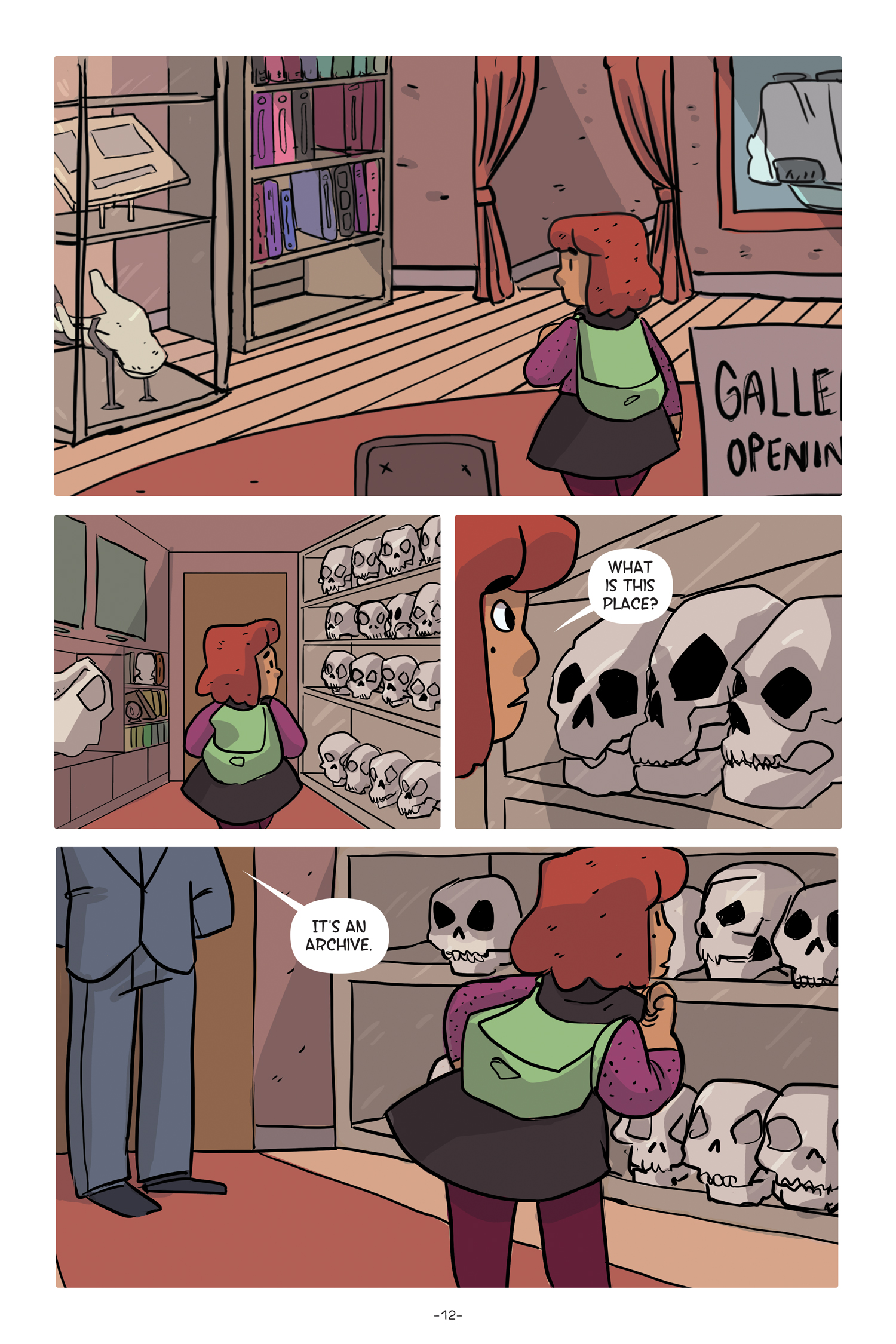
Image from Archival QualityLW: Why did you choose to frame Archival Quality as a ghost story? What drew (ha) you to the horror genre? Are you a horror fan? Why or why not? Do you have recommendations for similar material?

CS: I’m ALL ABOUT horror. I love being scared. There’s something thrilling about watching a film and feeling uneasy afterwards. It’s kind of like a high. I recommend the Poughkeepsie Tapes if you don’t want to sleep for like two nights and Housebound if you’re looking for humorous horror.

IW: I’m a big ol’ horror nerd, and I always have been. I particularly love ghosts and haunted houses – I think they represent so much more than jump scares, they can be this pensive consideration of memory and trauma. The biggest influences on this story were Guillermo Del Toro’s The Devil’s Backbone, Mark Z. Danielewski’s House of Leaves, and Shirley Jackson’s The Haunting of Hill House. I think Jackson’s book in particular blends the concepts of the highly personal with horror in a really fantastic way.

LW: You tackle the subject of mental illness and care very delicately, while at the same time head on. How did you manage to craft such a powerful narrative and equally powerful artwork for this story?

CS: I think when it comes to the art, I read the story… and knowing Ivy as a person, I felt like I had a good idea of what she was looking for in terms of style. We were on the same page when it came to aesthetics for this story. A shared Pinterest helped me a lot. Also knowing that Ivy trusted me entirely with the design of the book and characters let me stretch my world building muscles.

IW: For the story, it was very important to me to show a realistic portrayal of mental illness as it exists for one person. I think when you try to generalize, and make a narrative that fits everyone, or has a “happy” ending where someone is cured or “fixed”, you come up with something that I don’t feel is as genuine or effecting. Depression doesn’t always mean being beautifully sad. Sometimes it means being a jerk to the people around you because you feel out of your own control. I know some people won’t relate to Cel – and I think that’s okay. Depression looks different on everyone, and everyone’s path to helping themselves is doing to be different, too. It was important to me to show someone who struggles with the concept of getting help, because I think a lot of people who struggle with their mental health can relate to that feeling.

LW: Are there any plans or desire to further develop Celine’s story?

CS: I think Celine’s story is done. Celeste on the other hand could have many more adventures and continued growth. But I think we both want to take a break from the world of AQ for a little bit before getting into that.

IW: No, I think she’s got what she needed.

LW: Steenz, your artwork is so unique. I particularly love Holly’s character design! I also follow you on Facebook and adore your kung fu poses. How did you achieve your art style? What tools do you use for your work?  

CS: Thank you! I think when you’re learning to draw you subconsciously create your own style by fusing your interests with what your muscles naturally want you to do. I love Chris Sanders, Rebecca Sugar, and similar works. So, you can see the inspiration, but my style peeks through. I use a WACOM Cintiq, Manga Studio, and Photoshop. I’m hoping to get an IPad soon because all of my other comics friends has one and I’M HORRIBLY JEALOUS. Also, being able to work away from the desk is an amazing idea.

LW: Why should new graphic novel readers seek this out?

CS: Ivy and I both love reading works that aren’t just graphic novels. So, I think our work shows that. It has elements of cartoons, manga, and YA novels. So, if you like those things, there’s no way you won’t like Archival Quality.

IW: I think if you’re interested in haunted house tales, we’ve done something unique here in regard to the genre. And like Steenz said, we both brought techniques from a lot of the other media we consume to this book.

LW: Why should libraries be interested in Archival Quality?

CS: Well, we used to be librarians. And once a librarian, always a librarian. Support the homies, yanno?

IW: I think books that discuss the ethics of librarianship and archives in a conversational way are few and far between, and I hope Archival Quality offers libraries a way to engage with the topic while also getting spooked.

LW: What are some of your favorite books/graphic novels?

CS: Novels: The Lunar Chronicles, Six of Crows; Graphic Novels: Extremity, Daytripper, This One Summer, Batman: Detective Comics, Ms. Marvel, etc. I could go on for a really long time, but those came to my head first. Webcomics: On A Sunbeam, Agents of The Realm, Star Trip, Witchy


IW: Well, my favorite book is the previously mentioned The Haunting of Hill House. I just finished Night Film by Marissa Pessl and really enjoyed it. As for comics, I read pretty widely: I’m a big fan of Hellboy, Saga, Wicked + Divine…I also read a lot of manga – I’m loving The Girl from the Other Side right now.

LW: What other work have you done, separately or together?

CS: We’ve done work for anthologies together. Separately I’ve done work for the MINE! Anthology for Planned Parenthood and the ELEMENTS: Fire Anthology.

IW: We had a short story come out this month in Action Lab’s Princeless Charity Anthology!

LW: What else would you like librarians and readers to know about you?

CS: I tell everyone this, but GET A LIBRARY CARD. Also, I’ve spent many, many, many hours in libraries and I can guarantee you 100% that this is a book that you will want to curl up in a corner of your local library and read from beginning to end.

IW: I second Steenz’s urging for readers to get a library card. Libraries serve so many roles in their communities; your support is integral!

LW: What’s next for the amazing Ivy/Steenz team? 

CS: We’re working on a pitch for another book! Can’t say much other than that. So, GET READY.

IW: We’re working on something new! Which I should really get back to writing.

Interview with David Gallaher, Author of High Moon

Reviewer Lizzy Walker had the opportunity to interview David Gallaher, author of  the werewolf Western graphic novel series High Moon, just in time for the full moon…

Look for our review of volume 1 of High Moon, coming soon! You’ll definitely want to check it out after you read what David has to say!


LW: I’m familiar with and enjoy The Only Living Boy immensely. In fact, I recommended it for my academic library’s juvenile collection.High Moon has a very different feel to the tale of a lost boy in a strange world not his own, yet it feels familiar all the same. How different were these two worlds for you to write?

David: THE ONLY LIVING BOY comes from a place of innocence, wonder and exploration. It’s an emotionally complex story, but set against a background of High Adventure. It’s about fighting the good fight because it’s the right thing to do. HIGH MOON is a little more cynical and far more visceral. It explores man’s inhumanity and cruelty. It’s about fighting the good fight because nobody else will.

THE ONLY LIVING BOY is about finding yourself amid very challenge and adverse circumstances. It’s playful and defiant in the way I think great children’s literature is.

HIGH MOON by its nature is more violent, mythical, mysterious and savage. I don’t really enjoy violence or horror, so that’s a real challenge for me, but I do enjoy writing about the heroes sworn to uphold justice and protect those that can’t protect themselves.


LW: You have an excellent grasp on writing a Western horror. How rooted in actual American history is High Moon and how much research did you have to do in order to get a solid footing in this time period? What made you decide to write in such a specific time period and genre?

David: I was never much a fan of Westerns, but there were a few old radio westerns that I loved — HAVE GUN WILL TRAVEL, GUNSMOKE, and THE LONE RANGER — so I challenged myself to write the sort of western that I would want to read. As a big fan of American history, I through I’d approach the story from that angle first. I really tried to find moments to pin the story against.

I wanted to be authentic, down to the architecture, the weaponry, the costuming, and the other flourishes. I didn’t want HIGH MOON to be a generic western, I wanted it to align with the economic anxieties, troubles and tribulations that were experienced on the frontier.

The Sherman Silver Purchase Act was a United States federal law enacted on July 14, 1890. Farmers were straining under growing debt and sharply falling silver prices. It created a lot of economic instability in the country. Given werewolves own aversion to silver, this seemed like a good place to story telling the story of HIGH MOON. Combining that event with the stories of Jim Bowie’s botched expedition to the San Saba Silver Mines and well… it all seemed to fit.


LW: One of the most interesting characters in the book was the mysterious Tristan Macgregor. Is this a character you want to explore further at some point? Would you consider writing an arc devoted to him?

I love writing Tristan. He’s this crazy throwback character, basically an Arthurian knight in a world of cowboys, armed with this Tesla-made prosthetic arm. Steve and I have an outline for a Tristan spin-off that covers his adventures, his loves, and his loses. We’d love an opportunity to tell it.


LW: Which part of the first volume proved to be the most challenging to write?

David: There’s one scene about slavery during the Civil War that was particularly challenging to research and write about concerning black slave owners. It’s a cruel aspect of American history and was eye-opening for me.

One of the things I love about working on the series is that teaches me things that I never learned in history class. There are heroes like Bass Reeves, for instance, that have yet to really receive their due in the annals of history.


LW: Is there something in particular about the Macgregor storyline that you were the most invested in when you were writing it?

David: The foundation for the Macgregor storyline is based in Irish Mythology and Scottish History. It’s endlessly appealing to splatter those elements across a western landscape. Macgregor, for instance, is named after the Scottish outlaw, folk-hero and cattleman. It’s fun to tease all of our mysteries out on the pages, especially when they are illustrated by Steve Ellis.


LW: If you could add anything else to this Wild West world, what would it be? Unless that would be giving up too many mysteries you want to keep hidden for now!

I can say this… one of the things that I’d love to have included, but it didn’t quite mesh with our timeline, were the Bald Knobbers, a group of masked vigilantes in southwest Missouri. They began as group dedicated to protecting life and property, aiding law enforcement officials. They have a remarkably fascinating history, but didn’t mesh with the timeline we’ve established.


LW: Tell the Monster Librarian readers a little about yourself.

I was born in Honolulu, Hawaii. I traveled a lot as a kid, before my family settled down in Maryland. I spent my formative years in an old Civil War town littered with racists, mysterious military bases, and a twenty-five acre forest in my backyard. Those pieces of my childhood eventually became the basis for HIGH MOON, BOX 13, and THE ONLY LIVING BOY that I write from my studio, BOTTLED LIGHTNING.

Aside the projects I write for our studio, I’ve had the opportunity to write for Marvel, DC Comics, Image Comics and Amazon Studios. I also had the great fortune of being the editor of ATTACK ON TITAN and SAILOR MOON for Kodansha Comics. As a writer and as an editor, I love being involved in bringing great stories to reader of all ages.


LW:  Why bring back this particular book? What’s its history that makes it a cult classic?

David: Convention after convention, HIGH MOON is the one story that our fans consistently ask us about. I think they like the rough and tumble cinematic presentation of it all. As a webcomic, under DC Comics’ Zuda imprint, it build quite a following week after week, where it was notable for its cliffhangers. When the imprint folded, fans were left with all of the lingering questions. Brining the series back allows us to answer those questions and bring in a whole new audience of readers. I don’t know what makes it a ‘cult classic’ but Steve and I put a tremendous amount of passion into every page. We hope it shows.


LW: What are some of your favorite books/graphic novels?
David: I was deeply influenced by the works of Sir Arthur Conan Doyle, Edgar Rice Burroughs, and Rudyard Kipling. Madeleine L’Engle’s work on A WRINKLE IN TIME was also deeply influential. I tend to read much more classic literature than modern literature, but I recently enjoyed NO GOOD DEED by Goldy Moldavsky.


LW: Why should libraries be interested in High Moon?
David: I think HIGH MOON presents an interesting opportunity to remind readers that American history is wild, rich, and wonderful. If we can use monsters to help new readers discover more about the American frontier, well… that’s great teachable opportunity for libraries.


LW: What else would you like librarians and readers to know about your work?
David: Steve Ellis and I travel the country speaking at libraries. We frequently give talks about making graphic novels, participate in library conventions, and give readings. We adore how much the graphic novel has become an important piece of library collections around the country. We hope that conversation continues and we love being a part of it.