Home » Posts tagged "horror fiction" (Page 28)

Book Review: Horrid by Katrina Leno

A note from the editor:

We are midway through October and Monster Librarian still needs to raise the funds to pay for our hosting fees and postage in 2021. If you like what we’re doing, please take a moment to click on that red “Contribute” button in the sidebar to the right, to help us keep going!  Even five dollars will get us closer to the $195 we need to keep going at the most basic level. We have never accepted paid advertising so you can be guaranteed that our reviews are objective. We’ve been reviewing and supporting the horror community for 15 years now, help us make it another year! Thank you! And now our review of Horrid by Katrina Leno.

Horrid by Katrina Leno  (  Bookshop.org  |  Amazon.com  )

Little, Brown Books for Young Readers, 2020

ISBN-13 : 978-0316537247

Available: Hardcover, Kindle edition


There was a little girl

Who had a little curl

Right in the middle of her forehead.

And when she was good,

She was very, very, good,

And when she was bad, she was horrid!


The title of Horrid comes from a nursery rhyme that started out as a poem by Henry Wadsworth Longfellow, and there’s definitely some foreshadowing going on. After her father dies, Jane and her mother reluctantly move to the home where her mother grew up, North Manor, in Bells Hollows, Maine. Empty since her grandmother died, North Manor has an abandoned air. Its windows are broken and it is in disrepair, with bad wiring, creaky floors, and a local reputation as the “creep house”. Surprisingly, although it is September, roses are in full bloom.

Jane’s mother won’t explain why she never brought Jane there before, and as the two of them clean up, move in, and begin to move forward, strange and unexplained things start happening in the house and garden. Jane starts school, makes friends, and gets a job working in a bookstore, while her mom sorts and cleans and starts a new job with long hours. Wariness and even hostility from longtime residents of the community when they hear Jane is living in North Manor makes Jane suspect something terrible happened there that caused her mother to leave. Strange things keep happening: Jane discovers she’s lost time, with no memory of text messages she’s sent or things she’s done; she is certain someone is in the house, but no trace can be found; she has sudden bursts of violent temper. As she and her mother try to cope with their grief and loss, Jane becomes more and more disoriented, especially once she learns the town, and her mother, have been keeping her in the dark about a twisted family secret.

Very early in the book, we learn that Jane has pica (a psychological disorder that causes people to eat non-nutritive items and is associated with OCD and schizophrenia). Eating pages from books helps her manage her anger. As the story progresses, it’s difficult to tell if Jane is in a dissociative fugue and expressing extreme anger due to mental illness aggravated by grief and stress, especially after her mother takes her book away, or if she’s being possessed and/or haunted. I’m not familiar enough with pica to know if Leno’s representation is accurate, but her writing is evocative. It turns out that Jane is not the only person in her family to have had pica, or what effect it had on the past actions of other family members.

Leno does a great job of portraying the messiness and ugliness of grief and its effects on the book’s characters. Despite recognizing many of the elements of Gothic horror, I did not expect the ending, which left me shocked and breathless. Recommended.
Book Review: Night of the Mannequins by Stephen Graham Jones

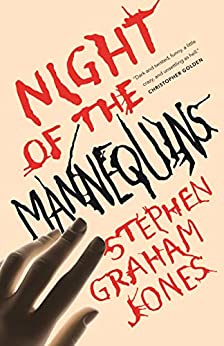
cover art for Night of the Mannequins by Stephen Graham Jones

Night of the Mannequins by Stephen Graham Jones (  Bookshop.org  |  Amazon.com )

Tor.com, 2020

ISBN-13 : 978-1250752079

Available: Paperback, Kindle edition


Night of the Mannequins is a short book, a rocket-fuel ride from beginning to end. It is narrated by teenage Sawyer, one of an offbeat, close-knit group of friends who have known each other forever and are about to graduate high school and go their separate ways. Stephen Graham Jones does a genius job with Sawyer’s narrative voice: it really feels like he is talking right to you. After they’re thrown out of a movie theater where their friend Shanna works, the friends come up with the idea of sneaking a discarded mannequin in to prank Shanna and the manager. Instead, the prank fizzles, the mannequin disappears, and Sawyer is certain he saw it walk out of the theater. After one of the Shanna is killed, along with her family, when a truck plows into her house, Sawyer is convinced the mannequin is the culprit and that he and his friends and their families are all in danger of death by mannequin. He is certain he has seen the mannequin and that the mannequin is stealing and eating Miracle-Gro to turn into a gigantic monster. Sawyer decides he has to act before the monster mannequin can. Jones takes us far down the rabbit hole in this surreal and disturbing tale as Sawyer’s perceptions become more and more skewed,  especially once he starts covering his face with a mannequin mask.

We don’t get to know the other friends well, but Sawyer’s feelings for them seem genuine, so you feel for them and their families when gory tragedy strikes. And wow, does it strike. Sawyer describes it in detail, and Jones does not pull his punches.

This is not intended to be a YA book but it very easily could appeal to YA horror readers looking for a bite-sized read. It’s short, fast-paced, and, unusual in YA horror these days, has a teenage boy as protagonist. With Night of the Mannequins you could hook someone who loves slasher movies but hasn’t shown much interest in reading.  Recommended for ages 15+


Book Review: Don’t Turn Out the Lights: A Tribute to Alvin Schwartz’s Scary Stories to Tell in the Dark edited by Jonathan Maberry

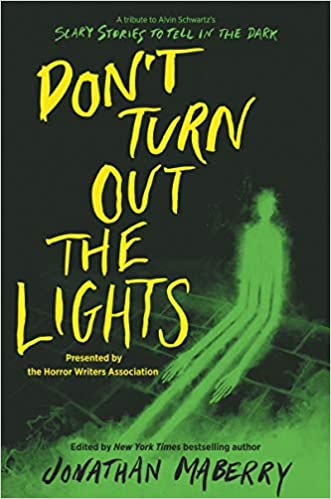
cover art for Don't Turn Out The Lights: A Tribute to Alvin Schwartz's Scary Stories to Tell in the Dark edited by Jonathan Maberry  ( Bookshop.org  |  Amazon.com )

Don’t Turn Out the Lights: A Tribute to Alvin Schwartz’s Scary Stories to Tell in the Dark edited by Jonathan Maberry

HarperCollins, 2020

ISBN-13 : 978-0062877673

Available: Hardcover, paperback, Kindle edition, audiobook


Don’t Turn Out the Lights is an anthology of stories by a variety of diverse horror writers, mostly of YA horror, inspired mainly by their nostalgia over Alvin Schwartz’s notable collections of urban legends and folktales, Scary Stories to Tell in the Dark (writers include Linda Addison, Amy Lukavics, Courtney Alameda, Tannarive Due, Kami Garcia, and R.L. Stine). Schwartz’s writing was spare, providing just the bare bones of the stories he shared, and Stephen Gammell provided terrifying black-and-white pen and pencil drawings to accompany each one It is unfortunate that the artist for the book is not credited, so far as I can tell. Nobody can be Stephen Gammell, but the interior illustrations suggest the artist studied his style. The artwork is outstanding and integrates well into the design of the book and the storytelling.

Unlike Schwartz’s collections, there aren’t a lot of jump-scares or gruesome rhymes: these are tribute stories rather than an attempt to recreate his work. As expected in a collection of 35 stories, each by a different author, some are better than others. Some stories stick closer to Schwartz’s style and choice of subject, with the feeling of a folktale, such as T.J. Wooldridge’s “The Skelly-Horse”, or “Jingle Jangle”, while others, like “The Funeral Portrait” were more reminiscent of Poe. A few manage to stick to the urban legend feel of the original while updating it for tweens today, like “Tag, You’re It,” by N.R. Lambert, which plays on social media anxieties, and “The House on the Hill”, which brings mystery emails and cell phones into play in a tale of peer pressure and surveillance in a haunted house. “The Neighbor” managed the fine line of evoking Schwartz’s tales in a contemporary context beautifully. Editor Jonathan Maberry’s introductory essay was very interesting, as he did not grow up with the stories but read them as an adult.

One of this book’s greatest faults is its length. The original Scary Stories books were relatively short in length, with plenty of white space and relatively large print on each page. Stories were usually very short and heavily illustrated. Don’t Turn Out the Lights is over 400 pages long, with most stories obviously intended to be read on the page instead of told at a campfire.  While the Scary Stories books are read by kids as young as third grade, the length of the book and of the stories suggests to me that Don’t Turn Out the Lights is aimed at a slightly older audience of tweens and middle-schoolers, and also the adult audience feeling the same kind of nostalgia for the Scary Stories books that the authors did. Recommended for grades 4+.

Contains: gore, violence, body horror, murder


NetGalley temporarily provided a review copy of this book.

