Home » Posts tagged "horror fiction" (Page 105)

Book Review: The Frenzy Wolves by Gregory Lamberson

The Frenzy Wolves (Frenzy Wolves Cycle) by Gregory Lamberson

Medallion Press 2014

Available: New paperback

ISBN-13: 978-1605427164

Book three in the Frenzy Wolves Cycle sees Father Tudoro having been taken into custody by the government. The Brotherhood of Torquemada has been wiped out, and many wolves from the Greater New York Pack have been lost. Gabriel and his family are in hiding, and Rhonda, who suffered the loss of her family and boyfriend, is bitter and angry, and looking for some revenge. Tony Mace and his special task force are on the hunt for Rodrigo Gomez, the Full Moon Killer, who has escaped prison and is heading for New York City—and he’s got a secret. Unfortunately, Tony also has to contend with freelance reporter Carl Rice, and the potentially dangerous information he’s looking to sell to the highest bidder.

As with the first two books in the series, Lamberson continues to write an engaging story with characters that the reader can identify with and care about. Tony Mace is on his game, as usual, hoping to save the day and keep the damage to a minimum, while also trying to keep peace between the humans and wolves. The Frenzy Wolves moves at a quick pace without losing any detail or suspense. Lamberson is an excellent storyteller and nothing ever feels contrived or forced. If you haven’t read any of the Frenzy Wolves Cycle, I recommend that you do. If you have read the first two, then you will be very happy with The Frenzy Wolves. Recommended for adult readers.

Contains: graphic violence, blood and gore, sexual situations

Reviewed by: Colleen Wanglund
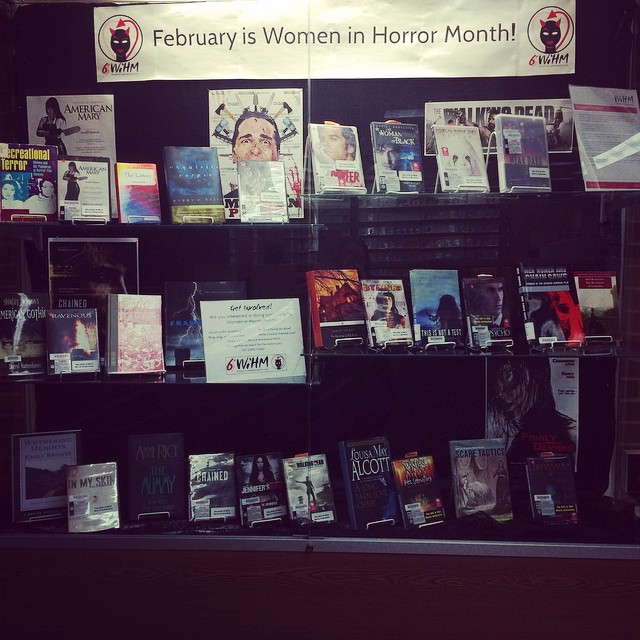
Women in Horror Month: WiHM LibGuide at the Wichita State University Library

When I talk about promoting horror at the library, THIS is what I’m talking about.

Lizzy Walker is the Metadata and Digital Initiatives Librarian at Wichita State University Libraries. She has a background in public services and metadata. She also has a strong interest in medieval studies, horror studies, and English literature studies. And check out what she did.

While other libraries and librarians are creating exhibits themed around Valentine’s Day, Black History Month, President’s Day, and other themes common to February library displays (and I’m not discounting the importance of any of these), Lizzy came up with this:
And she has created a Women in Horror Month LibGuide to go with it. How cool is that?
WiHM LibGuideHere’s what Lizzy had to say about her guide:

I created a Women in Horror Month (WiHM) LibGuide after researching materials we have in at the Wichita State University Ablah Library, as well as materials that we ordered just for the display. I quickly realized that not all of the materials would physically fit in the case. I didn’t want all of this research to go to waste, so I decided a subject guide would be the best place to keep all of this information. Here, users may browse the materials I included in the Movies, TV Series, Gothic Novels, Modern Fiction, Literary Criticism, and Film Studies tabs. It’s a work in progress—I plan on continuing to populate it with materials as I find them, as well as when we purchase materials that fit the criteria.
 

Lizzy included some really cool stuff in her guide, but it’s clearly just a beginning. It will be really interesting to see how this resource develops!

Women in Horror Month: Mary Shelley’s”Hideous Progeny”

And now, once again, I bid my hideous progeny go forth and prosper. I have an affection for it, for it was the offspring of happy days, when death and grief were but words, which found no true echo in my heart.  - Mary Wollstonecraft Shelley  When writing about women in horror, it’s almost impossible not to mention Mary Shelley.


Who was Mary Shelley? She was the daughter of two brilliant and unconventional thinkers, whose mother died in childbirth. A gifted and unconventional thinker herself, she read and wrote in five languages, and set herself an ambitious reading program. She was a pregnant teenager– just sixteen– who, accompanied by her half-sister, ran away from home with Percy Shelley, an older, married man. Disowned by her father, looked down on because she was an unmarried mother for most of that time, she saw three of her children die at a young age, the first just a few weeks after she was born.

Pregnancy must have been often on her mind often, and the consequences were often unpleasant: Shelley’s wife was pregnant when he ran away with Mary (she eventually committed suicide); and Mary’s half-sister was abandoned by Lord Byron when she announced she was carrying his child. It was in the midst of these events that Mary Shelley birthed her novel, Frankenstein.  Yet, Mary loved being a mother and loved her children. People familiar with the genesis of Frankenstein know the story of the wager made one dark and stormy night at the Villa Diodiati, between Percy Shelley, Lord Byron, John Polidori, and Mary Shelley; but Mary Shelley’s creation did not emerge from a vacuum. Her birth, which caused her mother’s death; her witness to the abandonment of other pregnant women (Shelley’s wife and her own half-sister); and the early death of her first child, all combined in the emotions and mind of an intellectually advanced teenage girl with intense emotions who was fascinated by the world around her.

In Literary Women, Ellen Moers relates that shortly after the death of Mary’s first child, she wrote “Dream that my little baby came to life again, that it had only been cold, and that we rubbed it before the fire, and it lived”. It’s no surprise, then, that the nightmare she wrote is a vision of the terrible power and consequences that accompany the creation,  the possibility of reanimation, and the death of a living creature. In Frankenstein is a synthesis of all the guilt, fear of abandonment, joy, and pain that Mary felt– a story narrated by men and monsters that illuminates a woman’s complex feelings about birth, parenthood, and death.