Home » Posts tagged "horror anthologies" (Page 5)

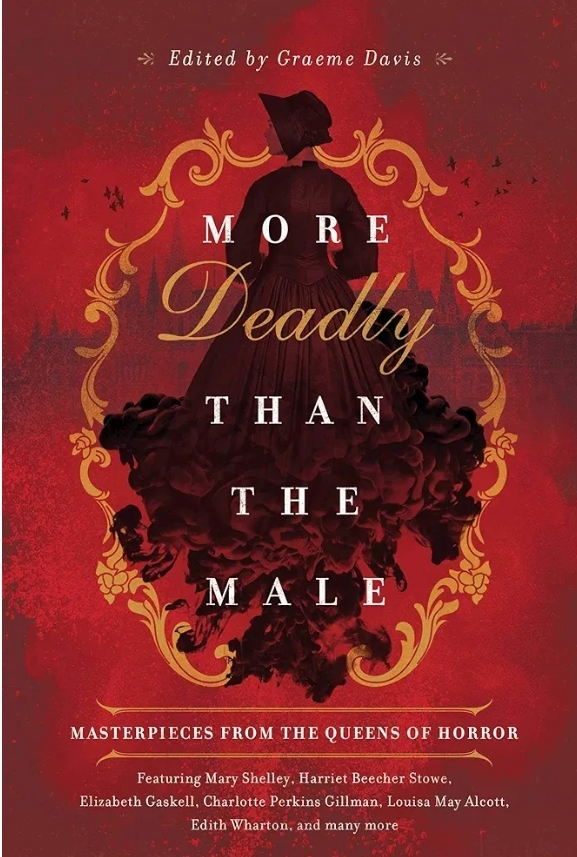
Book Review: More Deadly Than the Male: Masterpieces from the Queens of Horror edited by Graeme Davis

More Deadly Than the Male: Masterpieces from the Queens of Horror edited by Graeme Davis

Pegasus Books Ltd., 2019

ISBN-13: 9781643130118

Available: Hardcover, Kindle, audiobook, audio CD

Buy: Amazon.com


More Deadly Than the Male gives us 26 tales of terror written by women between 1830-1908. Some of my favorite Gothic and horror tales were written around this time period. Davis has selected some great stories in this anthology by well-known, and some not as well-known, women authors. In addition to select stories, Davis includes brief biographies with information about the authors’ lives and challenges they faced as women writers, and about the stories themselves. While I enjoyed all of the stories in More Deadly Than the Male, there are several that stand out. Some of my favorite tales include the following.


The volume opens with Mary Shelley’s “The Transformation,” in which Guido, seeking revenge, makes a deal with a monstrous being to trade bodies. What will become of the man trapped in a monster’s body?


In “Lost in a Pyramid, or the Mummy’s Curse” by Louisa May Alcott, Evelyn begs Forsyth to tell her how he came to be in possession of an ancient and strange gold box. He tells a tale of exploration, colonization, greed, hubris, and the mummy of an ancient sorceress and mysterious seeds found in the box.


Edith Nesbit’s “The Mass for the Dead” is a haunting story about a couple who change their history because of a vision. Jasper mourns that the woman he loves, Kate, is to marry someone else. When she reveals she is not marrying for love, but for wealth, he still insists that she should break her engagement. Out of familial obligation, she refuses to end the engagement in order to help her father with his finances. When she shares her vision of a mass for the dead with Jasper, they believe it to be a sign of her impending marriage. Later, when he reveals his own vision to Kate, they find they may have misinterpreted the vision entirely.


“The Vacant Lot” by Mary E. Wilkins-Freeman is a lovely ghost story. The Townsend family has decided to move to Boston, and the man of the house has purchased a home for a more than reasonable cost, originally $25,000 for a mere $5,000. The family wonders what the catch is with such a low dollar amount. After a month goes by, they find out. There are strange happenings in the vacant lot next door, and shadows moving about with nobody to cast them.


Other authors include Charlotte Perkins Gilman, Mary Austen, Elizabeth Gaskell, Edith Wharton, Eliza Lynn Linton, Margaret Oliphant, Vernon Lee, Mary Louisa Molesworth, Ada Travenion, Edith Wharton, and more.


It’s not new or controversial to say that horror is subjective. When we read the Gothic or older horror tales of the past, we may not be frightened, we may not get the spine tingles we are looking for or may scoff at the fainting or other what we would deem as “quaint behaviors” of the heroines. Descriptions tend to be much longer and go too far for modern audiences. I, for one, love Gothic and older horror stories, thanks to my late grandmother Phyllis, so these early stories were great to read. I just recently heard about a subgenre called “cozy horror,” and I believe these would qualify. Also, not only would this be a good addition to a Gothic fiction collection, but it would also be an interesting addition to a Gothic novels course.


Highly recommended

Reviewed by Lizzy Walker
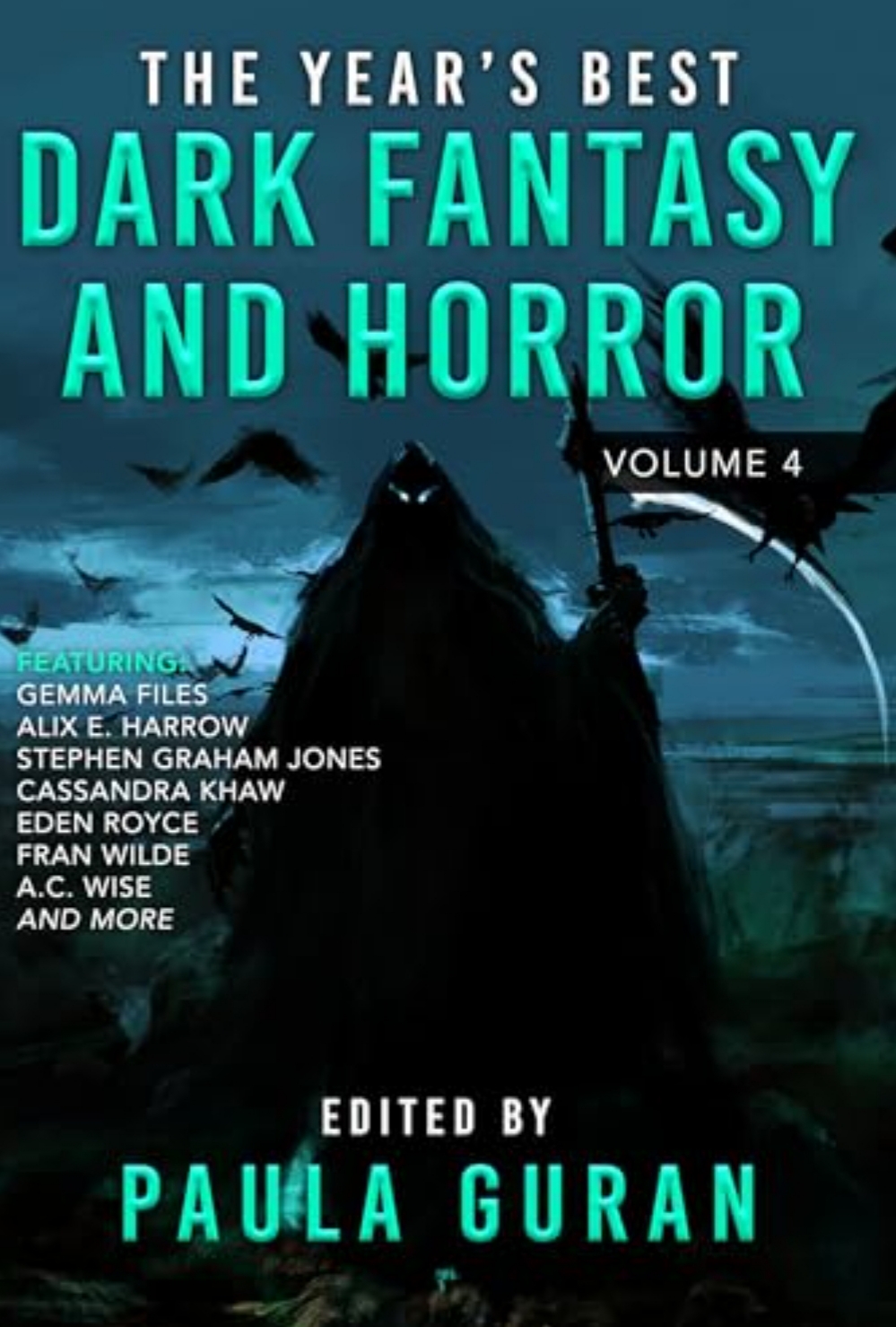
 

Book Review: The Year’s Best Dark Fantasy and Horror volume 4 edited by Paula Guran

The Year’s Best Dark Fantasy and Horror, vol. 4 edited by Paula Guran

PYR 2023

ISBN:  978-1645060673

Available : Paperback, Kindle edition

Buy:   Bookshop.org  |  Amazon.com


Editor Paula Guran is one of the two American women (the other one being Ellen Datlow) who keep providing every year the best short fiction that appeared in print the year before in the area of horror and dark fantasy.


The present, hefty volume includes twenty-one “best” tales. Frankly. to me 2022 doesn’t appear to have been such a great year for horror and dark fantasy, at least in the short form, because only a few among the selected stories were able to impress me and entertain me.


“Red Wet Grin” by Gemma Files, is a very dark, unsettling story where a nurse working in a care home witnesses a series of weird events.


Stephen Graham Jones contributes “Men, Women and Chainsaws” an engrossing, although a bit puzzling story, revolving around an old Camaro endowed with dangerous properties.


“The Voice of a Thousand Years” by Fawaz Al-Matrouk is a dark fable about an old man endeavoring to give life to an  automaton, while “ How Selkies are Made” by Cassandra Khaw is a splendid fairy tale featuring a beautiful, unhappy bride.


“Challawa” by Usman T. Malik  is a powerful, outstanding piece with a distinctive exotic taste, in which ancient gods take possession of an American tourist.


“The Long Way Up” by Alix E. Harrow is a disturbing allegory where a woman retrieves her dead husband in a deep chamber, and convinces him to return to the world of the living.


AC Wise provides “Sharp Things, Killing Things”, an obscure but intriguing story in which a group of youngsters have to deal with some unexpected deaths.


These are my favorite stories. Other readers could make a different selection, but these are the rules of the game and such a huge volume has plenty of material to offer.


Reviewed by Mario Guslandi

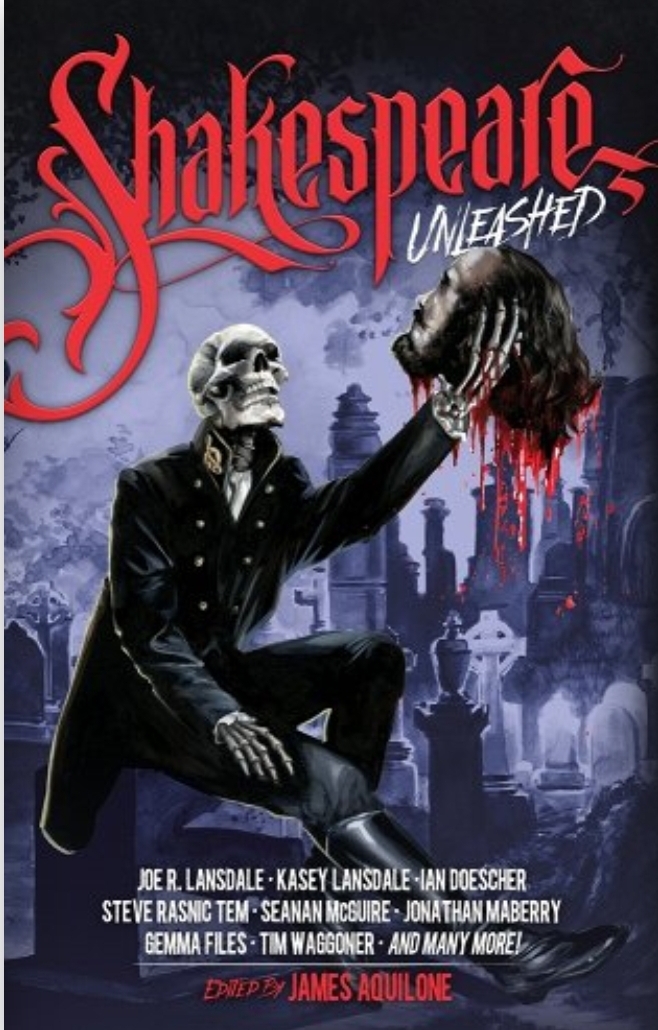
Book Review: Shakespeare Unleashed (Unleashed, #2) edited by James Aquilone

Shakespeare Unleashed (Unleashed, #2) edited by James Aquilone

Monstrous Books, 2023

ISBN: 9781946346193

Available: Hardcover, paperback, Kindle

Buy:   Bookshop.org  |  Amazon.com


This is the second book in the Unleashed series, the first being Classic Monsters Unleashed, previokusly reviewed for this website.  Like its predecessor, the stories are re-imaginings, continuations, or inspired by the Bard’s work.  How does it fare?  Pretty well, the book starts slow but gets better throughout, with the real bangers finishing out the book with a flourish.  If you haven’t read Shakespeare since being force-fed it in high school, it really helps to at least read the Wikipedia entries for his most famous works before reading the book.  Otherwise, a sizable portion of the stories might seem confusing.


The stories pull from a variety of Shakespeare’s work, with none of them used as a subject more than three times.  The usual suspects, like Macbeth, Romeo and Juliet, and Hamlet are represented, as well as lesser-known ones like A Midsummer Night’s Dream, The Merchant of Venice, and A Winter’s Tale.  Some stories add a prequel or epilogue, or a separate story involving one of the characters.  The best ones tend to be the ‘inspired by’ variety, where the basic concept is used in a different setting.


The first quarter of the book may be the weakest, and the hardest to follow, with the story ‘All Hallowed Tides Break Upon These Shores,’ a coda to The Tempest, being a bloody exception.  The story quality becomes better and more consistent the rest of the way.   Lavinia from Titus Andronicus features in a well-written tale of female revenge, “The Body, The Blood, The Woods, The Stage”, and the lecherous Sir John Falstaff gets a darkly comic dose of payback in “The Hungry Wives of Windsor”.The last quarter of the book is full of excitement and good writing.  Standouts are the Macbethian “Case of the Bitter Witch”, the Romeo-esque “Timeless Tragedy,”, and the King Lear inspired “Fortune”: all are outstanding.  They take the basic Shakespeare premise and run off in an entirely new direction, with excellent results.  It’s worth noting that with only an exception or two, the authors did NOT try to emulate the Bard’s writing style, but wisely stuck with their own styles.   The stories do get slick with blood at times, which is fitting, since Shakespeare’s work could be violent at times.  He just didn’t write graphically, which is something modern authors can certainly do!


Bottom line?  The book is a mixed bag, but there are enough good stories to justify the purchase.  Just re-acquaint yourself with Sir William ahead of time before getting the book, then watch the curtain rise on some truly twisted tales.


Reviewed by Murray Samuelson