Home » Posts tagged "horror anthologies" (Page 13)

Book Review: SLAY: Stories of the Vampire Noire edited by Nicole Givens Kurtz

A note from the editor:

We are midway through October and Monster Librarian still needs to raise the funds to pay for our hosting fees and postage in 2021. If you like what we’re doing, please take a moment to click on that red “Contribute” button in the sidebar to the right, to help us keep going!  Even five dollars will get us closer to the $195 we need to keep going at the most basic level. We have never accepted paid advertising so you can be guaranteed that our reviews are objective. We’ve been reviewing and supporting the horror community for 15 years now, help us make it another year! Thank you! And now, our review of SLAY: Stories of the Vampire Noire edited by Nicole Givens Kurtz.
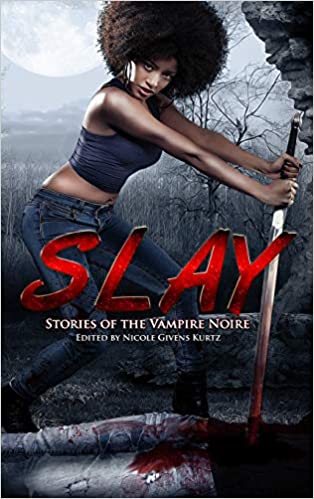
cover art for SLAY: Stories of the Vampire Noire

SLAY: Stories of the Vampire Noire edited by Nicole Givens Kurtz (   Bookshop.org  | Amazon.com )

Mocha Memoirs Press, 2020

ISBN-13 : 978-1735219554

Available: Hardcover, paperback, Kindle edition


The late L.A. Banks’ Vampire Huntress series, and her ability to transform common tropes of vampire fiction into stories that reflected the African-American experience, inspired many of the authors in SLAY: Stories of the Vampire Noire. Anthology editor Nicole Givens Kurtz continues that tradition here by showcasing Black writers and their imaginings of vampires, slayers, and hunters through their stories, giving Black readers the opportunity to be seen in vampire fiction that takes on the standard Eurocentric tropes and transforms them in a way that is uniquely relevant to Black people and also provides a window for other readers into what they have been missing because of the limited perspective of most vampire fiction. The stories come from all over the African diaspora, but the majority of them are by authors from the United States and Britain. Authors take various approaches to the concept of vampirism, inspired by Black culture, mythologies, history, and experiences, but there is nothing boring here. Interspersed between stories are beautifully calligraphed obituaries.

In the section of stories from the United States and Britain, strong stories include “Dessicant”, by Craig Laurance Gidney, takes place in a badly-kept up low-income apartment building that has red dust in the vents that is making its occupants sick and draining them of fluids. The negligent landlord can’t be reached and the protagonist, a Black trans woman ostracized by other residents, has to find a way to combat the dust, or whatever it is, on her own. “The Retiree”, by Steven Van Patten, is a funny, heartbreaking story that will give readers a new perspective on what goes on in a retirement home In “The Dance”,  by L. Marie Wood, the protagonist is surprised to learn there is more to her sexuality than she realized. In “A Clink of Crystal Glasses Heard”, by LH Moore, Neeka and her friends have a coming-of-age ceremony planned by their mothers that is not what they expected. “Diary of a Mad Black Vampire”,  by Dicey Grenor, puts the reader in the head of a bored, lonely and vicious Black vampire who finds herself intrigued by a fragile-seeming albino white girl. “The Last Vampire Huntress”, by Alicia McCalla, remixes the story of Kendra the Vampire Slayer, with Kendra the reluctant, prophesied, last vampire huntress who must accept her destiny and kill her vampire boyfriend after he attacks her friends. “Unfleamed”, by Penelope Flynn, tackles race and violence in the Victorian era with its take on the Dracula story. “Di Conjuring Nectar of di Blood” , by Kai Leakes, is a gorgeously written historical story of love and generational trauma. In “Snake Hill Blues”, set in 1927,  conjure woman Mamma Lucy eliminates a vampire who has been preying on dancing girls. I hope this author will bring her back in other stories!

The stories from African authors are also strong.  A few that stuck out to me included Oghenechovwe Donald Ekpeki’s “Attack on University of Lagos Law Faculty”, an entertaining story narrated by a pompous, egotistical law student who finds himself in the surprising position of vampire slayer, and “His Destroyer”, by Samantha Bryant, is a powerful rendering of the Passover story from the point of view of  the avatar of the Angel of Death. “Quadrille” is an engaging and occasionally darkly humorous story about friendship narrated by a vampire who has become a reporter in conflict zones in order to cover up his feeding habits, abetted by a djinn and a shapeshifter.

A last section contains stories about the future. These stories aren’t really horror, but they are compelling. In “Bloodline” scientists make a terrible mistake, enhancing a vampire’s powers.  “Message in a Vessel” is a science fiction story about the consequences of human enslavement to vampires, and “Blood Saviors” is a more fantasy-oriented tale in which an investigator for the vampires’ council discovers that a vampire has been enslaving and draining earth elementals to make a rejuvenating serum for humans, whose blood has become polluted, leading to vampires getting sick.

This is a great collection overall, with fresh takes on vampire lore that I really haven’t seen elsewhere, informed by Black experiences and perspectives. There’s enough here to love that it has taken me much longer than I expected to write this review. If you love vampire fiction or horror anthologies, and want to support Black authors, publishers, and readers of horror you should definitely pick this up. It’s a great way to discover some really talented Black writers, if you haven’t already. Highly recommended.

Contains: Animal killing, body horror, blood-drinking, torture, scientific experimentation, mutilation, murder, gore, violence, sexual situations, racism, sexual assault, rape, dehumanization, insects, genocide.

Graphic Novel Review: Mississippi Zombie by Bradley Golden, Alex Barranco, Joe Wight, Marcus H. Roberts, et al.

Mississippi Zombie: A Horror Anthology by Bradley Golden, Alex Barranco, Joe Wight, Marcus H. Roberts, et al.

Caliber Comics, 2020

ISBN-13: 9781643377131

Available: Paperback, Kindle, comiXology


Caliber Comics brings us Mississippi Zombie: A Horror Anthology, a series of walking dead tales set in rural Mississippi. In “Mississippi Crossing Part 1”, Private John Hilliard of the 1st Battalion, 155th Infantry tells the story of his fight against the incoming zombie horde from the north. “Mississippi Crossing Part 2” presents two rednecks in a bar arguing over whether the zombie threat on the news is real, part of a government conspiracy, or if the town psychic was right, and it’s the beginning of the Apocalypse. The conspiracy theorist gets fed up and leaves the bar in a huff, only to discover the truth for himself. “Mississippi Crossing Part 3”, begins on a football field, where zombies break into the arena to wreak havoc on the unsuspecting public. One player fights his way free, only to board the wrong school bus. In “Grave Times”, Theodore and Angela Brown are newlyweds when the unthinkable happens. Angela succumbs to a mysterious illness and turns. Her devoted husband keeps her chained and locked in their basement. He delivers a freshly robbed corpse to her, but it isn’t warm enough for her refined palate. “Zombie Attack on Horn Island”, told around a campfire, includes hapless settlers, a vengeful witch, and bloodthirsty zombies. In “It’s All About Commerce”, four friends are trying to get to Commerce, Mississippi for safety to find something potentially much worse than the living dead. “Planet Z” gives us a science fiction take on the zombie story. It’s Christmastime in an industrial colony in Jackson, Mississippi. Unfortunately, the zombies didn’t get the memo about peace on Earth and good will to men.

I thoroughly enjoyed the stories in this anthology. They are short, sweet, and full of zombies. I want to focus on the artwork for a bit. Phil Williams provides chaotic, intense art for the “Mississippi Crossing” segments, especially when the zombies attack. It’s very well executed. The art for “Grave Times” by Antonio Acevedo is highly detailed and has some great shadowy effects. Shaun Barbour’s art in “Zombie Attack on Horn Island” and Harrison Wood’s art in “It’s All About Commerce both feel close to what you would see in Eerie or Creepy. Rod Espinosa has a slick art style that is great for a sci-fi horror comic. It would be great to see him do art for a Warhammer 40K comic.

I would recommend this for anyone who wants to support independent, well-done horror comics. I think it is important for libraries to find ways to hold these in their collections as well. Highly recommended.

Contains: blood, gore, zombies


Reviewed by Lizzy Walker

Book Review: The Horror Collection, Black Edition by Kevin Kennedy


The Horror Collection: Black Edition edited by Becky Narron and Kevin J. Kennedy

KJK Publishing, 2019

ISBN-13: 978-1798000991

Available: Paperback, Kindle edition


The Horror Collection: Black Edition is an anthology of horror short stories.

“The Lake is Life”, by Richard Chizmar describes a troubled, teenage girl whose parents are facing divorce. She seeks emotional refuge visiting her grandmother at a tranquil lake.  There is a bloody massacre, and the keys to who and why are in the girl’s past. Unfortunately, the author never clearly explains her past.

“Pie Bingo: Last Man Standing”, by Veronica Smith describes a dystopian future with overcrowded jails.  The authorities need to winnow the jail population. Prisoners can opt to play bingo for pies, conjugal visits and freedom. However, if they don’t win, they won’t like the consolation prizes. The story is memorable because of the gruesome, sadistic details of the contest.

“Goblin Financial”, by Lee McGeorge is a lesson about the consequences of bad debts. A woman reneges on a loan she should have used for her education, causing her creditors emotional pain. She runs, but they have a hideous debt collector, and a horrific way of making themselves whole.

Readers familiar with the concept of informed consent in human experiments will cringe at “The Switch”, by Mark Lukens.  A financially desperate man agrees to be locked alone in a room for pay and told he must not flip a switch on the wall. The purpose, benefits, alternative choices and risks are not explained to him. Readers can guess what happens; it’s not really an experiment, because the researchers know the outcome.

“Those Who Watch from on High”, by Eric Guignard is an interesting account of emotional and psychological stresses on a drone pilot. Bored, isolated and suffering from disrupted sleep/wake cycles, an Air Force lieutenant in the Nevada desert struggles with reality. Is he looking down at a terrorist’s young son in the Afghan desert with a drone, or is he watching the terrorist’s hut from the desert floor? When he gets the order to fire on the hut, will he obey? If he does, what will he do the next day?

“The Ghost of Agnes Gallow”, by James Byers is an impressive poem about a witch whose curse stalks a family over generations on Halloween Eve.  Reciting his poem of ten stanzas of rhyming couplets out loud adds to the enjoyment.

Kevin Kennedy warns that  “A Tarantino Oz”contains strong doses of sex, violence and profanity. Readers who dislike Quentin Tarantino’s movies and misogyny should skip this story. Kennedy says all fairy tales were originally horror stories. In this tale, characters of L. Frank Baum’s The Wonderful Wizard of Oz meet for an orgy and murderous rampage.

In “Smolder”, Michael Arnzen uses the well-known difficulty of stopping smoking and the Surgeon General’s health warning to draw readers into his story. Who knew that there is something magical about each word of  “SURGEON GENERAL’S WARNING: Smoklng Causes Lung Cancer, Heart Disease, Emphysema, And May Complicate Pregnancy”?  A concerned husband tries to help his pregnant wife kick the habit. He finds a hidden pack of cigarettes, but has no idea that calamity strikes smokers when words of the warning are destroyed.


Contains: Gore, graphic sex and profanity


Reviewed by Robert D. Yee