Home » Posts tagged "cosmic horror" (Page 3)

Book Review: The Hollow Places by T. Kingfisher

A note from the editor:

We are midway through November and Monster Librarian still needs to raise the funds to pay for our hosting fees and postage in 2021. If you like what we’re doing, please take a moment to click on that red “Contribute” button in the sidebar to the right, to help us keep going!  Even five dollars will get us closer to the $45 we still need to keep going at the most basic level. We have never accepted paid advertising so you can be guaranteed that our reviews are objective. We’ve been reviewing and supporting the horror community for 15 years now, help us make it another year! Thank you! And now our review of The Hollow Places: A Novel by T. Kingfisher.
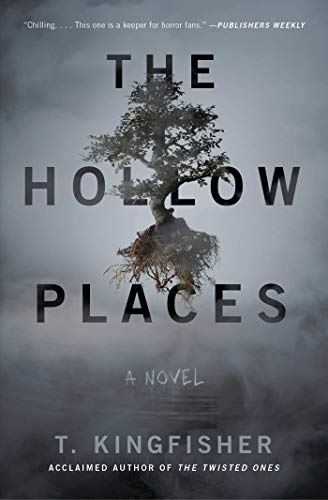
 

cover art for The Hollow Places by T. Kingfirsher

The Hollow Places: A Novel by T. Kingfisher (  Bookshop.org | Amazon.com )

Gallery/Saga Press, 2020

ISBN-13 : 978-1534451124

Available: Paperback, Kindle edition, audio CD

T. Kingfisher is the pen name for Ursula Vernon, author of a webcomic and also the middle-grade Danny Dragonbreath books. In The Hollow Places, the author shows she can successfully and satisfyingly navigate from one genre and audience to another.

Recently divorced, Kara has moved into her uncle Earl’s combination museum/curiosity shop/living space and is cataloging his jumbled collection of objects and taxidermy while she figures out what to do with her life. While she’s there, a box of oddities arrives at the museum with a carving labeled “corpse otter” inside. When Earl hurts his knees badly enough that he’ll need major surgery, Kara takes over running the museum in his absence, and a few days later finds a mysterious hole in the drywall in the otter room, which showcases a giant taxidermied Amazonian otter and also displays the corpse otter carving.

Kara asks Simon, the quirky (and very gay) barista at the coffee shop next door, if he can help her patch the drywall. When Kara and Simon look through the hole, they see that it opens into a hallway that shouldn’t exist and decide to explore the hallway to see where it goes… that is, once they’ve packed flashlights, string, a tape measure, and a thermos of coffee. Both of them have seen enough horror movies to know not to split up, but not, apparently to leave locked doors alone, because they open the door at the end of the hallway to somewhere very like the Wood Between the Worlds in the Narnia books, except that instead of a wood filled with pools, it is a water world of islands swamped by willow bushes, each with a door to another world.

I had not read it before I read The Hollow Places, but at the end of the story, T. Kingfisher credits Algernon Blackwood’s The Willows as an inspiration for this book. As much as I could see the influence of C.S. Lewis, it is very clear that The Hollow Places, in setting and atmosphere, owes a great deal to Blackwood’s story. Kingfisher has taken elements from both authors and created something wholly original. Kara and Simon are both well-developed characters. It’s enjoyable to see them interact: they are sometimes snarky, often supportive, and protective of each other. They are funny and resourceful,  and make a great team. The setting is almost a character itself: both the museum and the willow world with its many doors seem to have lives of their own. Without giving away the entire plot, I’ll just say you will never look at taxidermy the same way again.

The sense of creeping dread and the feeling that we are, as Kara puts it, just a pixel away from a hostile, alien dimension, is even more disturbing and compelling in Kingfisher’s book than it is in Blackwood’s story. While the plot doesn’t move along speedily, it has some great action sequences, especially near the end.  Certainly it is worthy of consideration for a Stoker. Highly recommended.
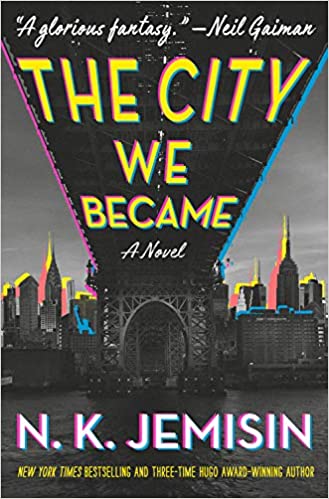
 

Book Review: The City We Became by N.K. Jemisin

cover art for The City We Became by N.K. Jemisin

The City We Became by N.K. Jemisin   (   Bookshop.orgAmazon.com  )

Orbit, 2020

ISBN-13 : 978-0316509848

Available: Hardcover, paperback, Kindle edition


The City We Became is the first book in a trilogy based on a short story by N.K. Jemisin titled “The City Born Great”, which focused on a young homeless Black man who becomes the avatar for New York City as it literally comes alive, and successfully battles a cosmic attack aimed at killing the city at great expense to himself.

The book begins after the events of the story, and if you haven’t read the story the beginning may be a little disorienting. The exhausted avatar of New York City, who sustained significant damage to himself, is hidden away and sleeping. It turns out that one person is not enough to sustain the life of an entire city. The five boroughs of New York, each with a distinct character, each have an avatar come alive that can defend their borough, and when they come together, they will be able to find and wake the avatar for New York City with their combined strength. They just have to find each other, choose to take on the responsibility of being their city as well as themselves, and overcome the “Woman in White,” a powerful representative from a cosmic force in an alternate reality. With one exception they are a colorful, multiracial, and argumentative group, but when push comes to shove, they are all New Yorkers who stand together. Manhattan is a younger, gay man who developed amnesia when he entered the city, but who obviously had a background steeped in violence.  He has come to New York to work on a graduate degree in political science. Brooklyn is an older Black woman who was a rap artist in the early years of rap music but is now a mother and member of the city council. The Bronx is a no-nonsense part-Lenape feminist lesbian professor of fine arts who directs a nonprofit arts center for marginalized artists and members of the community. Queens is an undocumented Indian student with a gift for math who is interning on Wall Street in hopes of gaining a path to citizenship.

But Staten Island stands back from the rest of the city. She is a young white woman living in a conventional family with a father who is an abusive, xenophobic, racist cop and a mother who is a passive alcoholic housewife. She barely qualifies to work at the library, and has been cautioned about the awful people in the city and the terrible things that could happen to her there.  When someone encourages her to read Lovecraft, his work confirms for her what “those people” are like (anyone who has ever said “it’s just fiction, not life” please take note). Despite the awful things that have happened to her within the walls of her own home (ranging from smashed self-esteen to attempted rape), she is more concerned with keeping others out than escaping it herself. As a white woman, it was heartbreaking for me to see her ignorance and obvious complicity with not just human but cosmic evil. I’m not familiar with Staten Island, but I really hope the portrayal here is not totally congruent with reality,

In The City We Became, extradimensional evil has grown more complex: better at planning in a way that, when cities begin to come alive, groundwork to kill it is already in place. The art gallery is attacked online by alt-right “artists” funded by a clearly sinister foundation led by the “Woman in White”, resulting in the staff getting doxxed and recieving death threats, and the building nearly burned down (this part of the book is terrifying). Brooklyn and her family are evicted from property they own outright by the same foundation, in the name of gentrification. Every chain store that replaced a community institution and changed the character of the boroughs and the city is killing it. Will Manhattan, Brooklyn, the Bronx, and Queens be able to revive the avatar of New York and save the city without the help of Staten Island, or will the city die, to be replaced with something more sinister and destructive?

While The City We Became touched on a lot of important issues (gentrification being a big one) it is also a love letter to New York City and its boroughs. Seeing the people Jemisin imagined as being these cities brought a new vividness into the way I think about the city and I loved meeting her main characters. I do feel like this book left a lot of loose ends. Who is Manhattan, really? Will we see more of his roommate? Where will the homeless avatar for New York go next? What finally happens to Staten Island? How do things change for the avatars when they go back to their daily lives? This is the first book in a trilogy, so I hope we’ll find out shortly.  Recommended.


Contains: attempted rape, domestic abuse, violence, racism, body horror, tentacles


Book Review: The Festering Ones by S.H. Cooper

The Festering Ones by S. H. Cooper

Independently published

ISBN-13: 978-1693388583

Available: Paperback, Kindle edition


The Festering Ones by S. H. Cooper is a horror novella featuring an avenging heroine, straightforward action, and plenty of gore. In this story, parallel realities exist alongside, but mostly separate from ours. One of them, however, is inhabited by hideous monsters that can invade our world by dreams, illusions and possession of our bodies. Human cults strive to open doorways for the monsters, who will destroy all normal life if they gain control.

On a hunting trip in Pennsylvania, a young girl, Faith, sees her father ambushed and killed by a spider-armed, Woken Daughter of the monster Gorrorum, but no one believes her story. Years later, she discovers more disappearances in the mountain town, and uncovers a local cult. On the trail of another cult in Florida, she teams up with Janice, who is seeking her kidnapped boy, and Sasha, who is searching for her missing sister. The women fight factotums of a rival monster. Faith and Sasha return to the mountain to avenge their loved ones, but they meet more than the Woken Daughters in the tunnels and cavern of the mountain.

Cooper’s writing is simple and direct. The plot is straightforward. Although her characters are not complex, the female heroines are determined and strong.


Contains: violence, gore


Robert D. Yee

