Since Monster Librarian has been around for quite some time, we actually reviewed reader’s advisory reference books in horror before there were many reader’s advisory books on the horror genre and even before social media became all-consuming. Most of these are on a page on our original website titled “Librarian Resources”. It’s pretty sparse, because anything published after 2014 will be found on this blog instead of the original site, and there really wasn’t much in existence then. What was once a fairly restricted community of readers and writers has grown like crazy, and the past few years have really boomed in terms of providing all kinds of helpful resources.
So it was a very big deal when Becky Siegel Spratford wrote a second edition to The Readers’ Advisory Guide to Horror, which was published in 2012. This month I saw her announce that the third edition will be coming out next year (wow!) so I’m republishing our review of the second edition now. She has kept it updated through her blog RA for All: Horror. If you visit now, Becky is counting down the days until the announcement of the titles for the HWA’s summer reading program, Summer Scares, for 2020.
With the horror genre having expanded its reach and audience considerably I will be curious to see the changes in the third edition!
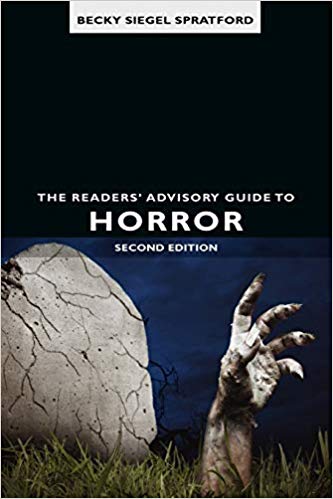
The Reader’s Advisory Guide to Horror, Second Edition by Becky Siegel Spratford
American Library Association, 2012
ISBN-13: 978-0838911129
Available: Paperback, Kindle edition
The Reader’s Advisory Guide to Horror, Second Edition, is the updated version of The Reader’s Advisory Guide to Horror, part of the American Library Association’s Reader’s Advisory series on genre fiction,. That is, the major professional organization for librarians endorses this as the authoritative text on reader’s advisory in the horror genre. The author, Becky Siegel Spratford, is a reader’s advisory librarian with a particular interest in the horror genre, and in promoting horror in the library– and is someone I admire very much. Updates for this edition can be found at her blog, RA for All: Horror.
The Readers’ Advisory Guide to Horror, Second Edition is an important book for a couple of reasons. First, because it’s published by the American Library Association, it is likely to reach a wide audience of librarians, and because it’s part of an established series on readers’ advisory, it has credibility as a resource for librarians who may not know much about(or like) the horror genre that other resources may not have. That opens a door for connecting a lot of people to books they may like. Spratford does a nice job of providing a concise history of horror, introducing some prominent authors, and addressing the classics. Spratford also mentions that many horror readers prefer to read only within one subgenre (such as werewolf books), and has set up the book to provide annotated lists for recommended titles in popular subgenres,. She also includes a chapter on horror resources and marketing, which does a very nice job of offering tools and strategies for growing and promoting library horror collections, not just during October but throughout the year. This is a topic that really needed (and needs) to be addressed– horror readers don’t just read horror as Halloween rolls around, and if your horror novels are shelved with the rest of the fiction they may not even know what the library has. I’m glad that Spratford specifically addressed this in her book.
However, there are aspects to the book of which librarians should be aware. Spratford chose to define horror as “a story in which… unexplainable phenomena and unearthly creatures threaten the protagonist and provoke terror in the reader”. That’s a very narrow definition. I recognize that for purposes of writing a reader’s advisory guide it’s necessary to set limits of what qualifies as belonging to a genre, but reader’s advisory librarians attempting to serve horror readers should be aware that many horror readers don’t require there to be a supernatural or unexplainable element in their reading. Because of the way she defines horror, Spratford’s breakdown of subgenres is sometimes problematic. For instance, in her chapter on “shape-shifters”, she included not only werewolf titles but killer animal books, and these two types of books appeal to different audiences. Many killer animal books have no supernatural aspect at all, such as Cujo, Stephen King’s novel about a rabid dog terrorizing his neighborhood (Spratford writes that Cujo “comes under the spell of demonic forces”, but that is not the case). Her chapter “Monsters and Ancient Evil” also combines in one list books that will appeal to different audiences- Lovecraftian fiction and more modern monster novels. In addition, Spratford leaves out the notable category of human horror. Books in this category aren’t literary novels of psychological suspense- they display the worst of human nature, without needing to employ the supernatural. Usually they have graphic gore, violence, and sexual situations (such as in the work of Wrath James White). This category doesn’t fall under Spratford’s definition of horror, and so it isn’t addressed in the book. Spratford is covering a huge amount of territory in a limited number of pages, but it would really have benefited users, and readers, to have these particular issues dealt with, and hopefully we will see that in the next print edition. In addition to covering a wide variety of authors and subgenres, Spratford addresses whole collection reader’s advisory and mentions several categories of books outside the genre that horror readers might also enjoy, I especially appreciated her mention of nonfiction, as there are a lot of appealing nonfiction titles that horror fiction readers will probably never find on their own.
Horror is a very difficult genre for both collection development and reader’s advisory. It doesn’t get much respect, or even recognition. The Reader’s Advisory Guide to Horror, Second Edition, although not a perfect tool, does a great job providing resources to librarians serving horror readers. Highly recommended for purchase by public and academic libraries.
Review by Kirsten Kowalewski






Follow Us!