Home » Posts tagged "children’s books" (Page 8)

Help a Reader Out: Are Myths Fiction or Nonfiction?

Interestingly, this question popped up in keyword searches a number of times, so I’m going to briefly address it.

“Are myths fiction or nonfiction?”

The answer probably depends on who you ask and why. I imagine that if you ask an atheist, you’ll get the answer “fiction”. But in the wonderful world of the Dewey Decimal System, books (and other media) on mythology are in the 200s, the category for philosophy and religion. So for straight mythology or books about mythology, it’s considered nonfiction. Poetry (like Homer’s Odyssey will generally end up in the 800s, with other books of poetry. Yes, poetry is considered nonfiction.

Novels and stories inspired by mythology usually end up getting pulled from the 800s and end up shelved with fiction, though. So if you’re asking because you want to know where Rick Riordan’s books fall on the shelf, you’ll find those in fiction. And if you are asking about a graphic novel, it kind of depends on the library. Some libraries will shelve all graphic novels under 741.5, the number for that format, and some pull the graphic novels into a separate section and shelve them by either subject (my daughter’s elementary) or author (my son’s middle school).

So the answer is that, especially in the library, it’s complicated. And sometimes it is kind of hard to figure out. If you’ve encountered Percy Jackson’s Greek Gods”, it probably falls in nonfiction, even though it is written in the annoying contemporary voice of a fictional character(that’s just my personal opinion, my kids love it) and “updated” versions of many myths. But the novels will end up shelved in fiction. Ultimately, though, the myths of a culture are stories of their gods, and their religion, and as long as people believe in gods, mythology is nonfiction.

It occurs to me that, given that this site focuses on horror fiction, someone reading this might think “Well, what about the Cthulu mythos? That’s a mythology, right? Why isn’t Lovecraft in the 200s?” As it was originally the invention of one person recognized as a writer of fiction, and how that person felt about religion is publicly known, I don’t see why it would be anywhere except in fiction. If you do know a person who worships the Elder Gods, please encourage them to seek help.

Book Review: My Grandmother Told Me To Tell You She’s Sorry

My Grandmother Told Me To Tell You She’s Sorry by Fredrik Backman

Atria Books, 2016

ISBN-13: 9781501160486

Available: Hardcover/Kindle edition/Audio Download/Compact Disc


Elsa is seven, “going on eight”. Her world looks bleak: she is too mature for her age. and is bullied and friendless at school.  Elsa’s parents are divorced.  She lives with her mother, who is tied up in her work and has little time for Elsa.  Fortunately, she has a tight bond with her grandmother.  Granny is seventy-seven, a retired doctor with a mysterious past.  For many years, she travelled the world helping others caught up in disasters, but spent little time at home raising Elsa’s mother.

Every evening at bedtime, Granny tells Elsa tales about a fantastic world called the “Land-of-Almost-Awake.”  That world has kingdoms with battling armies, princesses, heroes and beasts.  Granny and Elsa have a secret language.  One kingdom is named “Miamas” because Elsa called pajamas, “mjamas”, when she was younger.

As the story progresses, the separation between the fantasy world and the real world becomes obscured.  Elsa, her mother, and Granny live in separate flats in an old apartment building.  Tenants in the other flats are cantankerous and quirky.  Some might have superpowers and unknown connections to Granny’s past.  Most are human, but two tenants, who are never seen, might not be.  They are a hooded giant known as  “Monster”, and the “Wurse”, a huge, hairy canine.

Then Granny dies, leaving Elsa the task of delivering letters of apology to some of the tenants, as well as other people she has known.  Can Elsa evade malevolent creatures from the fantasy world she created with Granny as she tries to carry out Granny’s wishes?  Will she learn who the tenants really are. and what Granny really did in her other life?

My Grandmother Told Me To Tell You She’s Sorry perceptively and sympathetically portrays an exceptional, young girl’s struggle to fit into a world in which she is too mature for her peers, yet excluded from the secrets of adults.  When her Granny dies, Elsa loses her sanctuary and must try to reconcile her fantasy world with reality.  The characters are well drawn, and the plot moves along with an appropriate pace.  Fredrik Backman has written two other novels, A Man Called Ove and Britt Marie Was Here.  These novels also describe the dilemmas and problems misfits encounter in the world of ordinary people. Highly recommended for older children, teens, and adults.

Reviewed by: Robert D. Yee

Book List: Ordinary Heroes To Share With Your Kids

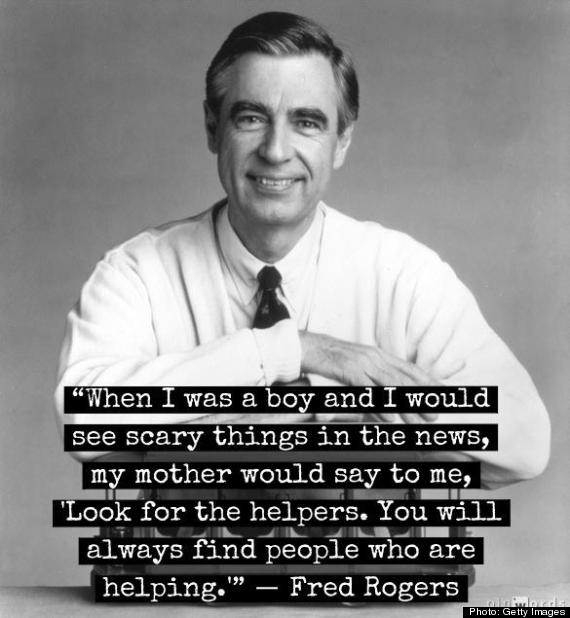
mister rogers helpers quote

It’s a scary world out there even if you don’t have your nose stuck in a book (sometimes even with horror, as the fiction can actually be more comforting than the reality) For sure, though, if you are anywhere around kids, you’ll know that they see and hear enough to get their anxiety ratcheted way up by what’s going on in the world today.

My daughter is pretty into the chapter book stage of childhood reading at this point but she picked out a book this week that actually is all pictures and no words, which is a pretty powerful illustration (that pun was not intended) of the impact ordinary people can make on the world. and it made me think of a couple of others that might be good to share with younger kids who are getting seriously worried. There is a lot going on that I haven’t figured out how to address with my kids– fear of nuclear war, hurricanes, wildfires– gosh, there’s so much to be afraid of. But also, there are helpers. Ordinary people. Artists, librarians, letter-writers, musicians, people walking down the street, even children, who have made a difference, and continue to do so.


Letters to a Prisoner by Jacque Goldstyn

This is the wordless picture book my daughter picked out. It’s very simple– line drawings that you could almost imagine a child drawing, with watercolor washes . In it, a father is separated from his child when a peaceful protest turns violent. He is jailed, isolated from the world. All kinds of people, from all over the world (and including one astronaut) write letters to him and on his behalf, until he flies away on their wings, home again.  The book was inspired by Amnesty International’s Write for Rights Campaign.
 

Painting for Peace in Ferguson by Carol Swartout Klein

In 2014, after a white police officer shot and killed an African-American man, Michael Brown, unrest and protests in Ferguson, Missouri resulted in violence and property damage. In an effort to begin healing the community, local artist Carol Swartout Klein brought artists and community members of all ages and races together to paint over the boarded-up storefronts with brilliant murals expressing hope and unity. Painting for Peace in Ferguson presents color photo collages of the creative people who participated and the art they created, over simple backgrounds created by Klein. Proceeds benefit art, youth and small business recovery programs in North St. Louis County.
 

Alia’s Mission: Saving the Books of Iraq by Mark Alan Stamaty

In 2003, Alia Muhammed Baker  was the chief librarian for the Central Library in Basra, Iraq. When the Iraqi military occupied the library, she knew it was only a matter of time before the library would be bombed and the books destroyed. Determined to save the books and the collective memory of the Iraqi people, she started smuggling books out of the library under her jacket, eventually filling her entire house with stacks of books. As the bombing escalated, she recruited friends to sneak books over a wall into the restaurant on the other side. With their help, Alia was able to save 30,000 of the library’s 40,000 books before the library was destroyed.  There’s a gorgeously illustrated picture book version of this story, The Librarian of Basra, but I like this graphic novel version better.
 

Mole Music by David McPhail

I love this book so much. Mole lives by himself, underground. Digging isn’t enough for him, so he decides to take up the violin. At first he’s terrible, but as he improves, the plants above his hole start to thrive. A tree takes root and grows, unnoticed, right through his ceiling, amplifying the beautiful music as the world above ground changes. Unaware as he is of the great conflict about to occur in the valley above him, it is Mole’s music that stops the armies in their tracks. One small person can have a very big effect.
 

Yo! Yes? by Chris Raschka

I get all children’s-librarian-geeky over this book. It doesn’t really have the message of  “we all can change the world for the better” or even “one person can change the world for the better.”Yo! Yes? gets down to the nitty-gritty: one person reaching out to another makes both of them richer. The text of the book is very simple– one or two words on each page. The words come from a conversation the author heard between two boys while walking down the street. The book is designed so that there is one boy on each page of the double-page spread, and you can see the two halves of the conversation going back and forth. The words are big on the page, so it’s a great shared-reading book, and you get to shout a lot, which is always fun. Our story here is that we have two boys, each on his own, and one reaches out to the other to make friends. This is not a quiet, tentative thing. Once these kids connect, they are loud and joyful. The world is going to hear them coming! But none of that happens without one ordinary kid calling out to the other, and getting a response.

And now back to our regular programming.