Home » Posts tagged "body horror"

Book Review: Newbourne Park by Jennifer Thorne

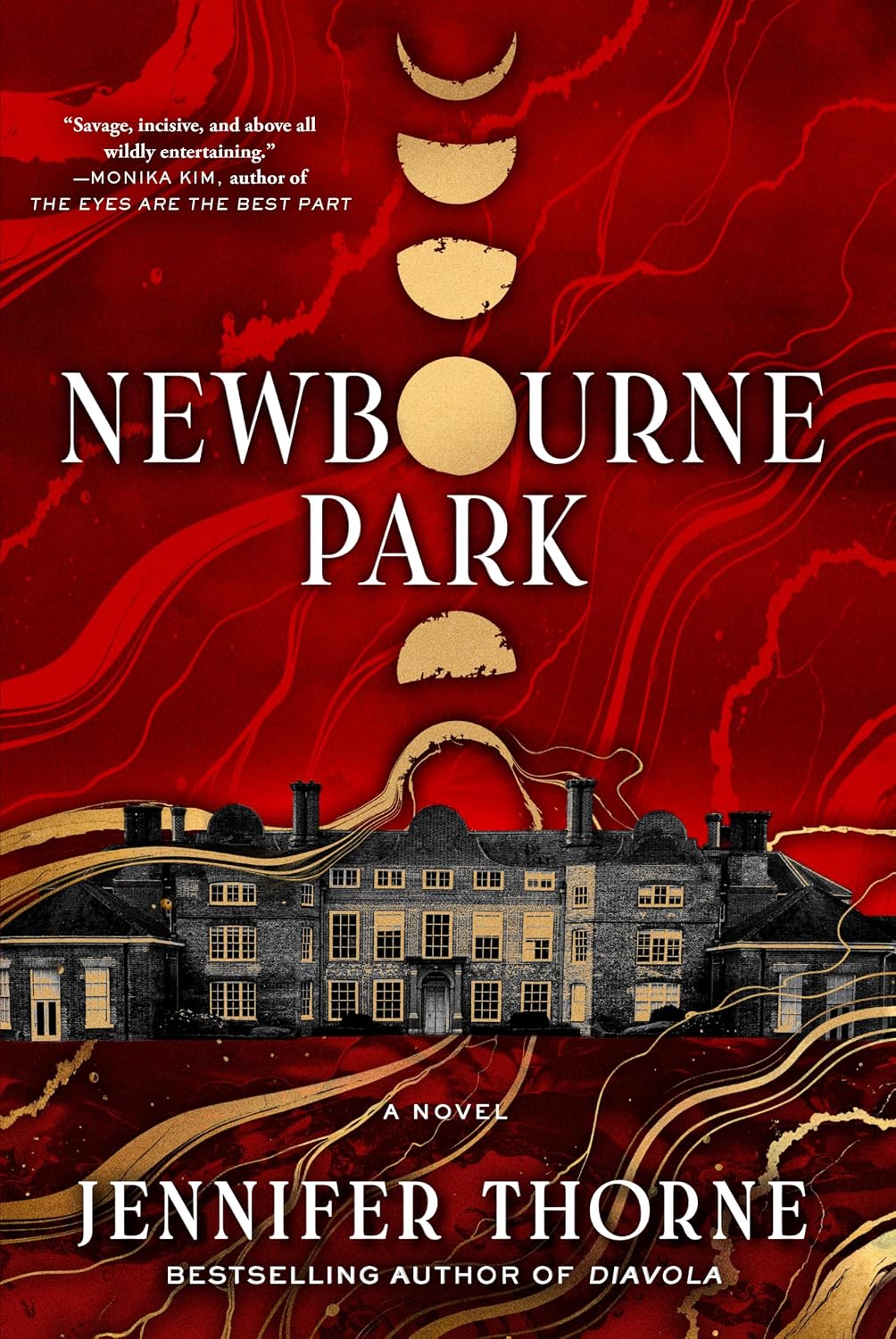
Cover art for Newbourne Park by Jennifer Thorne

Newbourne Park by Jennifer Thorne
G.P. Putnam’s Sons, 2026
ISBN-13: 979-8217177769
Available: Hardcover, Kindle edition, audiobook (pre-order before September 29)
Buy: Bookshop.org Amazon.com


Those obnoxious English aristocrats never want to share their beautiful country houses with the help while they go on vacation. Why? I mean, they aren’t there anyway, are they? What’s worse, when their minions do decide to invite themselves over, one of those snooty people comes back unexpectedly and makes everyone feel like they deserve whatever they get just for having a little fun and relaxation. No one would expect things to take such a turn.


Martha has an inkling, though. Those bones in the barrel? They might be deer bones. Maybe. The horses gone from the stable? Strange, but whatever. The main thing is that plenty of food and alcohol are available. Strangely, the meals are all leftovers, but so what? The partiers are too drunk to care. The group’s host has barely started the job. It’s a bit brazen to risk losing his position by having everyone over for an illicit house party, one would think. Clearly, bad things are about to happen– and they do.


What makes this story extra interesting is finding out what happens after the catastrophe. The sullen townspeople do not seem very sympathetic to the plight of the survivor when she turns up. In fact, they seem hostile, so you get to thinking the creepy stories like the one about the so-called Dripping Man might be true. The poor victim is going through some physical and mental challenges and spends time on odd websites which give tips on eating and how to lock yourself up at night.


In Part 2 of the novel, the survivor is invited to join a club with others she can relate to, which is unusual given the invitation comes from Lady Lambert herself, who has her own secrets and is far from innocent. What blue-blooded nonsense has this woman gotten herself into?


Jennifer Thorne’s Newbourne Park is a rollicking good time in spite of its dark take on what goes on in the English countryside after the sun goes down. The narrator is cheeky, sarcastic, and cool. She tells us everything, accurately and honestly, and she is far from naive. At the same time, she is, somehow, not to be trusted. A lurking suspense and fear build throughout this book in the same manner as music heightens the emotions in a horror film making the viewer think the worst even while the action suggests nothing of the sort. At the same time, the most horrible details are unpleasantly normalized. This is a horror novel with attitude and a creative swerve in that we certainly know what there is to know, yet we are surprised by what we know and even more surprised by what happens as a result. Chalk it all up to some superbly inventive writing by Jennifer Thorne.


Reviewed by Nova Hadley

Book Review: Shiny Happy People by Clay McLeod Chapman


Shiny Happy People by Clay McLeod Chapman

Delacorte Press, 2025

ISBN-13 ‏ : ‎ 978-0593904084

Available: Hardcover, ebook edition, audiobook

Buy:  Bookshop.org


I find Clay McLeod Chapman’s work uniquely disturbing. While Shiny Happy People, his foray into YA horror, isn’t as gruesome as some of his previous projects it is a natural fit with his other work, especially Wake Up and Open Your Eyes. 


Kyra was abandoned by her addict mother at a young age and is now the adopted daughter of a loving family. Her father works long hours at a large pharmaceutical company, BoTanic, which employs most of the town. She has terrible anxiety and panic attacks, and a supportive “black sheep” best friend, Halley.


Kyra’s need for control and family history of addiction mean she’s completely straight-edge even in the face of peer pressure, so when a new party drug starts making the rounds at school, she’s one of the few who hasn’t taken it and can observe the effects it is having on the people around her. Kids who have taken the drug go into violent convulsions, followed by becoming artificially happy and calm, causing an uncanny valley effect that Kyra feels but can’t explain to the adults around her, who are also acting very strange. With the people around her all gaslighting her, Kyra starts doubting her grip on reality. The only person who seems to be on her wavelength is new boy Logan, who is clearly hiding something.


Flashbacks to Kyra’s abandonment in a dark room infested with bugs, mold and fungus are truly claustrophobic and creepy, On a personal level, as someone who lives with epilepsy, the descriptions of violent convulsions created a visceral response. Kyra’s description of her anxiety as “ivy threaded through my ribcage” is vivid, and when it gets entangled with already-creepy fungal horror, becomes terrifying, with its network spreading wider and wider. This horror is not limited to one school or even one town.


There is so much going on in this book: it comments on addiction, Big Pharma, hive mentality, peer pressure, corruption, mental health, and more, but messaging doesn’t take over the story. Chapman follows Kyra’s narrative thread all the way through at a fast pace. It’s an uncomfortable, disorienting ride, and one that’s well worth taking.


Highly recommended.


Reviewed by Kirsten Kowalewski

Book Review: The Witch of Willow Sound by Vanessa F. Penney

The Witch of Willow Sound: A Novel

The Witch of Willow Sound  by Vanessa F. Penney

ECW Press, 2025

ISBN-13 ‏ : ‎ 978-1770418424

Available: Paperback, Kindle edition, audiobook

Buy: Bookshop.orgAmazon.com


The story starts with the burning of a woman. Author Vanessa F. Penney details the fire singeing the feet and its expansion as it rises up her body, the crackling sound of the fire, the color of the smoke, the logistics afterwards, the small rituals that have to be done when you burn a witch. It is easy to get rid of the flesh, but what to do with the bones? The prologue yanks you into this novel about the disappearance of Madeline Luck, the local witch, though the rest of the book is a slow burn (no pun intended).


Madeline Luck has been missing for three months. Her niece, Phaedra, also known as Fade, is given the task of finding her, due to the family’s rightful distrust of the local police department. Even though she used to be very close to her aunt, especially when she lived with her at Willow Sound, Fade hasn’t seen her for over 20 years. 


The reader follows Fade’s steps as she makes her way up unmarked paths to get to her aunt’s house, atop a secluded cliff in Nova Scotia, and works through the mystery of her disappearance. As Fade gets deeper and deeper into the case, she exposes shocking town secrets, uncovers literal skeletons in the closet, and learns the deep history of witchlore from a bumbling but lovable historian named Nish, who becomes Fade’s sidekick in solving the mystery. The novel keeps you guessing until the very end to find out if it was Fade’s aunt, Madeline, that was burning at the stake at the beginning of the book, or if she was the one that set the fire. 


The book moves at a slow pace, with each detail mentioned being an important clue to the final resolution. The author has a gift of bringing you into the woods where Madeline’s ethereal house stands, with a haze over the sound and a large shadow cast upon the nearby, distrustful town of Grand Tea. The town is literally under a shadow of a huge rock which threatens to fall and crush the residents. The air is full of suspicion and tension, directed at Madeline, who the townsfolk blame for all their misfortunes. Fade will not find any help from them.


The Witch of Willow Sound  is a delightful book that transports you into the landscape of Nova Scotia. It explores witchlore, and feminist ideas of the suspicion of women who do not conform to the gender norms expected of them. Even though it is labeled as horror, I would say it’s more of a mystery, with historical and gothic elements. It is a sweet tale about memory and expressing your appreciation of people before they are gone. Fortunately, Fade discovers this before the end of the novel.


This would make a great book for a reading club and would spark great debate about how society views women who live just for themselves. Men living alone in the woods are “self-sufficient” but somehow women living on their own are viewed with suspicion and labeled as witches who need to be taken into the fold. Labels such as cat lady (witches are also known to have black cats) and spinster (an occupation of spinning wool into yarn which was a way for unmarried women to support themselves during the Middle Ages) have similar attributions. Why can’t some of us just like animals more than people and be left alone with our hobbies without fear of being burned at the stake? Is that too much to ask for? Recommended. 


Reviewed by Lucy Molloy