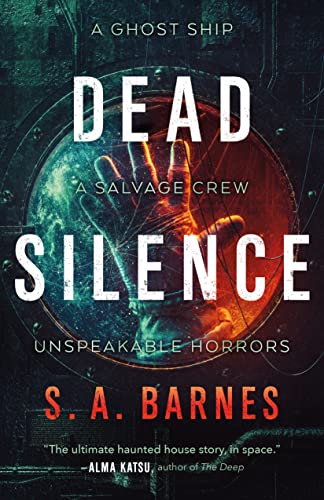
S.A. Barnes is the author of the terrific Dead Silence, out earlier this year. Monster Librarian reviewer David Simms had an opportunity to interview her this summer.
David: Dead Silence is space horror at its best. What was the inspiration for this novel?
S.A.: I’ve been obsessed with the Titanic for as long as I can remember. I pored over the photos from the wreckage when it was found. And I’ve visited several exhibitions of the artifacts that have been recovered. However, I am a big chicken and afraid of small spaces so you’d never get me in submersible to see it in real life. So I brought the wreck to space instead.
David: Claire is an interesting protagonist. Introvert and damaged. Why do you think flawed/broken characters work best for books in this genre?
S.A.: I prefer all stories to have a flawed/broken character because I find it more relatable! And I think it gives the character a clearer growth arc.
But I think it’s more prominent in horror because the stories often focus on the character’s flaws, specifically creating their worst nightmare. That’s what makes it horror, you know? I’m terrified of birds and small spaces, so forcing me to belly-crawl into a tunnel filled with flapping wings and scaly feet…I’m shuddering right now. But someone else who’s afraid of heights and spiders might not be bothered. It’s about confronting your own dark terrors in the process of growing as a character, I think.
David: The book has been referred to as The Shining meets Titanic. What’s your opinion on this?
Haha! That was actually part of my original pitch line for the manuscript, so I guess it must have been seen as accurate enough. I do hear that Aliens or Event Horizpn would have been closer, and both of those were certainly influences as well.
David: The Aurora is a memorable character in itself. Can you describe your process in writing this novel?
S.A.: Again, Titanic! I wanted to bring to life that contrast of wealth and gross inequity. I wanted the Aurora to be an object of desire, greed, even, but also for the eeriness to be the most prominent feature. Things are frozen in time, as if the Aurora herself is just waiting for new passengers to arrive. I wanted that feeling of bated breath, the haunted house that seems to react to your presence.
David: Since this is a horror novel at heart, are you a big fan of the genre? If so, what are your favorites?
S.A.: I love horror. I grew up reading Stephen King, Dean Koontz and V.C. Andrews. As far as favorites, I adored Strangers by Koontz, Flowers in the Attic by Andrews, and I’ve never been able to finish Pet Sematary by King because it scared me too much! More recently, I adored World War Z by Max Brooks, and anything by Mira Grant, particularly Into the Drowning Deep and the Newsflesh trilogy.
David: Dead Silence is chilling in its depiction of the supernatural. What’s your take on beliefs in the paranormal, supernatural (super-normal)?
S.A.: I’m sort of an open skeptic. I believe it’s all possible, particularly ghosts and extraterrestrial life. However, when presented with evidence, I’m more inclined to doubt first. Mainly, I think, because I don’t want to get my hopes up!
I’ve only had one supernatural experience in my life (a ghost turned a light on for me), and that was more than enough for me!
David: You’ve been successful in writing YA fiction. The Paper Dolls trilogy is great. Do you have a preference– adult, or writing for teens/children?
S.A.: Thank you! I love telling stories, for any audience! I think, however, teens and high school have changed enough from my own experiences—in mostly good ways—that I would have a harder time writing for that audience now in an authentic way.
David: Speaking of horror, you’re also a teacher. Thank you– this year has been full of horrors! How has that experience helped you cope with writing dark fiction– and vice versa?
S.A.: The two help me find balance. Writing is a very isolating profession, especially in the last few years! Going to school, working with students, helps me get out of my own head. Plus, helping a student connect with the right book for them is an amazing feeling. But, as you know, schools are not always easy place to work, especially for the last few years, so writing is a way of exerting control over my environment in a way that doesn’t exist otherwise. But mainly they—writing and school—make me feel like I’m contributing in two very different ways, and I love that.
David: Adding on to that last question: you tackle mental health in a strong, adroit manner. This is something that’s coming to the surface more and more in horror, but not science fiction. Any thoughts on this topic in fiction?
S.A.: I suspect we hope that mental health will be better addressed in coming years, which is why we don’t see it as much in science fiction, which is frequently set in the future. I’m thinking of Star Trek where poverty and world hunger have been solved by the 24th century. Which is wonderful and optimistic.
But I find I’m more drawn to stories with characters I relate to, especially when those stories are set in an unfamiliar environment, like space. And I think as long as people are people, we’re still going to struggle with the issues that come along with being human and imperfect. (Once we’re all uploaded consciousnesses on a computer, I make no guarantees!)
David: Deep space holds many terrors. What do you think is out there? (sorry– massive X-Files fan here!)
S.A.: The truth! (Sorry, also a massive X-Files fan!) In all seriousness, I’m fascinated by deep space. I think most of us have a tendency to forget that we’re on this rock, floating out in the middle of nowhere. And we’re one rock of billions. Who knows what we’ll find out there? I hope it will be friendly intelligence, but, as I believe, Stephen Hawking pointed out, anyone who can reach us is probably more advanced than we are and that usually doesn’t end well. Meanwhile we’re just blithely broadcasting our location for anyone—or anything—to hear.
David: What’s next for you?
S.A.: I’m working on another sci-fi horror novel! Set on an exo-planet this time.
David: Do you have any recommendations for your readers? Any favorite new authors or ones you think your readers would enjoy?
S.A.: Oh yes, I loved Dead Space and Salvation Day by Kali Wallace. Salvaged by Madeleine Roux is also excellent.
David: Why do you think space horror is such a draw for readers/film buffs? Do you have a favorite?
S.A.: I think it’s a draw because it projects a future in which space has become a relatively normal environment in which to work, suggesting a hopeful outcome, but also that human arrogance, frequently a flaw that comes into play in these stories, is still around. I also think space horror offers the same appeal science fiction does—the chance to learn about our society and its issues at a distance that allows discussion rather than immediate heated emotion.
![Blood Scion by [Deborah Falaye]](https://www.monsterlibrarian.com/TheCirculationDesk/wp-content/uploads/2022/06/IMG_20220514_215052_189.jpg)




Follow Us!