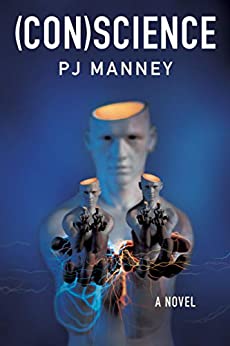
(CON)science: A Novel (Phoenix Horizon #3) by PJ Manney
47North, 2021
ISBN-13: 9781503948501
ISBN-10: 1503948501
Available: Paperback, Kindle edition, audiobook, audio CD, MP3 ( Bookshop.org | Amazon.com )
Note: this review contains spoilers for all three books in the series.
(CON)science is the third novel in PJ Manney’s Phoenix Horizon trilogy. Some trilogies by other authors can drag out plots that can be presented in one book, but Manney’s intricate, compelling story about a dystopian future, in which morality and ethics don’t keep pace with technology, requires multiple books.
In her first book (R)evolution, Manney introduces Peter Bernhardt, a driven, young Stanford graduate whose goal is to use breakthroughs in nanotechnology and computer science to cure brain disorders using computer implants that connect directly to brain cells by submicroscopic nanowires. Nanobots injected into blood vessels create the wires and also connect the rewired brain to other parts of the body. Peter creates a Silicon Valley start-up, but his venture capitalist insists that the nanobots be developed first and brought to market before the implants. Terrorists make aerosolized nanobots with Peter’s technology and kill thousands at a tech convention.
Another venture capitalist and former classmate, Carter Potsdam, helps Peter create a new company. An impatient Peter becomes the first cyborg. He has a miniaturized memory unit and neocortex implanted in himself and experiences the problems of accumulating and controlling every memory.
Carter initiates Peter into the Phoenix Club, a secret organization created by the Founding Fathers after the American Revolution. Members of the club include select politicians, businessmen, generals, scientists and other leaders who work to control and guide the country’s future. The Club planned the attack at the convention and plans to spread nanobots throughout the country to control the populace and maintain its power indefinitely.
Peter discovers the Club’s plans and sets out to stop them. He assumes a new persona, the cyborg Tom Paine, naming himself after the American revolutionary, and he and his friends infiltrate the Club’s secret compound, destroy missiles containing the nanobots and kill the Club’s leaders. Before Tom dies, his brain is uploaded into cyberspace and becomes the first fully autonomous, self-conscious, artificial human intelligence (AHI), known as Major Tom after David Bowie’s song. Major Tom exposes the secrets and plans of the Club to the public.
Manney’s second book (Id)entity describes the political disintegration of the United States after the Phoenix Club is exposed, and the struggle between a resurgent Club and groups like Major Tom’s that strive to stay independent. Most state governments have dissolved. Some large cities, like New York, Los Angeles, Chicago and San Francisco govern themselves loosely. Other groups form offshore or deep ocean, self-sustaining colonies called sea steads that use cryptocurrencies like bitcoin.
The AHI Major Tom used hidden servers in New Zealand and elsewhere to support his group of scientists, programmers, hackers, doctors and other followers. In a fatal mistake, Tom created AHIs of the two dead leaders of the Phoenix Club, Carver and Josiah Brandt, to converse with. Their AHIs escaped their confinement from Major Tom’s virtual Memory Place and reconstituted the Phoenix Club.
The Club reunited several southern states into the Southern States of America (SSA). The SSA revised history by destroying records and altering videos and other computer files to show Peter Bernhardt, Tom Paine and Major Tom causing death, destruction and chaos. Advanced nano and computer technology created insect-sized, video cameras for surveillance and contact lenses that changed what a person saw from real-life squalor to a virtual suburban bliss. The SSA used swarms of drones armed with lasers and machine guns and frenzied, brainwashed mobs to expand its territory.
Major Tom and the Phoenix Club’s AHIs needed physical bodies on the ground. Technology enabled both groups to create cyborgs out of robots originally designed as sexbots and the bodies of recently deceased humans. The robots and cyborgs could be in continuous contact with the AHIs.
An independent sea stead in the Pacific Ocean was mysteriously destroyed and the dark web’s superstar of false identities and Major Tom’s ally, Dr. Who, was kidnapped. The SSA lures the decommissioned destroyer Zumwalt with Major Tom’s cyborg and his top hacker and the hospital ship Savior into Port Everglades, Florida. Thousands gather at the port fleeing an SSA onslaught hoping for places on the ships. Armed SSA drones slaughter hundreds, but videos are altered to show Major Tom’s cyborg orchestrating the massacre. Most of the world now sees Major Tom’s group as the villains.
In book three (CON)science, the SSA creates multiple AHIs of Peter Bernhardt. Their memories are manipulated to accept the SSA’s version of history that the original human Peter Bernhardt, cyborg Tom Paine and AHI Major Tom overthrew the legitimate U.S. government and caused the chaos and death that followed. The SSA instructs its AHIs to create war games to simulate a doomsday attack against Major Tom’s group if it attacks the SSA.
The SSA chooses its most naïve and gullible AHI to make a trial run of its game. Unbeknownst to the AHI, actual attacks against major East and West Coast cities begin. Explosives planted by human infiltrators, soldiers and drones destroy infrastructure and kill thousands of people. At universities like Stanford, MIT, Caltech and the University. of Chicago, faculty and students are arrested or killed.
The Phoenix Club’s resurgence and victory are almost complete. Only a few of Major Tom’s team remain on the Zumwalt. They face monumental tasks: 1. convince others that the SSA’s version of history is false, 2. rescue captured team members, 3. protect persons fleeing from SSA massacres, 4. convince China to help or at least be neutral in the conflict, and 5. finally destroy the Club despite all of the humans, robots, cyborgs, AHI’ s and other resources it controls.
Many readers will find Manney’s novels interesting and relevant because they address contemporary problems. Autocrats and oligarchs can acquire political power and wealth by controlling the public’s access to information. Advances in computer science and the internet have made the influence of social media and control of news sources more effective. Given the rapid pace of breakthroughs in many scientific fields, the author’s nanobots, robots, cyborgs and AHI’s are not out-of-the-question in the near future.
Highly recommended
Contains: moderate gore, moderate graphic sex
Reviewed by Robert D. Yee






Follow Us!