Home » 2021 (Page 47)

Book Review: Jagged Edges & Moving Parts by Pete Mesling

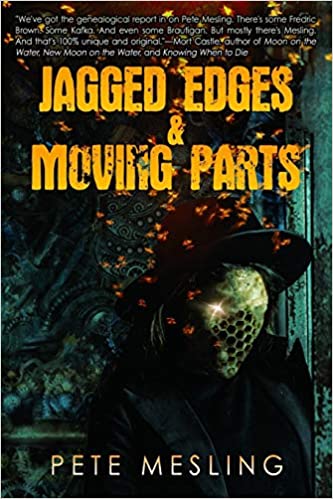
cover art for Jagged Edges & Moving Parts by Pete Mesling  ( Bookshop.orgAmazon.com )

Jagged Edges & Moving Parts by Pete Mesling

Other Kingdoms Publishing

ISBN :978-0-578-67738-5

Available: Paperback and Kindle edition


Jagged Edges & Moving Parts is a mega-collection featuring twenty-seven pieces, collecting both reprints and some new work by versatile author Pete Mesling. These include short stories of standard length, some micro-stories, and a few literary snapshots.

Horror fans will find a variety of subjects addressed by a talented writer able to disturb, entertain and entice the readers.

Commenting upon each single tale would be an impossible task, but among the huge amount of  material featured in the book, some stories are especially worth mentioning.

“The Things We Teach Our Young” is a solid piece where an Islamic truck driver giving a lift to a wounded hitchhiker turns out to be a terrorist on his way to performing an attack, while “A Pound of Flesh” is a vivid description of how a potentially romantic dinner ends up as an unexpected, painful nightmare.

The enticing “Not for All to See” revolves around a family curse featuring an inhuman creature who needs to be finally defeated, while the tell-tale titled “Crossing Lake Serene on a Dare” is a well-crafted story where a childish dare brings about dire consequences.

“Voices in the Crawl Space” will both terrify you and bewitch you with its load of malice and violence.

“In the Chillest Land”is a superb, tense tale portraying two men who, during a climbing expedition experience a terrible situation facing a dangerous, alien animal.

To me, the best piece in the collection is the outstanding “And a Little Child Shall Lead Them”, a very dark, creepy tale, conveying a sense of deep disquiet and dread and showcasing Mesling’s great ability as a storyteller. Recommended.


Contains: violence


Reviewed by Mario Guslandi


Book Review: The Best Horror of the Year, Volume 12, edited by Ellen Datlow

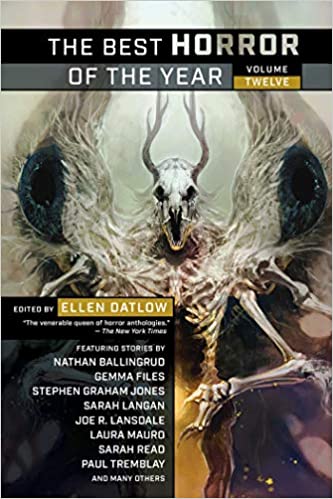
cover art for Best Horror of the Year, Volume 12 edited by Ellen Datlow   (   Bookshop.org | Amazon.com )

The Best Horror of the Year, Volume 12, edited by Ellen Datlow

Night Shade Books, 2020

ISBN: 9781597809733

Available: Paperback, Kindle edition


The Best Horror of the Year anthologizes short stories by a variety of writers, previously published during 2019, chosen by well-known editor Ellen Datlow. It is an almost even mix of excellent, decent, and forgettable stories: out of the 22 stories, seven are outstanding, seven are skippable, and the other eight are satisfactory, middle-of-the-road stories.

The majority of the stories are written from a first person point of view.  Of the stories written in the third person, many of them are written in the present tense.  This book is best suited for those who like variety, both in story ideas and writing style.  Readers who prefer third person narratives in the past tense may not find what they’re looking for, but everyone else will probably find something here to enjoy.  Let’s take a look at some of the best ones:

Scariest: “The Hope Chest” by Sarah Read and “The Puppet Motel” by Gemma Files are both winners that get genuinely creepy right towards the end.  The first one is a bizarre story of a dead grandmother returning (sort of) through a dress form.  The second is a wonderfully chilling story of a rental room that may have access to another dimension.  Like “The Hope Chest”, it piles on the scare factor at the end.  The best in the book for true fear is “My Name is Ellie” by Sam Rebelein.  It has the classic cabin in the woods, but this is beyond any other one you have read.  Little people, human sacrifices, body parts… they all contribute to the terror. This is the one to keep you awake at night when you hear the house creak.

Most Unusual: “I Say (I Say I Say)”  by Robert Shearman. Remember all the jokes you heard growing up concerning an Englishman, a Scotsman, and an Irishman?  This turns those joke personalities into actual people who live on a different plane of existence, and get summoned from time to time to perform the jokes we all know.   It’s not scary, but it’s very original, and very good.

Best Thrill Rides: “The Senior Girls Bayonet Drill Team” by Joe R. Lansdale and “The Butcher’s Table” by Nathan Ballingrud.  The first one makes a story out of the girls’ team’s bus ride to their next match, where the object is to kill the opposing team members with bayonets.  This is a nice portrayal of psychology where each game played may be the last, and puts a twist on the craziness of high school sports.  “The Butcher’s Table” is the longest story, and possibly the most overall fun.  Set in the 1800s, it concerns pirates escorting Satan worshippers across the Caribbean to the shores of Hell, where they plan to dine with Satan.  So silly that it’s great fun, and it’s nice to finally have a horror story with pirates, as they are a character type that is rarely used anymore.

Best Thriller and Chiller:  “Below” by Simon Bestwick.  This story about two young English lads who fall into a pseudo-town below the Earth’s crust brings out the claustrophobic feelings that films like The Descent tapped into so well.  The scare factor is there, but it’s also just flat-out exciting as the two boys race through the underground trying desperately to find an escape. This is possibly the most well-rounded story out of the collection.

The stories above probably make the book worth the price of admission, and there are still the eight perfectly reasonable stories not covered here to go with it.  It’s enough to overlook the seven stories that simply don’t cut it.  Editor Ellen Datlow also provides a detailed summary of the horror fiction genre and awards winners of 2019. The Best Horror of the Year, Volume 12 will be a good addition for most horror readers to add to their collection, and a good purchase for libraries wanting to keep current on the trends and authors at the top or rising to the top of the horror genre.


Contains:  violence, profanity


Reviewed by Murray Samuelson
Book Review: Writing in the Dark by Tim Waggoner

cover art for Writing in the Dark by Tim Waggoner

Writing In The Dark by Tim Waggoner

Guide Dog Books, 2020

ISBN-13 : 978-1947879195

Available: Hardcover, paperback, Kindle edition  ( Bookshop.org  |  Amazon.com )


To properly review this book, I believe a writer needs to be at the helm. New writing manuals crop up so often, it’s tough to decipher which are worthy additions to your collection.  I challenge any aspiring or accomplished writer to walk away from this book unaffected and without substantial improvement in how they view the world and their own writing. For those unfamiliar with prolific novelist Tim Waggoner, who seems to come out with a new book every few months, either in his own worlds or in the franchises of Supernatural, Alien, or Grimm, he is also well-known as a professor.

Waggoner tackles his topic in a hybrid manner. First, he rolls through all the requisite topics, providing a history of the tropes and story elements and explaining how they are utilized in classic and popular fiction. Second, he poses the same two questions to a bevy of writers, some new, some iconic. Their responses, sprinkled in at  every chapter, punctuate what he has covered. The exercises at the end are pragmatic and work to specifically improve the reader/writer’s own work. That Waggoner is is a teacher is evident here, but the book is not stuffy or academic. After just a few pages, it’s clear that most writers would love his approach. I felt as if I were sitting in a dive bar, discussing secrets of the universe with my feet up. Waggoner can take the toughest topic– from theme, to voice, to motivation and conflict– and talk someone through it as if reviewing his favorite new movie.

Each chapter is broken down into specifics. My favorites include: “Why Horror Matters”, “The Physiology of Fear” (the connection between psychology and biology through the rush of reading horror is fascinating), and “The Horror Hero’s Journey”, a take-off of Joseph Campbell’s famous work.

After each topic, Waggoner gives the writer a specific exercise that stretches the imagination, followed by the pair of questions tackled by writers from all levels and areas of the genre: 1. What makes good horror/dark fantasy/suspense? 2. What’s the best advice you can give to a beginning writer of horror/dark fantasy/suspense?

It continues the conversation and keeps the book from being a lecture.

The most useful part of this book for me were the appendices. The psychological makeup and “pain” makeup questionnaires for your characters can help dive deeper, as well as allow readers to analyze favorite novels. It’s a brutal exercise, but yields great results.

I was in the final edits of a novel that I believed to be solid. Waggoner’s advice suggested I dig deeper. I did and now the story feels so much more alive and relevant than I had believed it to be. I was also completing the final chapters of a middle-grade novel, and felt the same way.

This is a fine workbook for writers of all stripes, levels, genres, and interests.

Let the professor work his magic on you.

Highly recommended, right up there with King’s  On Writing.


Reviewed by David Simms