Home » 2021 (Page 4)

Book Review: The Things in Heaven and Earth by Michael Scott Hopkins

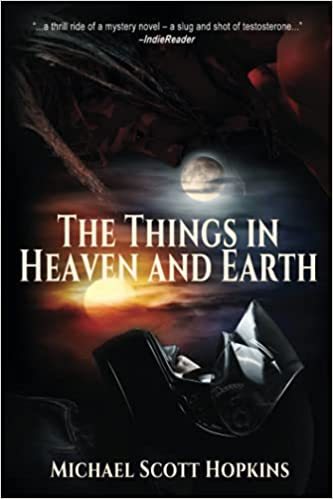
cover art for The Things in Heaven and Earth by Michael Scott Hopkins

The Things in Heaven and Earth by Michael Scott Hopkins

Black Rose Writing, 2021

ISBN: 9781684337118

Available: paperback, Kindle Bookshop.org |  Amazon.com )


The Things in Heaven and Earth is a good read the first time around, but it may take another read in order to understand all the details; some of the early chapters make a lot more sense the second time through.  That said, it’s still a good, imaginative take on the conflict between God and Satan (although those names aren’t really used) being played out through intermediaries on Earth.


Nash Baxter is a character with a convoluted life.  He shot and killed his family as a child, became a personal injury lawyer, then quit to become a paranormal hoax-buster and best-selling author, and somehow he is the repository of some of Satan’s life force.  If that isn’t enough, Nash can see real ghosts, and the demons that bind the ghosts to this plane of existence.  Sound complicated?  It is, both to the reader and to Nash.  When explanations are provided, Nash has an engaging habit of telling characters to give it to him in plain English, instead of using metaphysical jargon.  Some parts may still not make complete sense to the reader, but there’s enough to get the gist of it and follow the story.


As twisting as the plot is, it keeps you engaged through the uncertainty, to keep turning the pages to see where the story goes next.  Nash is a good leading man, and you’ll find it easy to relate to his down to earth manner.  He meets an assortment of odd companions along the way: his supposedly dead brother, a doctor who is granted mystical healing powers, real people with phantom personalities… quite the eclectic collection.   Somehow, the story holds all of them, and threads together nicely, keeping the interest level high.  The adversity faced by Nash and Co. is also unpredictable; a lightning bolt alone can provide three instant demon enemies for Nash and his friends.  The reader won’t be sure who the antagonists are in the story until close to the end; the author does a good job painting both sides in mystery.  Eventually, all becomes (mostly) clear, and the story wraps up nicely with a final confrontation between Nash and his enemies.


It’s a strange, convoluted tale, but it’s an entertaining one, although it might be a bit much for readers who like their fiction straightforward and easy to comprehend.  If you want a story that veers all over the basepaths yet somehow still crosses home plate in style, The Things in Heaven and Earth is for you.


Reviewed by Murray Samuelson
Book List: The Horror of Gentrification

When the topic of redevelopment comes up, affected residents need a seat at the table. If developers and city government aren’t interested in the needs and wants of the existing community, any “revitalizing” is for people who aren’t already there.  Gentrification has had the effect of displacing people and institutions that have been in the same neighborhood for decades and replacing their homes with higher-end residences they can’t afford, expensive office space, or shopping and restaurants, with far-reaching consequences. It affects Black, brown, and indigenous people the most, but, even when it’s well-intended, it’s ALWAYS about making money.


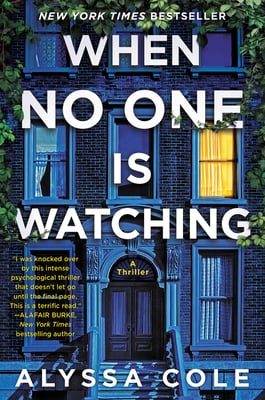
cover art for When No One Is Watching by Alyssa Cole

When No One Is Watching by Alyssa Cole Bookshop.org )


After leaving her abusive husband, Sydney returns home to her mother’s Brooklyn brownstone, in an area which is rapidly gentrifying before her eyes, with her neighbors disappearing mysteriously at a rapid rate as well-to-do white couples move in. As Sydney investigates the history of Brooklyn, she realizes there is a cycle that connects to disturbing events of the present.  When No One Was Watching gets into eugenics and medical experimentation and is grounded in some real historical events.


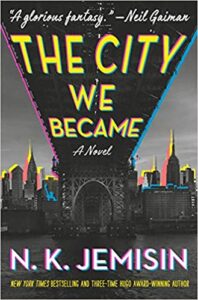
The City We Became by N.K. Jemisin

The City We Became by N.K. Jemisin Bookshop.org )


In Jemisin’s book, the follow-up to her story “The City Born Great”, every major city has a human avatar. New York City, however, is so large that each borough needs one. Enter the Better Way Foundation, a front for a potential eldritch invasion of Lovecraftian proportions, though The Better Way Foundation, represented by  Dr. White (I know…) This book has great LGBTQ+ representation, as well as indigenous, Black, brown, and Indian-American characters. Read our review here.


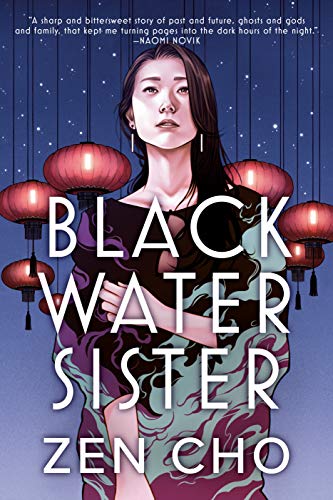
cover art for Black Water Sister by Zen Cho

Black Water Sister by Zen Cho  Bookshop.org | Amazon.com )


Gentrification is not limited to New York City. Black Water Sister takes place in Malaysia. Malaysian-American Jess was anxious about coming out of the closet. That’s small potatoes now that she is being haunted by her estranged, recently deceased grandmother, Ah Ma, who was a spirit medium for the goddess Black Water Sister and needs Jess to stop a developer from tearing down the vengeful goddess’ temple for a condo development.  I asked my daughter how she would feel about being possessed by a bossy grandmother obsessed with zoning (her grandmother is, in fact, obsessed with zoning), and the expression on her face was one of horror. And that’s not even the scariest part. Vengeance is bloody business. For my part, I thought Ah Ma’s interactions with Jess were really entertaining. You wouldn’t want to get on that lady’s bad side. Side note: a lot of the dialogue is written in Manglish, but I found it easy to follow and understand.


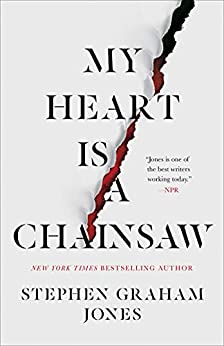
Cover art for My Heart is a Chainsaw by Stephen Graham Jones

My Heart Is a Chainsaw by Stephen Graham Jones Bookshop.org )


Gentrification occurs in rural and suburban communities as well as cities. In this love letter to the slasher movie, Jade Daniels, a troubled high-school of Blackfoot descent, uses her knowledge of horror movies and their tropes to navigate the town’s soon-to-be slasher story as wealthy gentrifiers begin building an exclusive enclave in her working class community.  As you would expect from a slasher-inspired story, this has plenty of blood and gore.


Gentrification’s effects aren’t limited to the living, either. How many haunted house stories depend on one building or neighborhood being built over the homes and lives of others? Here’s a link to a ghostly meditation on the effects of live people on ghosts who were simply haunting their own village.

.

Book Review: When Things Get Dark: Stories Inspired by Shirley Jackson edited by Ellen Datlow

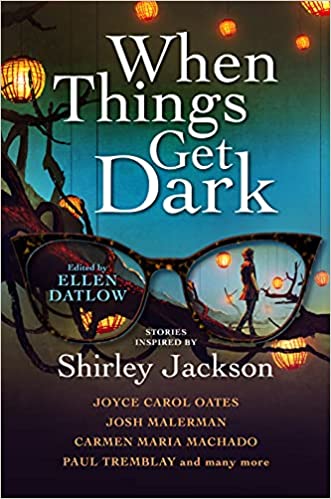
cover art for When Things Get Dark edited by Ellen Datlow

When Things Get Dark: Stories Inspired by Shirley Jackson edited by Ellen Datlow

Titan Books, 2021

ISBN-13 ‏ : ‎ 978-1789097153

Available: Hardcover, Kindle edition, audiobook Bookshop.org  | Amazon.com  )


Shirley Jackson couldn’t have known the impact her writing would have on the horror genre, speculative fiction, and literature in general: she was writing to pay the bills. Yet her work has resonated with readers and writers for both its depictions of domesticity, such as her fictionalized memoir, Life Among the Savages, and of the uncanny, seen in short stories like “The Lottery” and her most famous novels, The Haunting of Hill House and We Have Always Lived in the Castle (and sometimes both together). In When Things Get Dark, well-known anthology editor Ellen Datlow has collected tales by talented writers of horror, the uncanny, and the weird, inspired by Shirley Jackson’s work.


A number of stories take place within suburbia, with the uncanny just beneath a placid surface. Laird Barron’s “Tiptoe” focuses on uneasy family dynamics and the necessity of keeping up appearances, and “For Sale By Owner” by Elizabeth Hand, is a meandering story about three elderly women with a habit of breaking into empty summer houses who hold a sleepover in an empty, beautiful old house, which turns out to be a disorienting and disturbing experience. In Richard Kadrey’s “A Trip to Paris”, a nod to We Have Always Lived in the Castle, a recent widow planning her escape from her mundane life has her nefarious actions revealed by a stubborn, growing patch of mold on her wall, while Jeffrey Ford’s “The Door in the Fence” documents the strange and surprising changes in the narrator’s next door neighbor after her husband dies.


Some stories take direct inspiration from Jackson’s work, such as Carmen Maria Machado’s “A Hundred Miles and a Mile”, which references the “cup of stars” from The Haunting of Hill House, and stories such as “Quiet Dead Things” by Cassandra Khaw and “Hag” by Benjamin Percy that describe insular communities and their deadly rituals like the one in “The Lottery”.

With others, it’s sometimes hard to see the connection, although the stories are interesting. In Seanan McGuire’s dark fairytale “In the Deep Woods; The Light is Different There”, a woman escaping an abusive husband retreats to her family’s lake house, where she discovers the caretakers are not what they seem. John Langan produces a compelling, surreal tale of family, the occult, and mythological creatures in “Something Like Living Creatures”. In the dread-inducing “Money of the Dead”, Karen Heuler addresses the problems with resurrection and obsessive love; Joyce Carol Oates’ “Take Me, I Am Free” is a bleak, heartbreaking story about a child whose angry mother attempts to throw her away; in Josh Malerman’s dystopian “Special Meal”, a young girl discovers the difficulties, and consequences, of hiding knowledge. Genevieve Valentine’s “Sooner or Later, Your Wife Will Drive Home” is a cleverly constructed story about smart women in unlucky situations they can’t escape, something Jackson could certainly relate to. There were a few stories that didn’t hit the mark: “Funeral Birds” petered out at the end, “Refinery Road” and “The Party” left me confused, and “Pear of Anguish” didn’t seem to fit the theme or mood of the anthology.


While there are many excellent stories, the three that stood out to me were the previously mentioned “Tiptoe”; “Take Me, I Am Free”, a bleak, heartbreaking story about a child whose angry mother attempts to give her away; and Kelly Link’s “Skinder’s Veil”, a strange tale about a graduate student struggling with writing his dissertation who takes a housesitting job in rural Vermont, with the only rules being that anyone knocking at the back door must be invited in, but the front door should never be opened. Those who come to the back door are an unusual bunch, and the consequences of that summer are significant for him.


It’s not necessary to be a fan of Shirley Jackson to enjoy this book, but it does help, especially with Machado’s story, which depends on context from The Haunting of Hill House. If you do pick up When Things Get Dark without having read Jackson first, you will want to by the time you finish. Recommended.


Contains: self-harm, torture, suicide, murder


Reviewed by Kirsten Kowalewski