Home » 2021 (Page 35)

Book Review: The Science of Women in Horror: The Special Effects, Stunts, and True Stories Behind Your Favorite Fright Films by Meg Hafdahl and Kelly Florence

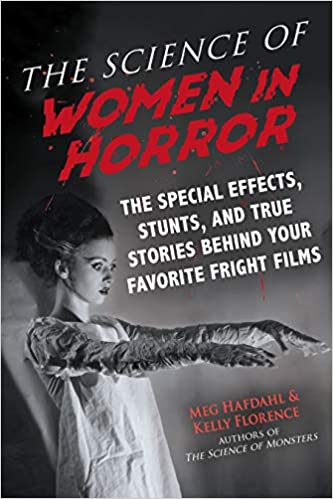
cover art for The Science of Women in Horror by Kelly Florence and Meg Hafdahl

The Science of Women in Horror: The Special Effects, Stunts, and True Stories Behind Your Favorite Fright Films by Meg Hafdahl and Kelly Florence

Skyhorse Publishing, 2020

ISBN-13: 9781510751743

Available: Paperback, Kindle edition  ( Bookshop.org)


The Science of Women in Horror explores theories behind women’s roles in horror. The book is broken down into ten sections, each containing well-researched film analyses and interviews with women working in the horror industry. Themes discussed are: the mother; the final girl; sex; revenge; innocence; the Gorgon; healer; and hysteria. The authors also include sections on films regarding women as “invaders” into masculine territory, women who kick ass, endnotes, and an index. All of the sections present fundamental and compelling analyses, but I will highlight some of the best sections in this review.


In “The Mother,” the authors took a closer look at Alice Lowe’s film Prevenge through the lens of mental health, revenge, and mothering; The Babadook and mothers who don’t form bonds with their children,  even murdering their own offspring; and the Bates Motel series regarding overbearing mothering. Included in this section are interviews with Alice Lowe regarding her film, and Dee Wallace on portraying mothers or caregivers in horror films.


“The Final Girl” section breaks down the history of the concept of the final girl and A Nightmare on Elm Street, with a portion of the chapter devoted to The Shining’s Wendy Torrance as final girl that could have been its own chapter. The first non-white final girl, from Tales from the Crypt: Demon Knight gets her own chapter in this section. The last chapter includes an analysis of the 2018 Halloween and the urban legends of babysitters in horror and how it is explored in horror films. The authors also discuss how Jamie Lee Curtis approached her role, in that Laurie never received treatment for PTSD, and how she addresses her mental illness in the future, as well as the concept of transgenerational trauma addressed in the movie. Interviews in “The Final Girl” include Jenna Kanell on physicality in her roles (she does her own stunt work) and Ashlee Blackwell, who started the incredibly informative Graveyard Shift Sisters blog and the documentary Horror Noire.


In the section regarding “Sex,” the authors explore Sleepaway Camp and representation of transgender characters, with interviews with Stacey Palmer regarding the representation of transgender women in horror films, and Alice Schroeder about being a trans woman working in theatre and portraying Frank N. Furter in Rocky Horror Picture Show. In the chapter about the film Teeth, purity culture, rape culture, and women frequently punished for indulging in sexual activity are presented. Finally, sexual assault and marital rape are looked at in Gerald’s Game.


“The Innocent” section takes a closer look at some of my favorite horror films. Themes include Let the Right One In and female innocence; Beetlejuice, and a great discussion of all things Lydia; and Whatever Happened to Baby Jane? in terms of trauma and extreme action.


“The Gorgon” introduced me to two new terms in the horror subgenre: psychobiddy and hagspoitation. Discussed in this section are Drag Me to Hell, The Visitation, and Friday the 13th. Included is an interview with Aislinn Clark about single or unmarried mothers in horror.


“Women in a Man’s World” focuses on the remake of Ghostbusters and the backlash that occurred even before the trailer was released; the influence that Scully from the X-Files had on the STEM field; and discussion of woman as monster in Ginger Snaps.


The Science of Women in Horror provides a great basis for discussion on horror and social sciences. I would recommend this for gender and/or film studies courses, as well as for the general horror reader who wants to gain a deeper understanding of films in their favorite genre. Highly recommended.


Reviewed by Lizzy Walker

Editor’s Note: The Science of Women in Horror: The Special Effects, Stunts, and True Stories Behind Your Favorite Fright Films is a nominee on the final ballot for the 2020 Bram Stoker Award for Superior Achievement in Nonfiction. 
Book Review: Miscreations: Gods, Monstrosities, and Other Horrors edited by Doug Murano and Michael Bailey

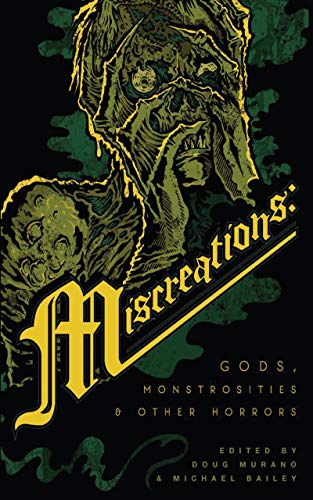
cover art for Miscreations edited by Doug Murano and Michael Bailey

Bookshop.org |  Amazon.com )

Miscreations: Gods, Monstrosities, and Other Horrors edited by Doug Murano and Michael Bailey

Written Backwards, 2020

ISBN-13 : 978-1732724464

Available: Hardcover, paperback, Kindle edition


In the foreword to Miscreations, Alma Katsu writes that “we’re told from childhood that monsters exist… we don’t need anyone to tell us they’re real”. Collected within the pages are 23 tales of monsters of all kinds, from the traditional to the unconventional, from the literary to the personal.  Interspersed is artwork from HagCult, who also did the cover art for the book.

Josh Malerman gives us a werewolf tale in “One Last Transformation” with an engaging, murderous narrator addicted to the change, and a number of writers approach the Frankenstein story in different ways. My favorites of these tales were Stephanie M. Wytovich’s poem “A Benediction of Corpses”  in which the Creature addresses his creator directly, and “Frankenstein’s Daughter”, by Theodora Goss, with its surprising and satisfying ending. Christina Sng takes an unconventional approach to an evil Russian water spirit in “Vodoyanoy”.

More personal monsters also appeared.  Michael Wehunt’s “A Heart Arrhythmia Creeping Into A Dark Room” was an effective and creepy tale about the anxiety and dread that accompany someone living in the shadow of a potential heart attack. The story was flawed by the author’s insertion of a fictionalized monster and victim in a story that was far too realistic. Victor Lavalle’s “Spectral Evidence” touched on the way grief lives on, and Scott Edelman’s “Only Bruises Are Permanent” tells the story of a woman who has the bruises left from an incident of domestic violence tattooed on her body.

Monstrous mothers also appear, in Joanna Parypinski’s brutal “Matryoshka”, in which a family tradition of giving each mother and daughter a matryoshka doll goes dramatically wrong, and Mercedes M. Yardley’s ironic “The Making of Asylum Ophelia”, in which a mother raises her daughter to resemble Hamlet’s Ophelia with plans to also replicate her fate.

Other strong stories I especially enjoyed include Nadia Bulkin’s “Operations Other Than War”, Usman T. Malik’s “Resurrection Points”,  Lisa Morton’s “Imperfect Clay”, and the disturbing “My Knowing Glance” by Lucy A. Snyder, which went in a much different direction than I expected it to.

Miscreations is overall a strong collection. The authors have come up with imaginative creatures using a variety of creative approaches, and readers will find sitting down with it well worth their time. Highly recommended.

Contains: murder, torture, violence, gore, body horror


Reviewed by Kirsten Kowalewski


Editor’s note: Miscreations: Gods, Monsters, and Other Horrors is a nominee on the final ballot for the 2020 Bram Stoker Award for Superior Achievement in an Anthology. 

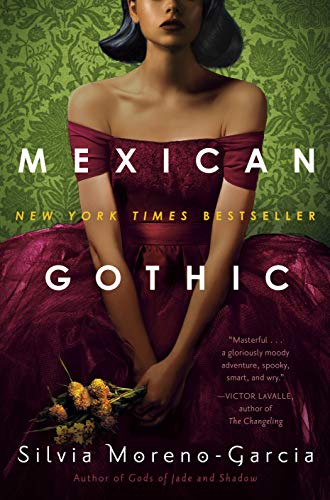
Book Review: Mexican Gothic by Silvia Moreno-Garcia

(  Bookshop.orgAmazon.com )

Mexican Gothic by Silvia Moreno-Garcia

Del Rey, 2020

ISBN: 9780525620785

Available: Hardcover, Paperback, Audiobook, Kindle


In 1950’s Mexico, Noemi, a flirtatious, intelligent fashionista, decides her cousin Catalina has been out of touch for too long.  When Noemi receives a disturbing letter from Catalina suggesting that she might want to escape from her new marriage, Noemi packs her gorgeous wardrobe and heads to isolated High Place, the ancestral home of the English Doyles, to investigate.

Ever the realist, skeptical of her cousin’s fairytale princess notions about marriage, Noemi immediately distrusts her suave brother-in-law. She soon realizes that he is evil, and so is his menacing house that has wallpaper “slippery, like a strained muscle” and walls like “sickly organs” with “veins and arteries clogged with secret excesses.” Something is not right at High Place, and Noemi starts to feel its curse invading her mind and body, slowly but surely, just as it has infected her cousin.

What begins as a poetic, gothic fairytale, becomes a wild blend of fantasy, horror, and science-fiction in Mexican Gothic by Silvia Moreno-Garcia. The Doyle men and women have preserved their family line by choosing between “fit and unfit people.” The men wield their power by practicing eugenics through a weird and totally terrifying combination of sexual abuse, drugs, intimidation, and psychological control. The house has an actual heartbeat that is pulsing with mold, fungus and rot, and the creepy family patriarch, an ugly man full of secrets and disgusting tumors, sores, and black bile, is directing and insuring the family’s future from his deathbed. Murders have occurred at High Place, and strange epidemics have killed droves of workers in the family’s silver mine. Once Noemi has the facts, she knows she must fight and use her wits  to survive and save the people she cares about before the evil overcomes them and traps them in a living hell forever.

Although the book seems set in a period later than the 50’s in terms Noemi’s language and sensibility, it still is, in more than one sense, a horror story that reflects the historically violent subjugation of women used as breeders in families and cultures obsessed with lineage and legacy. Religion, status, and seclusion frequently became barriers to freedom for these women by preventing them from making choices about the direction of their own lives. The women of Mexican Gothic cope with horrible suffering and mirror the superhuman strength it took for real women to endure, and sometimes find rare opportunities to escape, the nightmarish situations forced on their gender. Highly Recommended.

Contains: gore, sexual situations, profanity, incest, body horror


Reviewed by Nova Hadley

Editor’s note: Mexican Gothic is a nominee on the final ballot for the 2020 Bram Stoker Award for Superior Achievement in a Novel.