Home » 2021 (Page 16)

Book Review: Other Worlds: Peasants, Pilgrims, Spirits, Saints by Teffi, edited by Robert Chandler, translated by Robert Chandler and Elizabeth Chandler

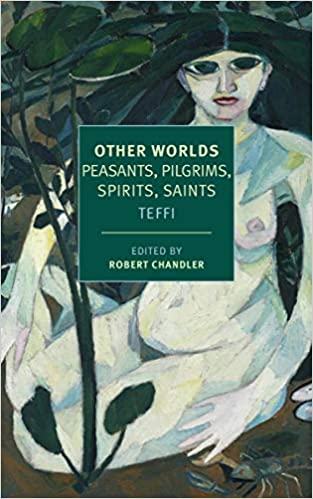
cover art for Other Worlds: Peasants, Pilgrims, Spirits, Saints by Teffi

Other Worlds: Peasants, Pilgrims, Spirits, Saints by Teffi, translated by Robert Chandler and Elizabeth Chandler

New York Review Book Classics 2021

ISBN 978-1681375397

Available: Paperback, Kindle Bookshop.orgAmazon.com )


Nadezhda Lokhvitskaya (1872-1952), known as Teffi, wrote distinctively Russian short stories drawing on her culture and its folklore and legends. These intriguing stories demonstrate Teffi’s ability to show how the supernatural coexists with the commonplace in the lives of ordinary country folk struggling to deal with the deprivation, superstition, dangers, and evils of their place and time.


Teffi’s characters are people who have seen it all and expect the unexplainable to happen. They are deeply spiritual but not necessarily religious. They have an eerie insight into the ways that supernatural good and evil touch human life. They are also preternaturally aware of the strange and frightening signs that tell them certain human beings are not what they seem and that unusual incidents are not random and harmless but are warnings, and even evidence, of hazards that must be confronted or at least recognized. Teffi’s characters do not live in a relatively stable world that is knocked out of shape by horror; they live in the midst of it – so much so, that its existence is chillingly normalized.


The stories in this collection, except for the first few, are built around characters and settings that feel sinister and menacing. In “Shapeshifter,” a doctor is thought to be “some sort of were-creature” whose “big stone house” was the site where a girl had previously been confined alive in a wall, and ten banknote forgers had been suffocated in the cellar to keep them from being found by the authorities. A woman experiencing a “Wild Evening” takes shelter at an old monastery that local children’s nannies use as a threat to keep their little charges in line.


In “Witch,” a couple struggles to be free of a servant who is said to have secured her job indefinitely by ritually burning scraps of paper and “blowing smoke” up the chimney. A priest’s vampire child threatens people’s safety in “Vurdalak,” and the “House Spirit” is up to its traditional tricks that might have to be taken as a serious warning against evil this time. In “Leshachikha” we hear “a kind of story that simply doesn’t happen anymore” about a widowed count with a “hard, yellowish nail of extraordinary length” who has a “malevolent” daughter with very odd ways. Several other tales focus on traditional Russian characters and their familiar stories:  the house spirit, the water spirit, the bathhouse devil, the rusalka, and shapeshifters of all sorts, including those in the form of dogs, cats, and “she-wolves” (who are actually women who have been confined for far too long by controlling husbands). Even the famous Baba Yaga makes an appearance.


The Foreword, Afterward, and additional notes on Russian names and translation methods are helpful to readers who are unfamiliar with Russian folklore and tradition. However, some of the translation choices, such as mirroring period dialect in English, are distracting and negatively affect the mood and tone of the stories. Nevertheless, this collection is a blast from the Russian past that suggests, in an unsettling way, that perhaps these old stories are the best, because they come closer to revealing the often discounted darker truths of life we dismiss as old fashioned ways of perceiving reality. Recommended.


Reviewed by Nova Hadley
Book Review: Ember of Night by Molly E. Lee

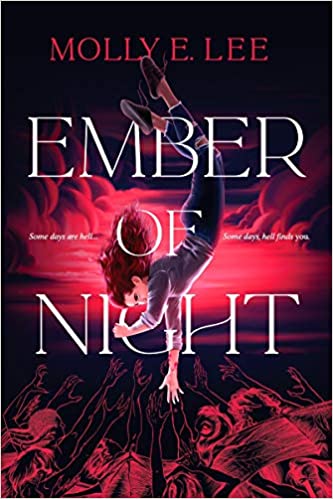
cover art for Ember of Night by Molly E. Lee

Ember of Night by Molly E. Lee

Entangled Teen, 2021

ISBN-13 ‏ : ‎ 978-1649370310

Available: Hardcover, Kindle edition Bookshop.org |   Amazon.com )

Harley is just about to turn eighteen and escape her abusive father with her younger sister Ray when Draven comes into her life. There’s a chemistry between them she can’t deny, but her life is already full between work and taking care of Ray, and she doesn’t have time for a guy in her life. Her best friend, Kai, warns her against Draven, but Harley doesn’t like being told what to do, and when Kai goes out of town, she discovers that she’s developing a friendship with Draven, who has also befriended Ray.  Unfortunately, the day she turns eighteen, demons attack her while she’s with Draven, and they have to fight them off.  Harley learns she’s not quite human– there’s something special about her blood– and Draven is watching her to see what she becomes. Despite anger, fear, and mistrust poisoning the situation, Harley and Draven are drawn to each other magnetically as they work to solve the mystery of who is behind the attacks, and what exactly Harley is.

Harley is a strongly-drawn character with intense emotions, unafraid to face anyone who challenges her, who has a force of personality that pulls the reader along. The chemistry between her and Draven is powerful. The way she sees herself and others is distorted, though: Ray is pure and must be protected, while Harley is a monster who deserves to be in pain. Author Lee uses vivid imagery to describe demons and villains and create atmosphere.

The physical abuse, trauma, and betrayal Harley endures during this story is difficult to read, more so than any of the attacks by supernatural elements. Although the story doesn’t quite make sense in places, Ember of Night is a compelling read that ratchets up the suspense and sensuality to the very last page and leaves you impatiently waiting for the sequel.


Contains: emotional and physical abuse, violence, gore, suicidal thoughts, sexual content.


Book Review: Ash House by Angharad Walker, illustrations by Corey Brickley

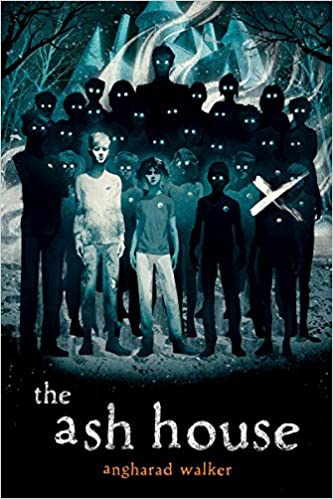
The Ash House by Angharad Walker

The Ash House by Angharad Walker, illustrations by Corey Brickely

Chicken House, 2021

ISBN:  978-1338636314

Available: Hardcover, audiobook, kindle


A chilling and impressive debut.


Angharad Walker’s debut novel The Ash House is a strong middle grade horror tale about a group of abandoned children. Stranded at an unusual orphanage, the residents seem to have internalized the strict moralistic ideology of their captors. With newly dubbed names like Freedom and Wisdom, each child acts within prescribed roles and duties to maintain upkeep of the property. They watch recordings instead of attending school and have limited memories of the world outside the smoky mansion. Ash House’s residents complete their chores with single-mindedness and nearly religious obsession, performing “nicenesses” and avoiding “nastiness.” This creates a rigid framework against which the newcomer, renamed Solitude (nicknamed Sol) rebels. As Sol questions the mindset, he also discovers alliances, potential dangers, and the secrets of the house. When the much-feared, cruel Doctor reappears to “help” Sol, the revelations are slow, winding like ivy up a manor, and the payoffs are worth the patience. Brickley’s bleak black and white illustrations and smoke-swirled chapter headings offer exquisite visuals to Walker’s foreboding, atmospheric descriptions.


Abandoned children, a missing headmaster, an arrogant and brutal doctor conducting torturous medical experiments, monitored by bird-like drones, hunted by strange beasts in the woods: Ash House is not for the faint of heart, but this immersive world and carefully crafted plot provides a steady study of how friendship, trust, and cooperation clashes with hyper-rule orientation and authoritarianism.  Readers who enjoyed Ransom Riggs’ Miss Peregrine’s Home for Peculiar Children or who are ready to step into a more speculative world than Snicket’s Series of Unfortunate Events or Golding’s 1954 Lord of the Flies will find much to enjoy in The Ash House. Recommended for ages 8-12.


Contains violence, medical torture.


Reviewed by E.F. Schraeder