Home » Posts tagged "collection development"

Book Review: Why I Love Horror: Essays on Horror Literature edited by Becky Siegel Spratford

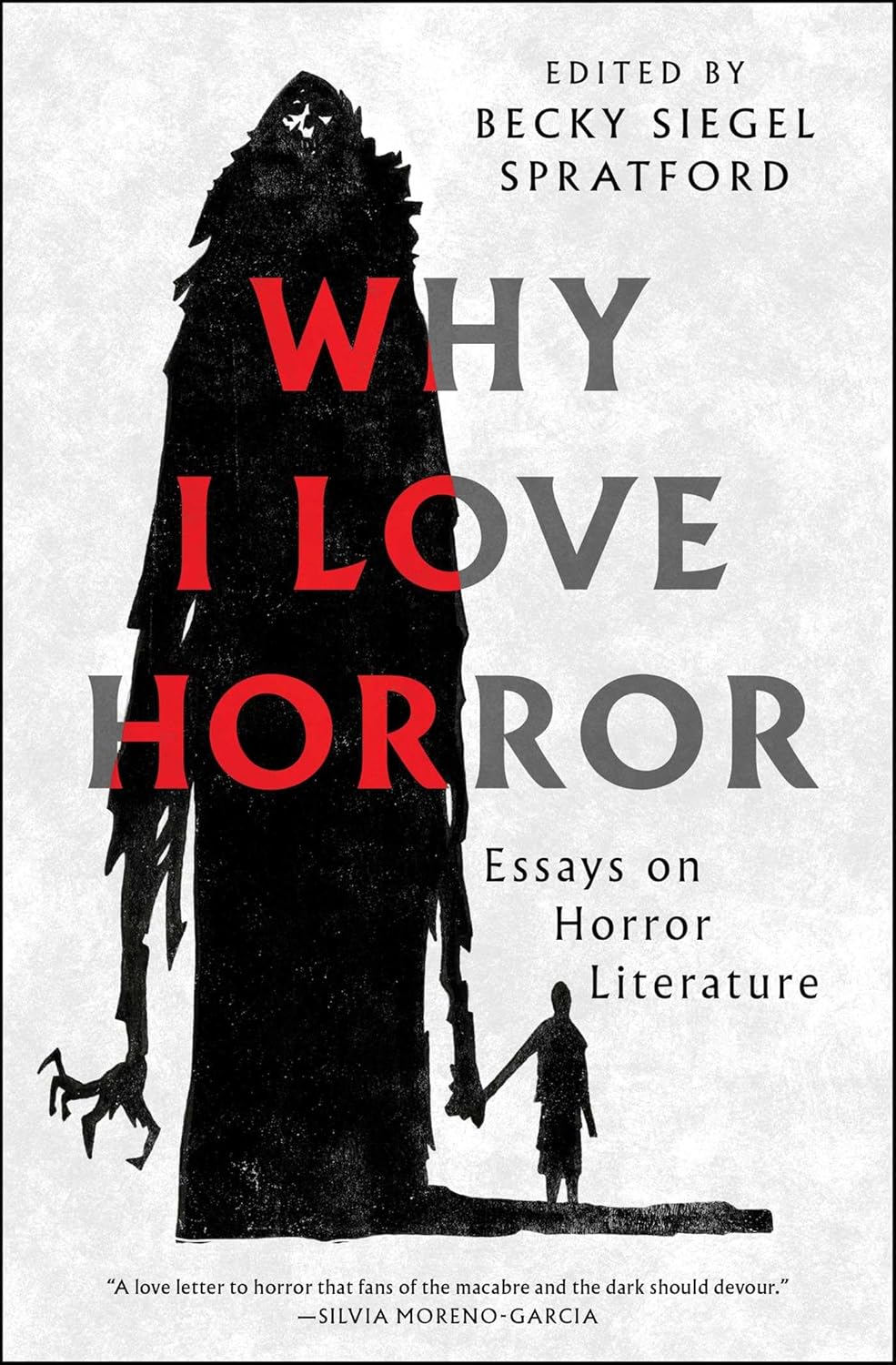
Cover art for Why I Love Horror edited by Becky Siegel Spratford

Why I Love Horror: Essays on Horror Literature edited by Becky Siegel Spratford

Saga Press, 2025

ISBN-13: 9781668205099

Available: Paperback, Kindle edition, audiobook, audio CD

Buy: Bookshop.org |  Amazon.com


Librarian Becky Siegel Spratford presents eighteen essays by current horror authors on why they love horror. The collection begins with a welcome to the reader by Sadie Hartman, followed by Spratford’s own essay, “Why Ask Why,” where she tells her story about how she found herself working with horror and curating this book full of talented horror writers. Before each essay, Spratford includes an introduction to the authors, a book recommendation to start with from their works, and a recommendation of an author in a similar vein.


My experience reading this was like opening a door to different times in my life where horror made significant appearances, despite having never really left me. Childhood memories and horror are foundational for some in this community. In “Brian Keene’s Giant-Size Man-Thing,” the author discusses his introduction to horror through comics and how horror helped him cope with dread and fear. John Langan writes of his childhood fascination with cryptids in “In the Bermuda Triangle with Sasquatch, Flesh Smoldering.” Jennifer McMahon’s “Monster Girl: How Horror Gave Me a Place to Belong” hit particularly close to home in terms of feeling out of place, being the weird girl who liked horror, and experiencing struggles at home. “My Mother Was Margaret White” by Cynthia Pelayo discusses abuse she experienced at home and at school, never feeling safe anywhere. Horror saved us both. “Permission to Scream” by Rachel Harrison and and “Tales From My Crypt” by Mary SanGiovanni specifically focus on girlhood and horror, both also speaking to similar experiences for me.


Horror providing comfort or a safe space is another thread that ties these essays together. Hailey Piper describes, in “The Giant Footprint of Horror”, how Godzilla introduced her to horror, and that there is joy in this dreadful genre. “My Long Road to Horror”, by Tananarive Due, describes horror as feeling. She writes a short but powerful history of her family and their personal horrors of racism and struggle.


Authors remind the reader that horror is more than a genre, it is an entire community. Alma Katsu’s “What You Can Learn from Horror: Don’t Run from Darkness; It’s Trying to Teach You a Lesson”, presents an essay questioning why people shy away from horror. A true crime writer I had a conversation with during my undergrad found it fascinating that there is a line in the sand between what his audience will and will not read: that line is fictional horror. Katsu states “I’m here to argue against running away from darkness,” (52) and provides personal information regarding past employment with government agencies as an intelligence analyst. Gabino Iglesias, in “Horror is Life: A Blood-soaked Love Letter,” discusses his life in Puerto Rico and discovering horror, which turns into a moving statement on how horror changed his life. In “A Day in My Psychedelic World,” Nuzo Onoh, dubbed the Queen of African Horror, reminds us there is horror for everybody.


There are so many great essays in this book. Other authors who contribute are Josh Malerman, Paul Tremblay, whose piece is accompanied by his daughter Emma, Grady Hendrix, Clay McLeod Chapman, Victor LaValle, David Demchuk, and Stephen Graham Jones. This would make a great addition to a general library collection, as well as essential reading for a course on horror. Highly recommended.


Reviewed by Lizzy Walker
Book Review: The Best Horror of the Year, Volume 12, edited by Ellen Datlow

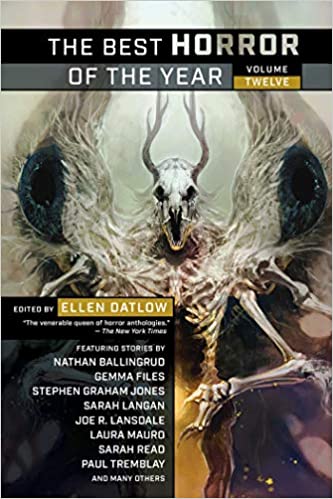
cover art for Best Horror of the Year, Volume 12 edited by Ellen Datlow   (   Bookshop.org | Amazon.com )

The Best Horror of the Year, Volume 12, edited by Ellen Datlow

Night Shade Books, 2020

ISBN: 9781597809733

Available: Paperback, Kindle edition


The Best Horror of the Year anthologizes short stories by a variety of writers, previously published during 2019, chosen by well-known editor Ellen Datlow. It is an almost even mix of excellent, decent, and forgettable stories: out of the 22 stories, seven are outstanding, seven are skippable, and the other eight are satisfactory, middle-of-the-road stories.

The majority of the stories are written from a first person point of view.  Of the stories written in the third person, many of them are written in the present tense.  This book is best suited for those who like variety, both in story ideas and writing style.  Readers who prefer third person narratives in the past tense may not find what they’re looking for, but everyone else will probably find something here to enjoy.  Let’s take a look at some of the best ones:

Scariest: “The Hope Chest” by Sarah Read and “The Puppet Motel” by Gemma Files are both winners that get genuinely creepy right towards the end.  The first one is a bizarre story of a dead grandmother returning (sort of) through a dress form.  The second is a wonderfully chilling story of a rental room that may have access to another dimension.  Like “The Hope Chest”, it piles on the scare factor at the end.  The best in the book for true fear is “My Name is Ellie” by Sam Rebelein.  It has the classic cabin in the woods, but this is beyond any other one you have read.  Little people, human sacrifices, body parts… they all contribute to the terror. This is the one to keep you awake at night when you hear the house creak.

Most Unusual: “I Say (I Say I Say)”  by Robert Shearman. Remember all the jokes you heard growing up concerning an Englishman, a Scotsman, and an Irishman?  This turns those joke personalities into actual people who live on a different plane of existence, and get summoned from time to time to perform the jokes we all know.   It’s not scary, but it’s very original, and very good.

Best Thrill Rides: “The Senior Girls Bayonet Drill Team” by Joe R. Lansdale and “The Butcher’s Table” by Nathan Ballingrud.  The first one makes a story out of the girls’ team’s bus ride to their next match, where the object is to kill the opposing team members with bayonets.  This is a nice portrayal of psychology where each game played may be the last, and puts a twist on the craziness of high school sports.  “The Butcher’s Table” is the longest story, and possibly the most overall fun.  Set in the 1800s, it concerns pirates escorting Satan worshippers across the Caribbean to the shores of Hell, where they plan to dine with Satan.  So silly that it’s great fun, and it’s nice to finally have a horror story with pirates, as they are a character type that is rarely used anymore.

Best Thriller and Chiller:  “Below” by Simon Bestwick.  This story about two young English lads who fall into a pseudo-town below the Earth’s crust brings out the claustrophobic feelings that films like The Descent tapped into so well.  The scare factor is there, but it’s also just flat-out exciting as the two boys race through the underground trying desperately to find an escape. This is possibly the most well-rounded story out of the collection.

The stories above probably make the book worth the price of admission, and there are still the eight perfectly reasonable stories not covered here to go with it.  It’s enough to overlook the seven stories that simply don’t cut it.  Editor Ellen Datlow also provides a detailed summary of the horror fiction genre and awards winners of 2019. The Best Horror of the Year, Volume 12 will be a good addition for most horror readers to add to their collection, and a good purchase for libraries wanting to keep current on the trends and authors at the top or rising to the top of the horror genre.


Contains:  violence, profanity


Reviewed by Murray Samuelson

15 Years of Monster Librarian

It is hard to believe we’ve been doing this for fifteen years now. My husband Dylan, the original Monster Librarian, posted the first reviews on January 1, 2006, just three months (and a couple of days) after our first child was born, because what better time to take on a gigantic project than when you have a newborn.

He founded Monster Librarian because at the time, he was working an internship at a branch of the Indianapolis Public Library as part of completing his master’s degree in library science, and he found that the librarians there didn’t know anything about the horror genre past Stephen King and had no interest in putting in the effort to learn more about it. At the time, much of the horror fiction available was also being published only by small presses not listed in the databases of major wholesalers like Baker & Taylor, Follett, and Ingram. It required a commitment for librarians to seek out publishers and order individual titles, and the books could be expensive ( I was working as an elementary school library media specialist at the time, and Baker & Taylor provided a 40% discount. That’s a big deal for a small budget). As a longtime horror reader who started building his collection as a teenager by haunting his local used book store, the indifference the librarians had to the horror genre was something her felt he needed to do something about.

At the same time, I was working with elementary kids who were asking me for scary books while sitting on an awards committee for my state library association’s children’s choice award. The way that was supposed to work was that we read all nominated books, then met to choose a representative sample of 20 books that would cover all genres. The genre I had to fight for was horror. It went beyond indifference– some committee members actively disliked it. I had done research into reading engagement while working on my MLS and one thing Dylan and I both agreed on was how important it was to hook kids and teens with what researcher Stephen Krashen calls “home run books”. So many kids and teens get hooked through scary stories and horror that he felt it was important to reach librarians and advocate for the horror genre for readers. This was his passion and he posted reviews even after he became ill and through five years of painful migraines and chronic, life-imparing pain, until just before he died in 2014. I think he’d be delighted to see all the positive changes that have occurred in the horror genre and in librarians’ attitudes and knowledge of the horror genre and scary stories for kids since the site was founded in 2006.

I love seeing the diversity growing in the genre. There is still plenty of room for growth, but wow, things have changed a lot, and mostly for the better. I think Dylan would love to see it.

I would like to make sure we are providing useful information to you. Monster Librarian is an all-volunteer effort and I need to make sure we are at least covering our hosting costs and postage. That costs about $200  every year and we almost didn’t make it this year. Without your support, either through purchasing items through Monster Librarian’s store at Bookshop.org or contributing through Paypal, we will struggle to continue our work, and after this long at running the site, I’m not sure what I would do without it! Thanks for visiting, and I hope you’ll be back again soon!