Home » Posts tagged "YA horror" (Page 3)

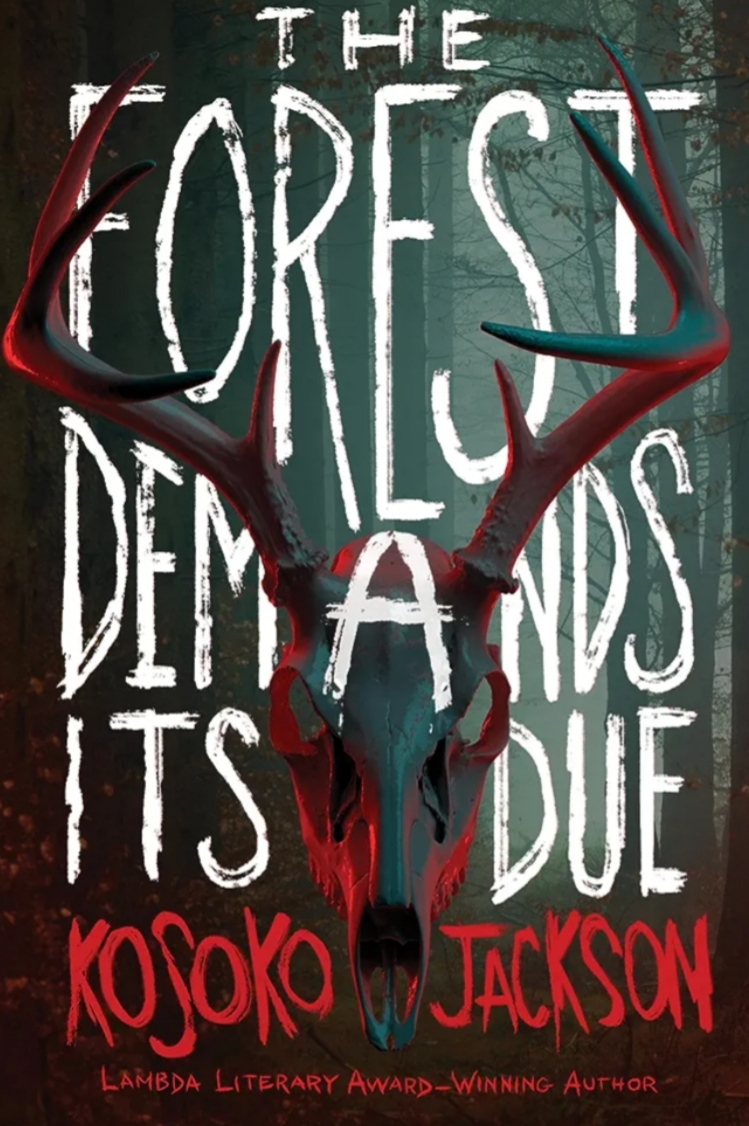
Book Review: The Forest Demands Its Due by Kosoko Jackson

The Forest Demands Its Due by Kosoko Jackson

Quill Tree Books, 2023

ISBN-13: ‎978-0063260795

Available: Hardcover, Kindle edition, audiobook, audio CD

Buy:  Bookshop.org  |  Amazon.com


I have enjoyed Kosoko Jackson’s previous YA books, the dystopian Survive the Dome and the time travel novel Yesterday is History, both with Black queer boys as protagonists. The Forest Demands Its Due once again changes genre, to a combination of dark academia and folk horror.


Douglas Jones was arrested for arson and manslaughter when a lawyer offered her services pro bono if he would agree to attend an elite boarding school in an isolated area of Vermont. The school is bordered by a forest that students are warned away from as there have been many who disappeared into them never to be seen again.


As the only Black queer boy attending Regent School, Douglas is a target for bullies. He also hears loud, disturbing voices he can’t  turn off that he is certain come from the forest. Just the first few pages and Jackson had me deep in his story.


Early in the book a bully drags Douglas into the forest and is killed. Everett Everley, a member of the Everley family charged with protecting students, bargains with the Emissary, a vengeful creature of the god of the forest, to save himself and Douglas. Douglas learns that whenever there is a suspicious death the headmaster “erases” the existence of the person from everyone’s memories, so no one is aware of how many students and teachers have been lost to the forest.


There is a curse on the forest, nearby town of Winslow, and the five founding families of the town preventing them from leaving because they participated in the burning of Henry, the forest god’s lover, generations ago. His grief and anger have caused the death and anguish of many students and locals.  Everett and the headmaster are both descendants of the founding families. Everett helps Douglas investigate the history of Winslow, the school, and the forest, and after some awkward misunderstandings they start to develop a romantic relationship. The headmaster convinces Douglas to enter the forest  in hopes that he can find the gate to the forest god’s retreat and break the curse. Everett goes with Douglas to protect him. The forest is nightmarish, twisty and changeable and they easily get lost, then attacked by Emissaries and their grotesque servants, called Perversions. When they find the gate, Douglas goes through to try to convince the god to let go of his grief and anger and release the forest and town from their curse. As the god dies, he transfers his powers to Douglas, tying him to the forest and freeing Everett.


This was a very emotional story with a lot of darkness and trauma. The two boys have had very heavy responsibilities set on their shoulders and see and experience things no one should have to. They witness the aftermath of a suicide and there is a fair amount of gore and body horror (the Perversions are a grotesque combination of human and animal parts) Jackson’s writing is descriptive and atmospheric, although it’s a little slow in places, and he has created an immersive experience of the dark fantastic.


Jackson frequently addresses the injustice and inequality of institutions such as the legal system and education, and that is evident here. I love that he puts power for change in the hands of someone marginalized, who has only ever felt powerless. Recommended.


Reviewed by Kirsten Kowalewski
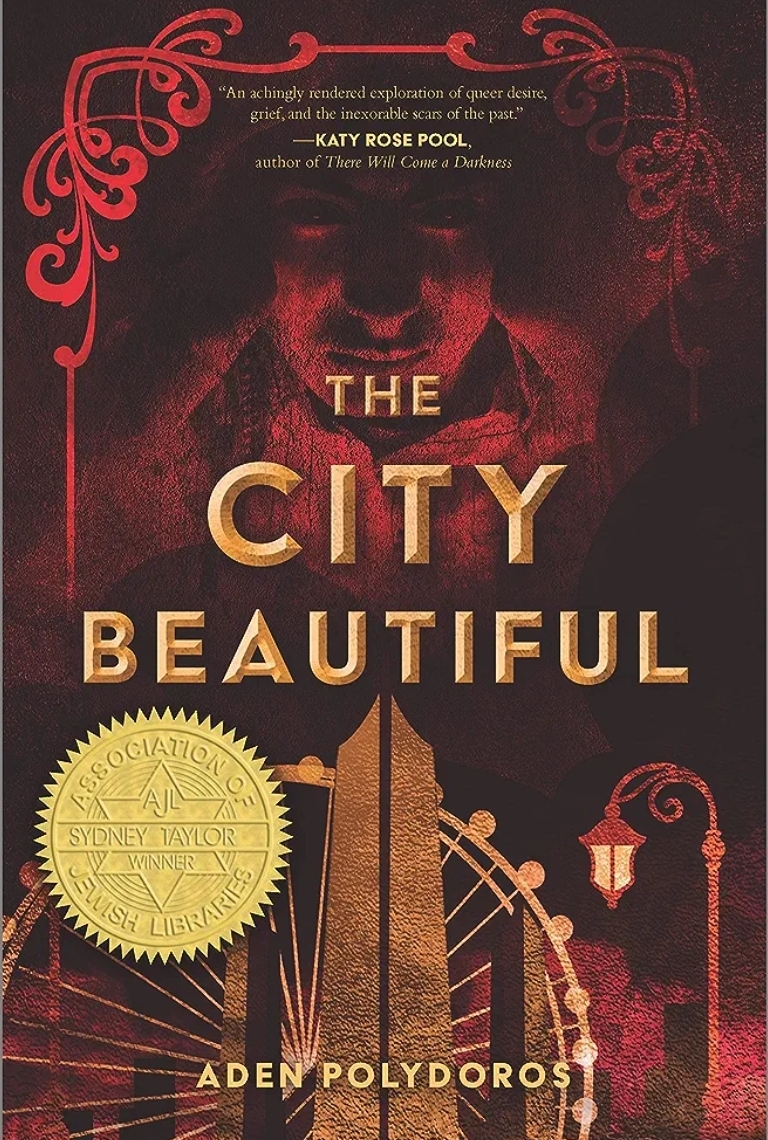
Book Review: The City Beautiful by Aden Polydoros

The City Beautiful by Aden Polydoros

Inkyard Press, 2021

ISBN-13: ‎978-1335402509

Available: Hardcover, paperback, Kindle edition, audiobook

Buy;   Bookshop.org  |  Amazon.com


Wow. Polydoros set out to write a work of historical fantasy about Jews and Judaism not set during the Holocaust, and was inspired by an article about H.H. Holmes to set his story among Jewish immigrants from Eastern Europe during the 1893 Chicago World’s Fair.


Alter, the main character, was ill as a baby and named to avoid the notice of the Angel of Death, but people around him frequently die. Alter is also gay, but in denial and ashamed. He is in love with his roommate Yakov, who leaves to meet someone and is found drowned the next day, the most recent of several Jewish boys who are dead or missing.


Alter, a member of the burial society, is helping immerse Yakov in the mikveh when he thinks he sees Yakov move, and jumps in the mikveh to pull the body out. Instead, he is possessed by Yakov’s dybbuk (a dybbuk is a malicious spirit, usually the dislocated soul of a dead person with unfinished business). Alter’s only choices to save his own soul are either0 to exorcise the dybbuk or to find Yakov’s killer and exact revenge. Luckily, he has the help of Raizel, a unionist working for an anarchist newspaper (the local matchmaker keeps trying to hook them up), and Frankie, an ambitious Russian Jewish teenage criminal and boxer who heads a gang of thieves.


This is such a layered, detailed story, both in the integration of the various aspects of Jewish culture and the Eastern European immigrant experience, and the vividness of the Chicago and World’s Fair setting. In addition, it really reveals the viciousness of antisemitism in this country and how it also traveled from overseas. I think people don’t really think about how insidious and common it was. It’s truly a Jewish horror story, and there aren’t too many of those around. I’m so impressed with the research and writing on some very difficult-to-address topics.


The City Beautiful won the 2022 Sydney Taylor Award and was a finalist for the 2022 World Fantasy Award for Best Novel, the 2021 Lambda Literary Award, the 2021 National Jewish Book Award, and the preliminary ballot for the Bram Stoker Award for Toung Adult Novels. The attention is well-deserved.


Reviewed by Kirsten Kowalewski

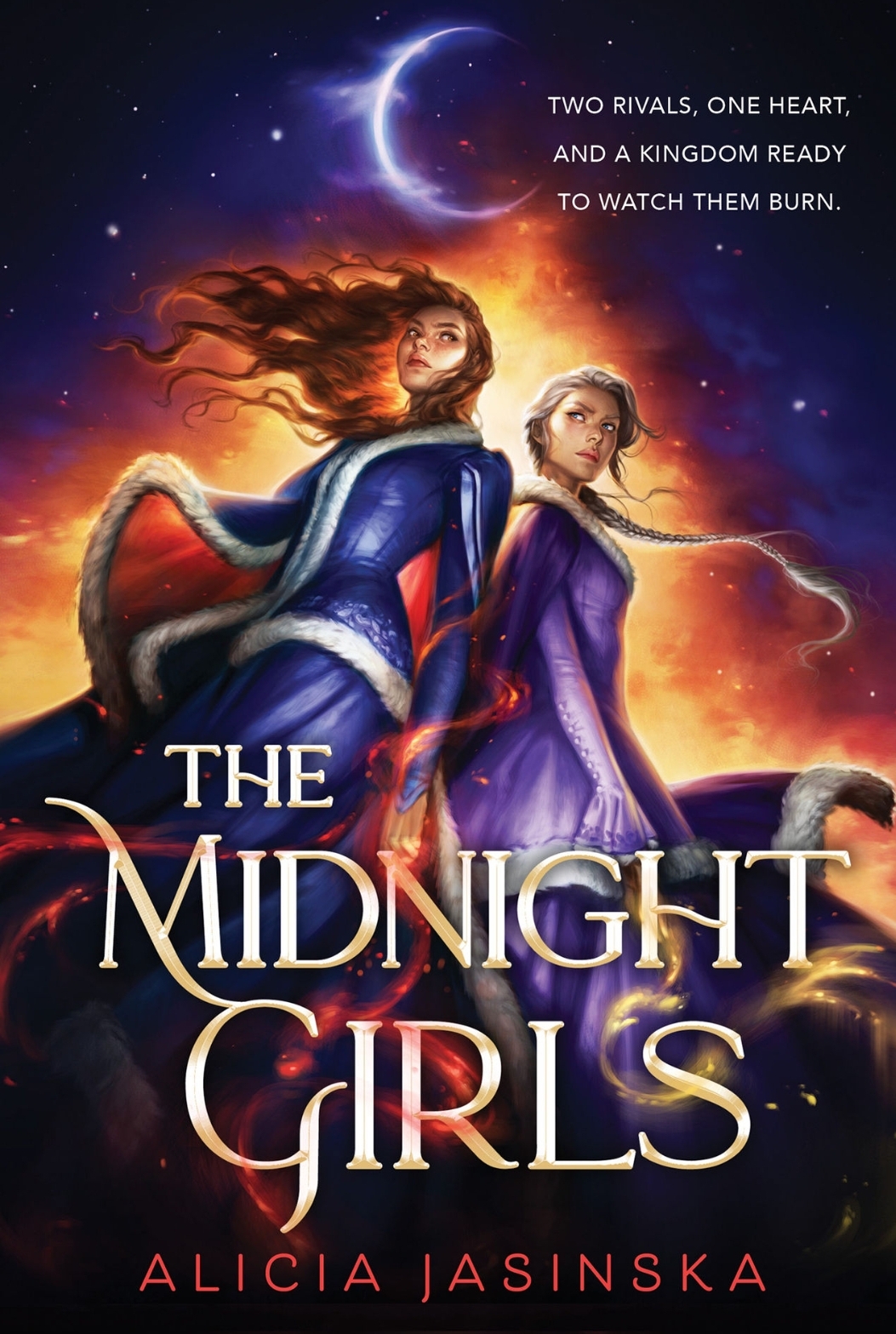
Book Review: The Midnight Girls by Alicia Jasinska

The Midnight Girls by Alicia Jasinska

Sourcebooks Fire, 2022

ISBN-13: 978-1728209753

Available: Hardcover, paperback, audiobook, Kindle edition.

Buy:   Bookshop.org   |  Amazon.com


The Midnight Girls takes place in a fantasy kingdom based on the Kingdom of Poland at the end of the 18th century, which was torn apart by wars with Russia, Lithuania, and Poland.


Three sister witches terrorize the forest, each with a servant girl who desperately wants to please them. Black Jaga’s servant is Zosia, with the power of Midnight. Red Jaga’s servant is Marynka, with the power of Midday. White Jaga’s servant is Beata, with the power of Morning. The girls compete to seize the hearts of princes for their witches. Zosia, hidden away, is most successful. Marynka is desperately in competition with her as she is punished when she fails and receives affection when she succeeds. Beata quietly claims the spoils while Marynka is distracted. The descriptions of the servant girls’ powers and especially of their literally ripping hearts out of people”s bodies were really hard for me to read.


All three girls are sent to the city during Karnaval season to claim the pure heart of Prince Josef, a source of powerful magic when eaten. In their competition, Marynka and Zosia inadvertantly keep saving the prince in order to gain the opportunity to claim his heart. It would be funny but it is deadly serious. In spite of their antipathy, they develop a close connection. Zosia plans to run away after taking this last heart and asks Marynka to come with her.


Prince Josef wants his kingdom to rebel and fight the tsarina of Rusja in order to preserve Lechija’s national identity and freedom from its oppressors, while the king is tired of fighting and willing to make concessions. His life is complicated by the return to court of Kajetan, his closest friend, who supported his family and turned against him on the battlefield. Both Zosia and Marynka and Josef and Kajetan harbor strong and contradictory feelings for one another. Josef and Kajetan’s story had unexplored potential. Marynka and Zosia feel more like they are characters from a folktale, and as one would expect in a folktale, are relatively one-dimensional. Their rivalry and romance are the primary focus of the story, so the political situation Josef and Kajetan were navigating, while intriguing, didn’t get much attention. The Midnight Girls has a similar feel in places to Katherine Arden’s.The Bear and the Nightingale, but that book balances these elements better.


This was a clever premise with great world building, and it wasn’t an easy book to read. Regardless of their home environment or your investment in the story, these girls really are monsters. They don’t try to justify their actions. It is really something that Jasinska has humanized them.


Reviewed by Kirsten Kowalewski