Home » Posts tagged "weird fiction"

Book Review: Observer by Nicholas Russell

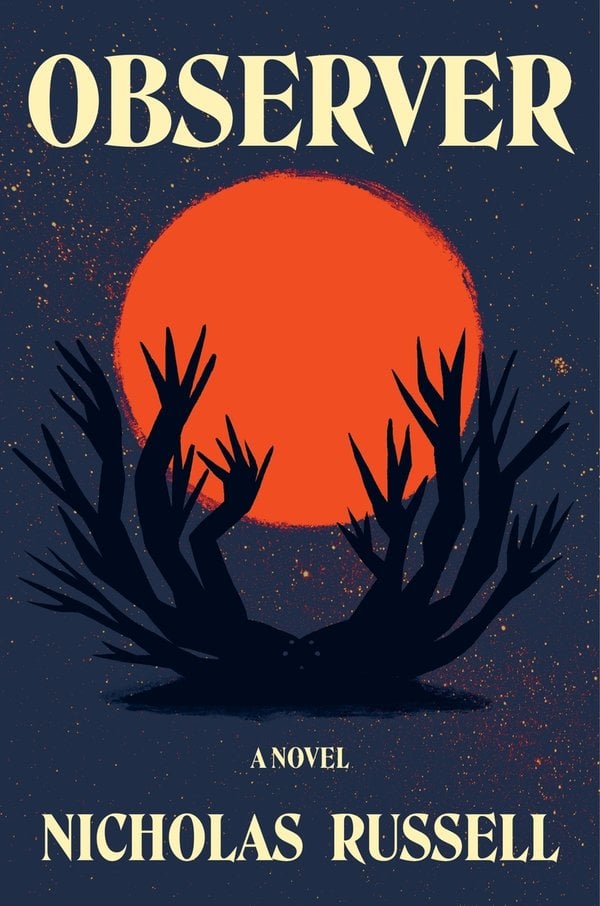
Observer bookcover

Observer by Nicholas Russell

HarperCollins, 2026 (pre-order)

ISBN-13: 978-0063452398

Available: Hardcover, Audiobook, Kindle, MP3CD

Buy: Bookshop.org


A threatening landscape, the arrival of all of a mother’s worldly goods without explanation, and the mysterious world of a suddenly closed Nevada observatory, set the stage for this debut novel.


Observeropens in a canyon where signs of life are vanishing as the inanimate remnants anticipate the return of a “flying creature” that might be responsible and is now lying in wait to end “you.” From this strange start, the story quickly transitions to Renata and the two family members with whom she lives. Renata struggles to find out about the mother she barely knew, a woman who seems to have chosen a career in science over having a daughter, and quickly realizes that the desert her mother studied is not the empty place one might imagine. Their past and current interactions and how they are now responding to what they assume is the death of Renata’s mother, Corinne, are complicated and suggest that each person has unrevealed and unresolved feelings about their family and about Corinne.


As Renata reads from a journal about her mother’s work in the desert, she is fascinated by connections to a diary written in the early twentieth century by a surveyor whose notes have similarities to those written by her mother. This propels Renata into a journey through what becomes, simultaneously, a dream-memory landscape and a desert death-nightmare. Time and human contact seem less real and the hidden life of the desert more real.


Nicholas Russell’s writing is infused with mystery and is, at times, phantasmagoric– which corresponds to Renata’s experience of her mother as a type of mirage. This image contrasts the experiences of the surveyor with her mother’s scientific account while casting doubt on the science. Francis Brown’s diary records how he “witnessed visitations” and “experienced them.” He did not view them as “encounters with the devil” but “failures of the rational mind to comprehend its surroundings with any reliability or discernment.” Brown concludes, “We imagine monsters” but “what frightens me is not their existence, but our fatal sensory impotence.”


While Brown opines a human lack of awareness, Russell recognizes where horror comes from and draws us slowly to it, all the while making us wonder when it will rear its supernatural head. This promising novelist’s work conjures a Western Gothic feel through prose that sketches the recognizable yet odd characters and delineates the menacing setting in that disquieting way you can’t quite put your finger on. What will Russell do next? Whatever it is, hopefully it’s soon!


Reviewed by Nova Hadley

Book Review: The Eris Ridge Trail by Larry Hinkle


Cover art for The Eris Ridge Trail by Larry Hinkle

The Eris Ridge Trail, by Larry Hinkle

Four Winds Bar Publishing, 2025

ISBN: 9798992454215

Available: Paperback, Kindle edition

Buy: Bookshop.orgAmazon.com


The trail in The Eris Ridge Trail is not a friendly one for thru-hikers!  Instead of the serenity of nature, the four unfortunates who end up on the trail find themselves in a confusing alternate dimension with frequent landscape shifts.  The setting shifts frequently, with little explanation for the hazards encountered by the characters.  Does it work for this story?  Yes.  Readers who want entertainment and aren’t concerned with a story where all ends are tied up neatly will find this quite enjoyable.


The book wastes no time getting down to business, as Wayne, Shelley, Craig, and Erik each get a quick chapter that tosses them right into the other dimension.  This is also the only part of the book that feels like it could have used a bit more fleshing out, to lead into the main story.  Two of the characters simply give a quick recounting of their arrival to their companions later in the book, while the other two protagonists get a very quick narration chapter.  It would have been nice to make all the lead-in to the main plot part of the third person narrative, as it sounded very intriguing.  There’s a car ride with a very odd individual, and a tunnel crawl through the basement of the Stanley Hotel (yes, THAT Stanley Hotel) but little detail is given.  That might have helped build up some anticipation for the main story, which only Shelley’s opening chapter did.


That minor quibble aside, the story takes off at a run, as the four of them (and two lovable dogs) find that their new home almost is like an LSD-laced dream.  One minute they can be in a desert, take five steps and PRESTO!, they’re in a desert.  A bit further, and SHAZAM!, it’s a prairie.  It could be confusing, but the author writes well enough that the transitions don’t seem jarring or random:: they flow with the story and are believable.


Although this is an adventure story, the real core of the story is the character interactions.  Craig, Shelley, Erik, and Wayne are four strangers tossed into a reality that makes no sense, but they have to survive and maybe find a way out.  That requires teamwork and trust, which develops over the course of the story, and is done very well.  The author clearly has a flair for writing characters, and he does an excellent job having them overcome their foibles and gel together into a cohesive unit.  Their new reality throws all sorts of fun stuff at them: weird skittering sort-of humans, six-legged freak squirrels called Squixells, and DINOSAURS!  (can’t go wrong with those!)  It’s all well-imagined and written in a style that keeps the reader turning pages quickly.  Sure, there is little to no explanation given for why or how these things happen, but who cares?  Much like the classic novel Picnic at Hanging Rock, The Eris Ridge Trail works better leaving explanations to the reader’s imagination.  The ending is excellent.  It doesn’t resolve things, but does wrap the story up perfectly.


Bottom line: take a hike along the unique Eris Ridge Trail, it’s a brain-tweaking journey.  Recommended.


Reviewed by Murray Samuelson


Book Review: Fourteen Days edited by Margaret Atwood and Douglas Preston

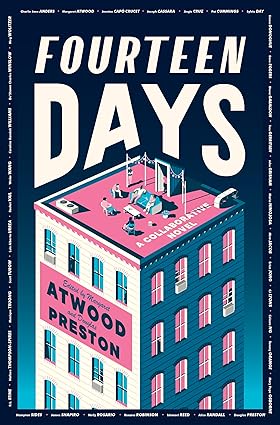
Fourteen Days edited by Margaret Atwood and Douglas Preston

HarperCollins, 2024

ISBN-13 ‏ : ‎ 978-0358616382

Available: Hardcover, paperback, audiobook, Kindle edition

Buy:   Bookshop.org  |  Amazon.com 


Fourteen Days is a collaborative novel written by thirty-six American and Canadian authors, benefiting the Authors Guild Foundation. It takes place during the Covid-19 pandemic in a dilapidated apartment building during fourteen days under a shelter-in-place edict in New York City. Yessenia, the new super, is stuck in the building without the resources to do her job and unable to get through to the nursing home where her father is a resident. The previous super left his things behind, including a journal with notes about and a nickname for each tenant.


Unable to stand staying isolated inside, the residents start gathering on the rooftop each evening to tell stories, each night over the course of fourteen days. Yessenia never refers to them by name, only their nickname, and she secretly starts to record the stories on her phone and transcribe them into the super’s journal.


The structure of people isolating themselves to tell stories during a plague reminded me of  The Decameron but the editors specifically say it is not… and one of the stories, told by a professor who attended a book group that read from it, acts as a critique that suggests that this is actually a counter narrative, including people from different ages, belief systems, backgrounds, and races: the people who, unlike the characters of The Decameron, don’t have the wealth to escape the city as the plague rages.


At first the book seems grounded in realism: maybe it’s not something likely to occur, but it seems possible, with events that did occur, like the inability to get through to nursing homes, and unlike many stories set during the pandemic, here it is integral to the story. But unexplained events start to occur. Is the building haunted? Did a spider girl really interrupt their gathering? What’s the noise in the apartment above the super’s?


The stories also get weirder, more confessional, and gruesome, such as the story of Elijah Vick, who lost his arm to an alligator gar, and a story of retribution against a rapist. Other readers may guess the ending sooner than I did, but it managed to surprise me.


Fourteen Days does not have many contributions from horror writers, but it does have many “literary” authors contribute strange, unsettling, and disturbing tales, including Dave Eggers, Tommy Orange, and Margaret Atwood. It is a haunted novel, and worth the time to untangle.


Reviewed by Kirsten Kowalewski