Home » Posts tagged "short story collections" (Page 5)

Book Review: Other Worlds: Peasants, Pilgrims, Spirits, Saints by Teffi, edited by Robert Chandler, translated by Robert Chandler and Elizabeth Chandler

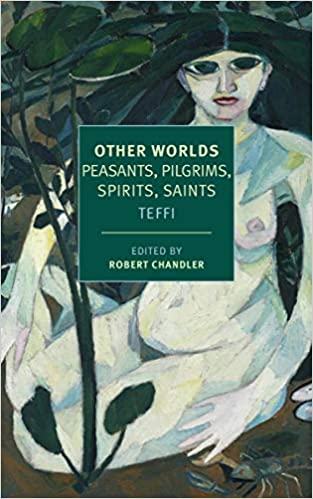
cover art for Other Worlds: Peasants, Pilgrims, Spirits, Saints by Teffi

Other Worlds: Peasants, Pilgrims, Spirits, Saints by Teffi, translated by Robert Chandler and Elizabeth Chandler

New York Review Book Classics 2021

ISBN 978-1681375397

Available: Paperback, Kindle Bookshop.orgAmazon.com )


Nadezhda Lokhvitskaya (1872-1952), known as Teffi, wrote distinctively Russian short stories drawing on her culture and its folklore and legends. These intriguing stories demonstrate Teffi’s ability to show how the supernatural coexists with the commonplace in the lives of ordinary country folk struggling to deal with the deprivation, superstition, dangers, and evils of their place and time.


Teffi’s characters are people who have seen it all and expect the unexplainable to happen. They are deeply spiritual but not necessarily religious. They have an eerie insight into the ways that supernatural good and evil touch human life. They are also preternaturally aware of the strange and frightening signs that tell them certain human beings are not what they seem and that unusual incidents are not random and harmless but are warnings, and even evidence, of hazards that must be confronted or at least recognized. Teffi’s characters do not live in a relatively stable world that is knocked out of shape by horror; they live in the midst of it – so much so, that its existence is chillingly normalized.


The stories in this collection, except for the first few, are built around characters and settings that feel sinister and menacing. In “Shapeshifter,” a doctor is thought to be “some sort of were-creature” whose “big stone house” was the site where a girl had previously been confined alive in a wall, and ten banknote forgers had been suffocated in the cellar to keep them from being found by the authorities. A woman experiencing a “Wild Evening” takes shelter at an old monastery that local children’s nannies use as a threat to keep their little charges in line.


In “Witch,” a couple struggles to be free of a servant who is said to have secured her job indefinitely by ritually burning scraps of paper and “blowing smoke” up the chimney. A priest’s vampire child threatens people’s safety in “Vurdalak,” and the “House Spirit” is up to its traditional tricks that might have to be taken as a serious warning against evil this time. In “Leshachikha” we hear “a kind of story that simply doesn’t happen anymore” about a widowed count with a “hard, yellowish nail of extraordinary length” who has a “malevolent” daughter with very odd ways. Several other tales focus on traditional Russian characters and their familiar stories:  the house spirit, the water spirit, the bathhouse devil, the rusalka, and shapeshifters of all sorts, including those in the form of dogs, cats, and “she-wolves” (who are actually women who have been confined for far too long by controlling husbands). Even the famous Baba Yaga makes an appearance.


The Foreword, Afterward, and additional notes on Russian names and translation methods are helpful to readers who are unfamiliar with Russian folklore and tradition. However, some of the translation choices, such as mirroring period dialect in English, are distracting and negatively affect the mood and tone of the stories. Nevertheless, this collection is a blast from the Russian past that suggests, in an unsettling way, that perhaps these old stories are the best, because they come closer to revealing the often discounted darker truths of life we dismiss as old fashioned ways of perceiving reality. Recommended.


Reviewed by Nova Hadley
Book Review: The Fatal Move and Other Stories by Conall Cearnach

cover art for The Fatal Move and Other Stories by Conall Cearnach

The Fatal Move and Other Stories by Conall Cearnach

Swan River Press, 2021 (reprint, originally published in 1924)

ISBN: 978-1-78380-037-7

Available: Hardcover  Swan River Press )


Reprinted for the first time in nearly one hundred years, The Fatal Move is a slim collection of six ghostly tales penned by Conall Cearnach (the pseudonym of F.W. O’Connell, a peculiar and versatile Irish clergyman and scholar).


Thus, lovers of ghost and supernatural stories have the opportunity to get a taste of a different author rather than keep reading the classic works of the usual suspects.


The title story, “The Fatal Move” effectively portrays two bachelor friends, both passionate chess players, in love with the same woman. In a final chess game, an ingenious trick bound to bring death to one of the players will select the survivor(and winner of the woman’s heart).


The excellent “The  Fiend That Walks Behind” describes the obsession of a psychiatrist whose fame has usurped that of the real author of a scientific discovery, and becomes the object of a paranormal haunting and vengeance.


“The Homing Bone”,  a traditional type of ghost story– featuring an anatomist stealing a femur from a grave site– is  so well-told it entices the reader despite its predictable outcome, while “Professor Danvers’ Disappearance” is an intriguing, clever mystery, with a supernatural veneer.


The volume is enhanced by a number of quite enjoyable short essays by the author, addressing topics such as dreams, sleeplessness, nervous children, and the power of languages, plus an Irish alternative view of Dante’s Divina Commedia, “ The Vision of Merlino”.  The book is prefaced by an exhaustive, learned introduction by Reggie Chamberlain-King. “F.W. O’Connell: Master of Strange Tongues”.


A delightful change from the usual stuff published nowadays.


Reviewed by Mario Guslandi

Book Review: Night Terrors and Other Stories by Lisa Morton

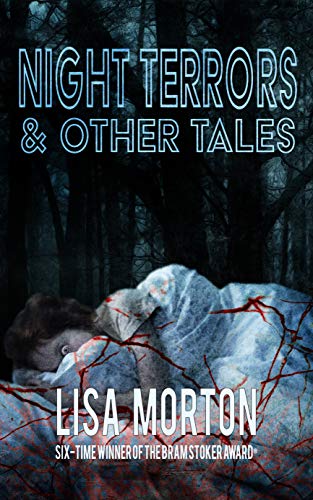
cover art for Night Terrors and Other Stories by Lisa Morton

Night Terrors and Other Tales by Lisa Morton

Omnium Gatherum, 2020

ISBN-13 : 978-1949054286

Available: Paperback, Kindle Bookshop.org |  Amazon.com )


Night Terrors and Other Tales collects twenty of Lisa Morton’s short stories selected by the author. There are so many great stories in this anthology. Morton has separated the sections titled “Monsters,” “The Psych Ward,” “Mad Science,” “Bad Magic,” “and “The Unnamable”.


Several tales stand out in each section. From the “Monsters” section, “Joe and Abel in the Field of Rest” presents a unique take on the zombie story. Joe knows loss all too well. He has spent his last few years killing zombies and burying them in a large pit he calls the Field of Rest. One day while he is out near the field, he finds a walker still alive in the pit. The creature doesn’t move to attack Joe, so they become friends of sorts, with Joe feeding him and spending time out at the pit. Another human, Hansen, comes onto Joe’s property, and it is only a matter of time before the human and walker meet. Will Joe and Abel’s friendship survive? Another story, “Sparks Fly Upward” tells of a woman who has to confront the fact that in the Colony, there are limited resources and her second child cannot be born. Doc Freeman has deemed it so. The dead return to spots that meant something to them in their lives. Unfortunately, as she and her escorts arrive at the family planning facility, they find a group of undead pro-life protestors in their way.


“The Psych Ward” is the next section of the book. In “The New War,” Mike hates the caretaker Maria in the nursing home. He insists she brings something dark in with her whenever she’s around. Mike’s daughter, Angela, doesn’t believe him. No one believes him. Then, the black thing and where it’s from becomes clear.


“Mad Science” contains some deeply disturbing tales. In “The Resurrection Policy,” a wealthy man defaults on his payments to his insurance company. He discovers this after he dies, and his essence is saved in a folder on a server somewhere. After talking with the insurance agent handling his claim, he is finally resurrected into a body that does not meet quality control. He finds that navigating in this new form is more difficult than he ever could have imagined. “Feel the Noise” reveals a new weapon that has the capability to scramble the body’s senses, mixing them up, driving the victim crazy. Jackson Howard was a private in the military when he was hit by this weapon. It takes an outside party and a point in the right direction to get his vengeance on the person responsible for his condition.


One of the best stories in “Bad Magic” is “Erasure.” Linda visits her husband’s grave every day, despite the fact he was a terrible person. She meets a young woman in the cemetery who offers Linda a chance to forget.


“The Unnamable” is the final section in Night Terrors. In “The Secret Engravings”, set in 1523, Death comes to Hans Holbein with a commission. The entity is so pleased with Holbein’s work that he is commissioned for a second time, which proves to be all too real. “Night Terrors” involved a worldwide pandemic that begins with someone screaming in their sleep. Soon, the night terrors take over the world, one by one.


Morton, a well-deserved six-time winner of the Bram Stoker Award, selected some incredibly effective stories in this volume. I recognized a few of the stories I have read elsewhere in other anthologies, and was ecstatic to revisit them. Morton is a polished storyteller. I would recommend this collection to anyone looking for a good short story anthology. I would caution those sensitive to child sexual abuse that “Poppi’s Monster” deals with this topic.

Contains: blood, child sexual abuse, gore, murder, sexual assault, sexual content

Recommended

Reviewed by Lizzy Walker