Home » Posts tagged "science fiction" (Page 15)

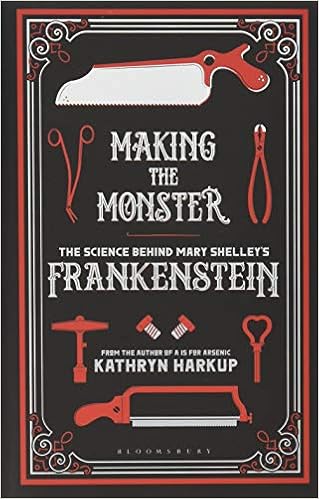
Book Review: Making the Monster: The Science Behind Mary Shelley’s Frankenstein by Kathryn Harkup

Making the Monster: The Science Behind Mary Shelley’s Frankenstein by Kathryn Harkup

Bloomsbury Sigma, 2018

ISBN-13: 978-1472933737

Available: Hardcover, paperback, Kindle edition, audiobook, MP3 CD


The primary takeaway I got from Making the Monster: The Science Behind Mary Shelley’s Frankenstein is that Frankenstein really truly is science fiction. There are things implied in the book that science today still isn’t able to accomplish! I think in today’s world we don’t really have the ability to imagine the time that Mary Shelley was writing, when the way people saw the world was in flux, with alchemy only very reluctantly ceding its way to the barely understood beginnings of chemistry, biology, and physical science, and the materials for experimentation not easily available. The potential of science to change what makes us human, as exciting and mysterious as it was, also activated anxieties and fears that, while they have changed in specifics, still affect us today. The mystery of what science could accomplish, though, was so profound at that time that Shelley’s novel of an ambitious, obsessive scientist has so little actual science in it, and so little of the text actually devoted to creating the monster itself.

Harkup breaks her topic down by first summing up the life of Mary Shelley to the point at which she wrote Frankenstein, and then, about 80 pages in, addressing the specific aspects of science and experimentation described in the text. She does a good job of recreating the gruesome aspects of science at that time, and the enthusiasm scientists had that sent them past the point of what we would consider ethically acceptable. She covers some fascinating people and ideas, such as anatomist John Hunter (evidently the model for both Dr. Doolittle and Dr Jekyll); foundational chemist Antoine Lavoisier; serial killers William Burke and William Hare, who sold the bodies of their victims to anatomy schools; and Luigi Galvani and Alessandro Volta, the major players in the debate on the role of electricity in animal and human bodies, among others. Bodysnatching, graverobbing, transplants, preserving body parts in jars, the creation of batteries, chimeras, body decomposition, electroshock therapy, acromegaly, transfusions, feral men, Lamarck’s theory of genetics, all are covered in the pages as the flotsam surrounding educated (and not as educated) people at the time, often simultaneously as entertainment and education.

Making the Monster is interesting, even compelling at times, but there were some stretches that took me a long time to get through. I got impatient when Harkup moved too far into the past or too close to the current day, and much of what she said about where Shelley got her ideas was farfetched supposition. That is, not that Mary couldn’t have encountered these ideas and people, but that she might have encountered (for example) John Hunter’s ideas because of a one-time encounter between Hunter and her father. Despite it running only 274 pages, I ended up picking it up and putting it down several times.

As it’s the 200th anniversary of the novel, this is a good addition to a Frankensteinia collection, and some of the stories about the science of the times make for interesting reading if you are interested in the history of science in the 1800s. Making the Monster is a mostly enjoyable read, but outside of the specific applications of science that tie into the novel, it treads some pretty familiar ground, so it’s not an essential item for most collections.  Recommended for large public library collections and Frankenstein lovers.


Book Review: The Mind Altar: A Novel of Subterranean Terror by Michael Just


The Mind Altar: A Novel of Subterranean Terror by Michael Just

Giddings Street Press, 2018

ISBN 13:9781530441297

Available: Paperback, Kindle edition


The Mind Altar: A Novel of Subterranean Terror by Michael Just is head and shoulders above most novels in the science fiction, horror and mystery genres. The author describes scenes in just the right amount of detail to place the reader within the story.  He reveals the personalities and motives of the characters gradually, keeping the reader engaged.  His plot has twists and turns that keep the reader continually guessing about the story’s outcome.  The ending is no less complicated and intriguing, seemingly doubling back on itself three times.

Taking place in the near future, the U.S. government sends a team of black-ops mercenaries to the desert in the Four Corners region of the country.  Communications with a secret facility buried in a mountain, called Bright Angel, went dead a few weeks earlier.  Each of the seven-team members has a special skill, and knows only part of their mission.  Our protagonist, Eurydice Wiles, is an expert in resurrecting programs and data from crashed computers.  She is buttoned up, avoids emotional contact and has no memories from the age of seven to eight.

As Eury and her teammates explore the myriad of Bright Angel’s rooms and caverns, they discover hollowed-out, plasticized bodies with no heads, preserved brains cut in-half, and dozens of crisp, burned bodies.  All computer hard drives have been smashed.  Eury intuits that the entire tunneled mountain is a computer and that ghostly visions and voices are part of its programs.  Did the staff and inmates go mad and kill each other?  One-by-one the team members are dying.  What will Eury and the other survivors find when they get to the Mind Altar at the heart of the mountain? Highly recommended.

Contains: Mild sexual situations, moderate gore.


Reviewed by Robert D. Yee

Book Review: Faction 9: A Novel of Revolution by James Firelocke

Faction 9: A Novel of Revolution by James Firelocke

James Firelocke, 2018

ISBN-13: 978-0999568293

Available: Paperback, Kindle edition.


On the surface, it seems like a great plot.  The future United States still operates under our current political system, but has been fully hijacked by evil capitalistic pig warmongers who have made serfs (or slaves) out of most of the population.  Small groups called ‘factions’ are fighting back behind the scenes, trying to take America back for the people, and stopping the enslavement of the population.  If the idea had stopped there and been better written, this could have been a good book.  However, Faction 9 makes for a lackluster reading experience.  The plot is part of the problem: it is cluttered with unneccessary and distracting ideas, such as alien metallic insects and humans with feline DNA. These add nothing to the basic premise, and strain the story’s credibility.It will appeal to a select crowd, but would have been better suited to a comic book or graphic novel format.

The use of elaborate language and cartoonish portrayals of the characters also detract from the story.  One notable example of the language problem is saying that a character ‘strained to achieve colonic climax’ when sitting on the toilet. Character development is minimal at best, and cartoonish in the case of the villains.  The author throws in every cliché when describing the money-loving evildoers.  Gold toilets, eating only steak and lobster, toilet paper with the Constitution printed on it, seeing every female as a sexual target, all people are their slaves, money is God…you get the idea.  You can’t even hate the villains in this: they are so laughable you don’t feel any emotion about them.  The protagonists aren’t much better. There is little backstory on how they became revolutionaries fighting for the people, and you wind up not caring what happens to them.

The author does have skill, but it only comes in flashes.  The time spent describing the foolishness of government hurdles when trying to do something as simple as changing a computer password was excellent, and his description of prisons in the future showed good imagination.  But, those moments were too few, and it’s not enough to save the story. While most readers won’t want to slog through this, the book could find a place among YA readers, or people looking for any story that involves despising conservatives, in terms of politics. It will appeal to a select crowd, but would have been better suited to a comic book or graphic novel format.


Contains: mild violence and profanity

Reviewed by Murray Samuelson