Home » Posts tagged "occult horror" (Page 13)

Book Review: Conquer (John Conquer Series, Book 1) by Edward M. Erdelac

Bookshop.org |  Amazon.com )

Conquer (John Conquer Series, Book 1) by Edward M. Erdelac

Independently published, 2020

ISBN: 9798579334848

Available : Paperback, Kindle edition


Harlem, 1976: an era of bad clothes, bad habits, and bad music.  From this scene emerges John Conquer, private investigator, and the baddest brother around.  How bad?  Well, “didn’t he kung-fu Frankenstein off the marquee at the Apollo, and bust him to pieces with John Henry’s hammer?  Didn’t he go fishin’ and catch the Creature from the Black Lagoon, and throw him back because he was too small!  He played ball with Dr. J in Rucker Park, and let him win!”  Conquer is a folk hero to Harlem, and his exploits have grown into legend among the locals.  These are his stories.


Conquer consists of seven short stories, three were previously published in Occult Detective Quarterly in 2017.  The stories are consistently entertaining, if a bit formulaic at the beginning of each story.  They usually start with Detective Lou Lazzaroni of the NYPD being assigned a case.  Lou realizes that the cases have a supernatural bent to them, and that’s where John Conquer steps in.  Although he’s a standard PI, Conquer also has a deep knowledge of voodoo, hoodoo, and all kinds of occult stuff, as he was partially raised in Louisiana, America’s capital of pagan weirdness.  It’s up to Conquer to solve the cases and save the day.


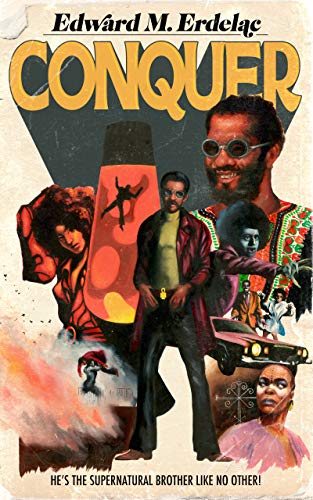
Author Erdelac has done a nice job writing a horror period piece: his portrayal of the late 1970s feels quite authentic, both in terms of setting (ox-blood leather coats, linoleum, lava lamps, etc.) and dialogue.  The dialogue feels very accurate with its terminology and phrasing, and does a good job transporting the reader back to another time in American history.  After Conquer is brought onto each case, the author shifts gears and shows a strong flair for creativity.  Readers might assume that voodoo automatically means zombies, but only one story actually has the undead.  Instead, Erdelac does a nice job cross-pollinating various African and Asian mythologies into the story.  Examples include a Slip-Skin Hag (or ‘boo hag’), a Popobawa (a bat-wing creature) and a monster based on Dahomeyan beliefs that defies easy categorization.  He did an excellent job researching these creatures for the book, but there are times when a little more explanation would have helped.  Unless you’ve read Wade Davis’s The Serpent and the Rainbow, terms like bokor, vodoun, veve, and Papa Legba are likely to sail over the heads of most readers, sending them scrambling for Wikipedia.


The stories are fast with no wasted time. Conquer dives right into the action, destroying villains with often-creative methods, such as cigarettes laced with sage for exorcising demons, and a pocket-coating powder that renders pickpockets immobile and subject to Conquer’s commands.  Part of the character’s appeal is that he doesn’t just blast away with his Colt Python, but often relies on his own magic methods to beat the baddies at their own game.  Special mention must be made of a fantastic secondary character, in the form of the ghost of a dead pimp that haunts Conquer’s car, and speaks to him through the radio.   This also allows Conquer to control the car through voice command, when the ghost agrees.  It’s like a bizarre 1970s version of the television show Knight Rider, and the back and forth squabbling provides unexpected and welcome hilarity.


Overall, Conquer is a welcome horror novel throwback to another era.  Let’s hope for more from Conquer and company in the future.  Recommended.


Contains:  violence, profanity


Reviewed by Murray Samuelson
Women in Horror Month: Of One Blood: The Hidden Self by Pauline Hopkins, edited by Eric J. Guignard and Leslie Klinger, introduction by Nisi Shawl

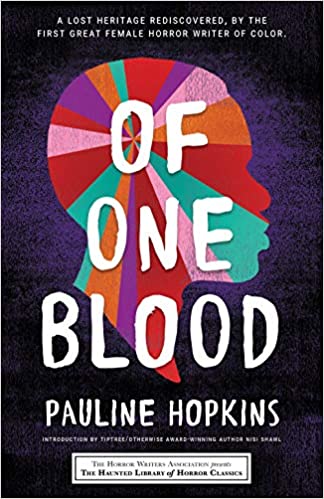
cover art of Of One Blood: The Hidden Self by Pauline Hopkins

Of One Blood: The Hidden Self  (Haunted Library Horror Classics) by Pauline Hopkins, edited by Eric J. Guignard and Leslie S. Klinger, introduction by Nisi Shawl

Poisoned Pen Press, 2021

ISBN-13 : 978-1464215063

Available: Paperback, Kindle edition


This new edition of Of One Blood is part of a series published by Poisoned Pen Press in partnership with the Horror Writers of America.  Author Pauline Hopkins was an African-American writer of the early 20th century,  and Nisi Shawl introduces the book, originally published in chapters as a serial in The Colored American magazine during 1902-1903, as an early speculative fiction novel combining the popular genre of “society novels” with a “lost world” narrative. revolutionary because the “lost world” is an advanced society consisting entirely of Black individuals, and promoting the thesis, novel at the time, that Africa is where the arts and technology have their origins.

Set in Boston in 1891 (my best guess based on the footnotes), Reuel Briggs is an impoverished medical student passing as white who is obsessed with the hidden forces of the supernatural and how to control them enough to reanimate the recently dead (shades of Victor Frankenstein). He is given the opportunity to put his theories into practice when the beautiful African-American singer Dianthe Lusk is killed in a car accident. While he is successful at bringing her back to life, she has lost her memory, and Reuel, his wealthy friend Aubrey, and Aubrey’s fiance Molly, set out to rebuild her into a new person. Molly becomes close friends with Dianthe, and Dianthe and Reuel fall in love and marry. To support her, he appeals to Aubrey for help in finding work. Aubrey, secretly in love with Dianthe, gets Reuel to sign on to a two year expedition to Africa to get him out of the way so he can marry Dianthe himself.

As Reuel journeys through Africa he sees its greatness, vividly described by Hopkins. The white men he is traveling with are surprised and at first dismayed to realize that African civilizations and peoples are the cradle of culture, as they have always believed that Africans were lesser than white people. Through Aubrey’s machinations, Reuel and Dianthe receive letters informing them that the other is dead, but while Reuel’s supernatural and mystical powers grow,  Dianthe feels more and more lost and traumatized, especially as she learns more about her tangled family tree.

There are many books now that deal with the intergenerational trauma, tangled family trees, and family separation caused by slavery, including Octavia Butler’s speculative novel Kindred,  Yaa Gyasi’s Homegoing, and Maisy Card’s These Ghosts Are Family.  In Of One Blood, we see a fantastical, awe-inspiring world, that contrasts the glories of African civilization rising again with the results of  the terrible treatment, taken for granted, of African-Americans. Dianthe in particular goes through unbelievable trauma: she is killed, re-animated, separated from everything she knows, nearly drowned, grieving a friend and a husband, and under tremendous pressure from Aubrey already, when the additional information about her family comes to light. In her case, it only takes one generation to destabilize her and poison her interactions with her environment. Shawl described this novel as science fiction, but to me it seems more to combine the “lost world”  utopian narrative Reuel experiences in Africa with the Gothic horror experienced by Dianthe.

Occasional footnotes are helpful in dating the time period of the book and understanding vocabulary and literary references. A brief but detailed biographical note about the author,  discussion questions, and a wide-ranging list of recommended further reading follow the story.

This is a good choice for readers interested in the beginnings of Afrofuturism and African-American speculative fiction and horror, Gothic horror, lost world and utopian narratives, and early 20th century African-American and women writers. In addition, Of One Blood would be a unique choice for the increasing number of book clubs focusing on anti-racist titles, which, in my experience, generally avoid genre fiction. Highly recommended.

Contains: incest


Reviewed by Kirsten Kowalewski


Graphic Novel Review: Daphne Byrne by Laura Marks, art by Kelley Jones

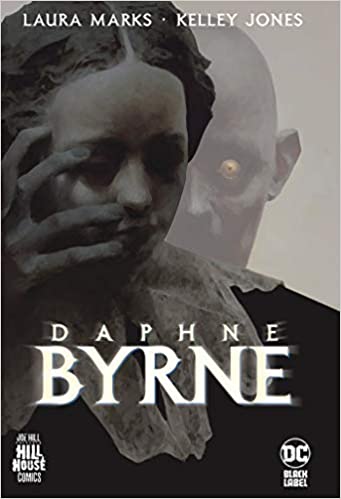
Cover art for Daphne Byrne by Kelly Marks

(Bookshop.com Amazon.com )

Daphne Byrne by Laura Marks, art by Kelley Jones

DC Comics, 2020

ISBN-13:

Available: Hardcover, Kindle, comixology


Set in 1886 New York, Daphne Byrne is still in mourning over the death of her father and has been affected greatly upon his passing. She’s tormented at school by the popular girls. She’s grappling with her mother who has been seeing a medium who she knows is a fraud. Her mother is spending the little money they have left on trying to contact her dead husband. Daphne tries her best to expose the medium, only to earn the ire of them both. While all of this is going on, Daphne meets a supernatural entity, simply called Brother, who offers friendship and support to the sad girl. He also encourages Daphne to stand up for herself, inviting her to use his powers as a tool. This power becomes particularly useful when she discovers the utter betrayal committed by certain parties close to the family.


Daphne Byrne would be of interest to anyone who enjoys stories from this period. Something I noticed in the less favourable reviews out there regarded the setting, which also influenced some of the plot points such as the fraudulent medium. I loved the story and found Daphne to be an interesting character. The artwork helped in this. Jones has been drawing comics for a long time, and I recognized his work immediately from his work on Sandman. He lends an otherworldly quality to creatures and characters. At times Brother reminded me of a sinister Dream. Recommended.

Contains: blood, body horror, nudity, sex


Reviewed by Lizzy Walker