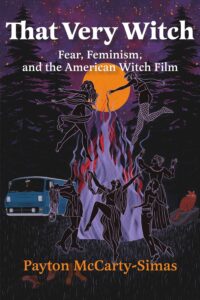
That Very Witch: Fear, Feminism, and the American Witch Film by Payton McCarty-Simas
Luna Press Publishing, 2025
ISBN-13: 9781915556608
Available: Paperback, Kindle edition
Buy: Bookshop.org | Amazon.com
Payton McCarty-Simas’ That Very Witch: Fear, Feminism, and the American Witch Movie analyzes the cinematic witch’s evolution and relationship to feminist movements from the 1960s to the 2020s. Using historical, social, and feminist models for basis of analysis, they examine how the witch became viewed as both the feminist representation of empowerment and fear. McCarty-Simas’ analysis of the witch film reveals how the witch has been portrayed over time, reflecting significant changes in American culture and politics.
A brief history of early European witches, and their associated witch hunts, or “crazes,” driven by bigotry, misogyny, and racism, creates the basis for the contents of the book, as these are central to the concept of the witch. The author addresses the concept of the witch as a symbol in feminist circles, what can be learned from various witch cycles through history, whether witches through time can be considered feminist figures, and more, in their analysis of witch films.
In Part 1, “Season of the Witch: The Countercultural Witch Films of the Long Sixties,” the author explores witch films from 1960 through 1973, including the birth and death of the witchsploitation film in the context of the sociopolitical climate of the era. Part 2, “Unpleasant Dreams: Feminism, Satanic Panic and the Witch Films of the 1980s,” takes the reader through the rise and decline of the Satanic Panic. McCarty-Simas expands on how this era’s witch films responded to the earlier witch cycle film, the Panic’s effect on the figure and evolution of the witch and Satan, and antifeminist rhetoric pushed by conservatives that the role of working women, as well as the innovation of home video technology and the VHS, were to blame for Satanic cults lurking around every corner. Particularly interesting in this section is that McCarty-Simas highlights the “Satanic Panic specials,” framing them as horror comedies. For readers who have seen clips or the full version of such shows, you know why the author includes these as horror comedies. Over-the-top “reporting,” alleged experts on Satanic Ritual Abuse who spread disinformation, and decrying explicit material in horror movies while in the same show describing in great detail what happened to alleged victims, are just a few of the reasons the author correctly includes them here.
“Interlude: Notes on the Postfeminist Witch Film (1990-2013)” focuses on the witch film in terms of Third Wave feminism, Riot Grrrls, girl power, the commodification of witches to teenagers, and the bitchification of the witch. The author presents an insightful analysis of
The Craft and its overall failure at intersectionality, and discusses girl and women witches in the Harry Potter franchise. The author includes some television series from this time period as examples of dark fairy tales, highlighting American Horror Story: Coven and its successful portrayal of feminism, race, and intersectionality.
Part 3, “Gender, Genre, Psychedelics, and Abjection in the 2010s ‘Witch’ Horror Cycle,” examines 2010s witch films, tying the “demonic woman” to the cycles in previous chapters. A major visual the author uses as a tool for analysis is the smile of the heroine or final girl at the end of horror films, comparing them to how the meaning of this expression can be interpreted on the face of a witch at the end of her film.
I would be remiss if I did not address a significant issue with the text, that being the “Works Cited” section. There are links that point the reader to academic library databases where an account is needed to access the articles or books, Google Books links, and broken links, rather than using DOIs (digital object identifiers) or stable URLs. Correct citations bolster the text and provide readers with further information. This includes directing readers to the resource itself.
Regardless of the problems with the citations, That Very Witch would be a good resource for readers interested in the history of the American witch film in terms of particular political climates, social movements, and historical context. It provides an extensive film and mediography that has increased my watch list. Recommended.
Reviewed by Lizzy Walker





Follow Us!