Home » Posts tagged "middle grade horror" (Page 6)

Book Review: The Witching Stone by Danny Weston

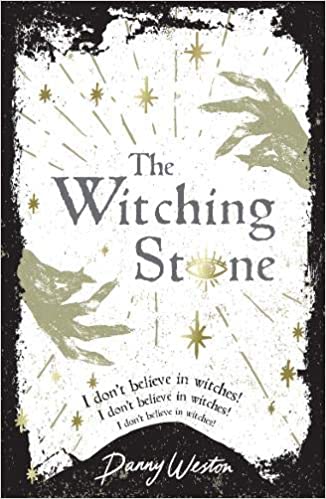
cover art for The Witching Stone by Danny Weston   

The Witching Stone by Danny Weston ( Amazon.com )

uclanpublishing, 2020

ISBN-13: 13579108642

Available: Paperback


The Witching Stone by Danny Weston is an enjoyable read for young readers who appreciate coming-of-age stories with a touch of mystery and horror. Danny Weston is the pseudonym for Phillip Caveney, who has written many thrillers for adults, children and teenagers, some of which have won prizes.

Teenager Alfie Travers has just been dumped by his longtime girlfriend. Alfie agrees to accompany his father on a job in a small English village, but is prepared to be bored out of his gourd. Killing time in the church graveyard, he sees a large stone marking the grave of the alleged witch Meg Shelton, who died in 1705. Mia, a goth teen, challenges him to summon the witch by walking counterclockwise around the stone three times, while intoning “I don’t believe in witches!”

Of course, Meg apparates before Alfie. She claims she’s not a witch and that her infant son was taken from her. Meg threatens to kill everyone Alfie loves if he doesn’t find the grave of her son.

Alfie and Mia search for clues. Meg, impatient for progress, shows her anger by turning the village’s milk sour, putting toads in muesli, and blowing up computers. Alfie and Mia’s search takes them to library archives, the ruins of Meg’s cottage and a viscount’s estate with an impenetrable maze of yews. Was Meg a witch? How did she die? What happened to her son?

The plot is straightforward and easy to follow. The narrative is simple and direct. There are only a few punctuation errors. Recommended for ages 10-14.

Contains: discussion of teenage pregnancy


Reviewed by Robert D. Yee

Book Review: Don’t Turn Out the Lights: A Tribute to Alvin Schwartz’s Scary Stories to Tell in the Dark edited by Jonathan Maberry

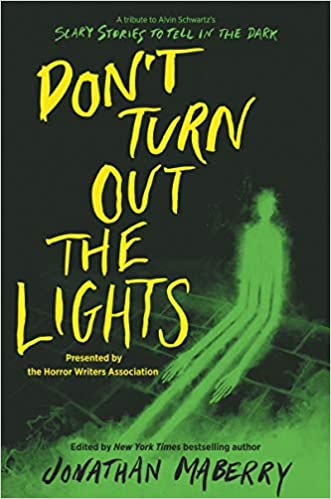
cover art for Don't Turn Out The Lights: A Tribute to Alvin Schwartz's Scary Stories to Tell in the Dark edited by Jonathan Maberry  ( Bookshop.org  |  Amazon.com )

Don’t Turn Out the Lights: A Tribute to Alvin Schwartz’s Scary Stories to Tell in the Dark edited by Jonathan Maberry

HarperCollins, 2020

ISBN-13 : 978-0062877673

Available: Hardcover, paperback, Kindle edition, audiobook


Don’t Turn Out the Lights is an anthology of stories by a variety of diverse horror writers, mostly of YA horror, inspired mainly by their nostalgia over Alvin Schwartz’s notable collections of urban legends and folktales, Scary Stories to Tell in the Dark (writers include Linda Addison, Amy Lukavics, Courtney Alameda, Tannarive Due, Kami Garcia, and R.L. Stine). Schwartz’s writing was spare, providing just the bare bones of the stories he shared, and Stephen Gammell provided terrifying black-and-white pen and pencil drawings to accompany each one It is unfortunate that the artist for the book is not credited, so far as I can tell. Nobody can be Stephen Gammell, but the interior illustrations suggest the artist studied his style. The artwork is outstanding and integrates well into the design of the book and the storytelling.

Unlike Schwartz’s collections, there aren’t a lot of jump-scares or gruesome rhymes: these are tribute stories rather than an attempt to recreate his work. As expected in a collection of 35 stories, each by a different author, some are better than others. Some stories stick closer to Schwartz’s style and choice of subject, with the feeling of a folktale, such as T.J. Wooldridge’s “The Skelly-Horse”, or “Jingle Jangle”, while others, like “The Funeral Portrait” were more reminiscent of Poe. A few manage to stick to the urban legend feel of the original while updating it for tweens today, like “Tag, You’re It,” by N.R. Lambert, which plays on social media anxieties, and “The House on the Hill”, which brings mystery emails and cell phones into play in a tale of peer pressure and surveillance in a haunted house. “The Neighbor” managed the fine line of evoking Schwartz’s tales in a contemporary context beautifully. Editor Jonathan Maberry’s introductory essay was very interesting, as he did not grow up with the stories but read them as an adult.

One of this book’s greatest faults is its length. The original Scary Stories books were relatively short in length, with plenty of white space and relatively large print on each page. Stories were usually very short and heavily illustrated. Don’t Turn Out the Lights is over 400 pages long, with most stories obviously intended to be read on the page instead of told at a campfire.  While the Scary Stories books are read by kids as young as third grade, the length of the book and of the stories suggests to me that Don’t Turn Out the Lights is aimed at a slightly older audience of tweens and middle-schoolers, and also the adult audience feeling the same kind of nostalgia for the Scary Stories books that the authors did. Recommended for grades 4+.

Contains: gore, violence, body horror, murder


NetGalley temporarily provided a review copy of this book.


Book Review: Kiki Macadoo and the Graveyard Ballerinas by Colette Sewall

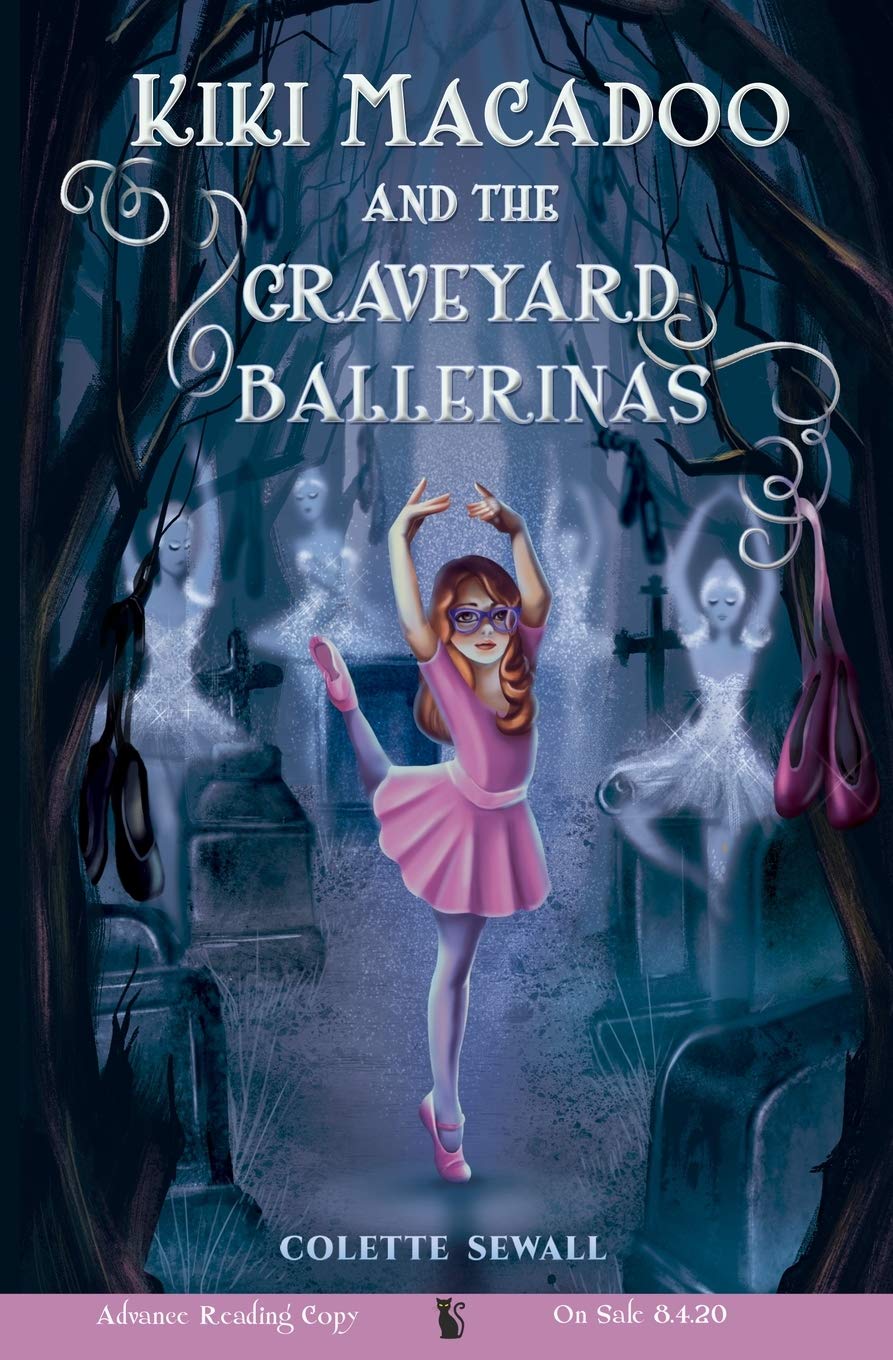
cover for Kiki Macadoo and the Graveyard Ballerinas

Kiki Macadoo and the Graveyard Ballerinas by Colette Sewall ( Amazon.com )

Owl Hollow Press, 2020

ISBN-13: 978-1945654558

Available: Paperback, Kindle edition


Kiki Macadoo, age eleven, and her teenage sister Alison, are going to a special ballet summer camp housed in a Gothic castle in a remote area surrounded by dense forest. Kiki loves ballet but is terrible at it, while Alison is very talented. While both of them are excited about camp, Kiki is nervous, and Alison is bummed because she’ll be spending the summer away from her boyfriend, Dylan.

Despite the camp’s setting, the kids seem pretty normal– they’re there because they want to excel in dance. Sewall writes naturally about ballet and dance, without making the terminology intimidating. Kiki is placed in the lowest dance class, with 8 year olds, but she’s lucky in that she has a pretty good relationship with Alison, her roommate is kind and friendly even though she’s a much better dancer, and the dance teacher is understanding and helpful. The camp director, Madame Dupree, is elderly, forgetful, and a bit eccentric (there’s a subplot where her son’s fiance attempts to have her committed so he can sell the property to developers, but it doesn’t really go anywhere), but she’s also thoughtful and generous. When she learns that Alison will have her sixteenth birthday at camp, she enlists Kiki in helping plan a surprise party for Alison. It’s  refreshing to see a school story, especially one involving teenagers and middle-schoolers, where the main character isn’t bullied because of physical flaws or struggles with learning.  It’s also nice to see the conflicting feelings Kiki has about dance and about her sister– she may struggle but she perserveres.

While the campers have been forbidden from going into the forest, it doesn’t stop Kiki. Her lessons end earlier than Alison’s or her roommate’s, leaving Kiki plenty of time to explore. One of the boys at the school, Oliver, lives on the grounds and tells her she needs to be careful because fairies and spirits live in the woods (Oliver isn’t mocked for dancing; we have come a long way since Oliver Button Is a Sissy). At first she doesn’t believe him, but it turns out that Kiki is one of a rare few who can see them, because she has “ghost eyes”, two different-colored eyes. Kiki and Oliver become friends and explore the forest together (it is almost a character in its own right), and between Oliver’s stories and hints dropped by Madame Dupree, Kiki learns that in addition to harmless spirits, there are some dangerous ones as well. The wilis, water sylphs who died of broken hearts while at ballet camp, draw in any young woman with a broken heart and force her to dance to her death, at which time she becomes one of them. There is a graveyard filled with the bodies of girls who died dancing and became wilis.

The surprise party for Alison does not end well. Alison’s boyfriend shows up with bad grace and she discovers he’s seeing another girl; broken-hearted, she runs into the forest where she is drawn in to the wilis’ dance. As terrifying as they are, it is up to Kiki to break her sister away from the wilis’ spell.

I really liked the author’s choice to make the wilis her dangerous spirits. They are part of Slavic folklore and are not commonly known, but they do appear in the ballet Giselle, which is tragic and terrifying. Giselle is maybe not as well known to the average kid as The Nutcracker or Swan Lake, but that makes the story extra cool in integrating the ballet theme into the story.

As it is a middle grade book, things end well, but the path to getting there has its frightening moments, and definitely magical ones. The door is left open to a sequel, and I’ll be interested to see if one happens and, if it does, where it takes Kiki, Alison, and Oliver next. Recommended for ages 8-13.