Home » Posts tagged "librarians"

Book Review: Witchcraft for Wayward Girls by Grady Hendrix

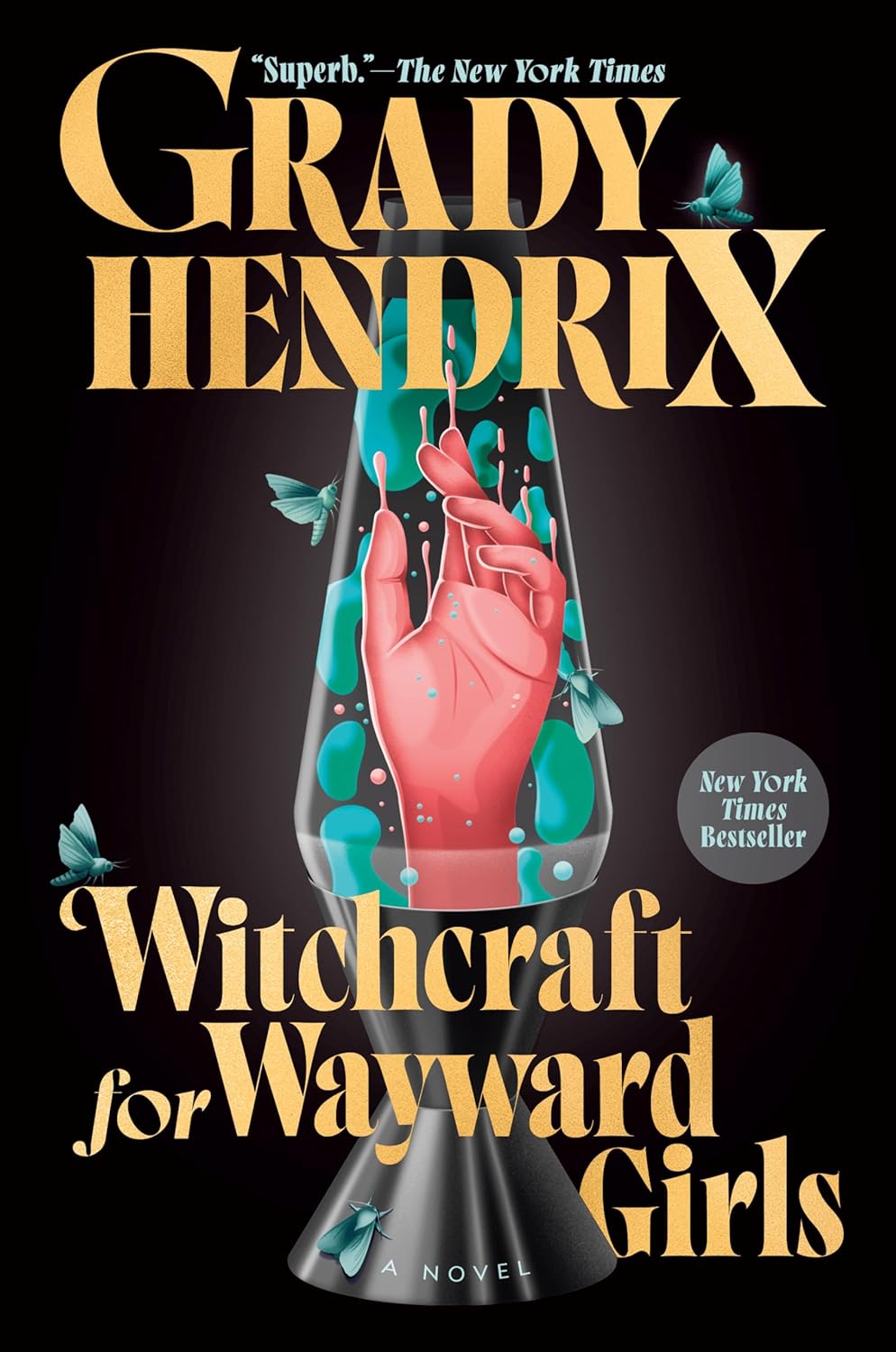
Witchcraft for Wayward Girls by Grady Hendrix

Berkley, 2025

ISBN-13: 978-0593548981

Available: Hardcover, paperback, Kindle edition, audiobook

Buy:   Bookshop.org | Amazon.com


It’s 1970. Neva is 15, pregnant, and lost. Her father leaves her at the Wellwood Home in St. Augusta, Florida, a maternity facility for pregnant teens. Miss Wellwood, the proprietor, runs her home with strict rules and reprimands the girls about their loose morals and poor decisions. the adults in charge include Diane, a social worker who guides the girls through their time in the Home;  Dr. Vincent, a cold elderly man with traditional views on women’s healthcare, who prescribes restrictions and other cures for the girls, with a focus on the babies; Nurse Kent, who minds the girls at night and when needed; Hagar, a Black woman who runs the kitchen; and Hagar’s sister Miriam, who instructs the girls on their domestic roles, such as proper cleaning of the Home.


The adults are not the focus of the story, of course. It is the girls, renamed by Miss Wellwood as flowers, as though she is tending a special garden. Neva is renamed Fern. Rose, a radical hippie who wants to keep her baby Blossom, is a force to be reckoned with in the Home. Always on strike, she fears nothing and no one… until she does. Holly has been through terrible trauma in her short life, at the hands of a powerful member of the community. She’s wild, refusing to allow people to get close to her, and remaining mute until she finds her voice. Zinnia is a musician who loves the father of her baby, swears they will marry upon her return home, and tries to ignore what she was put through at the hands of her mother when her parents found out she was pregnant. There are other girls, and as one leaves, she is replaced by another flower.


One hot summer day, the local library’s bookmobile arrives with librarian Miss Parcae at the wheel. She presents Fern with a book called How to Be a Groovy Witch, a powerful tome that opens a new world for Fern, Holly, Rose, and Zinnia. There is something special about this book, and it reveals more to them the deeper they go as they form their own small coven and cast their first spell. The unassuming librarian is more than she seems. As Fern and the girls become more involved with witchcraft and the librarian, they find their newfound power comes at a painful price.


Witchcraft for Wayward Girls is powerful. I read the ARC, hardcover, and audiobook versions. Author Grady Hendrix opens the ARC with a letter to the reader, while the published version includes a statement in the acknowledgments, where he provides a brief history of these homes, and shares the experiences of his own family members. There are visceral depictions of body horror in terms of giving birth, which I had a difficult time getting through. Medical horror, especially regarding women’s health and trauma, is difficult for me to read.


Hendrix’s ability to write about and from the perspective of girls and women is incredibly effective and well-executed. Readers who enjoy this book may also enjoy his other books, especially The Southern Book Club’s Guide to Slaying Vampires, My Best Friend’s Exorcism, and We Sold Our Souls.  Highly recommended.


Reviewed by Lizzy Walker
Musings: The Disconnect Between What Kids Want and What Teachers Recommend

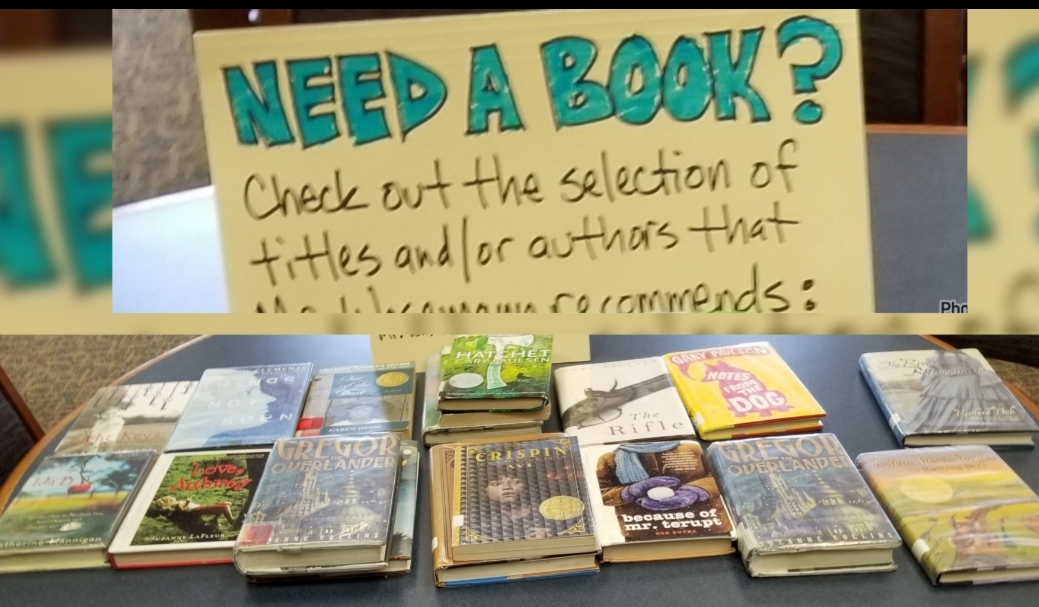
Table with sign that says "Need a Book? Check out thes authors and titles that Mr. ____ recommends" with a number of books face up on the table.

The reason I went back to school after working as a children’s librarian in a public library was that I noticed that sometime around grade four kids stopped coming to the library, They were too busy, they had too much homework, they had stuff going on. Even programs carefully designed around their interests weren’t attracting those kids.


I wanted to reach those kids. And I was willing to quit my job and go back to school to reach them where they were– school– a captive audience I could finally reach. And I did. But even in 2005, the librarians were the first ones to go when the budget got sliced.


In grad school and through 2005 I was part of a children’s choice committee for grades 4-6. We had a list of books proposed that we had to read, evaluate, discuss, and eventually choose 20 books for our nomination list. Kids who read at least 5 could vote for their choice for  best book. And the book with the most votes won the award.

Where am I going with this?

I currently volunteer in my kids’ former middle school library.

In early February I was asked to pull teacher favorites for a display. These included many of what would be considered classics- To Kill a Mockingbord, Night, The Call of the Wild, 1984, The Adventures of Huckleberry Finn. Only two of them had been written since 2005.


In mid-February, a teacher put a table of best books out on a table These were great choices I would have no problem recommending.  But I recognized almost all of them as books I had read while on the children’s choice committee. Only a few had been written in the last five years. One (Scythe) is taught as required reading at the high school.


We are not reaching teachers. They may be tolerating or even accepting horror in their classrooms but many aren’t promoting or providing horror genre titles to their students. And teachers have a huge influence on what gets checked out. It has to be a cooperative effort. The media specialist had a virtual visit with students with Lorien Lawrence in February, but on the day I came in, his books were still on the shelf.


I have helped the media specialist pull and promote scary and horror-themed books in the past. At the elementary, there’s time for storytelling to shape readers. But that isn’t enough at the secondary level. How do we reach teachers, especially at a time when giving kids books is so dangerous?  It’s time to think outside the box.


Editor’s note: I have had this characterized as a “diatribe against teachers”. It’s not. Teachers have a difficult job that is being made harder by conservative school boards and state legislatures. There is currently an effort to pass a law that would criminalize teachers and librarians for giving students “inappropriate” books in my state. Many school and classroom libraries have been cleared away elsewhere. 

Teachers face the difficulty of finding reading material their students will find relevant and engaging within challenging restraints. 20 years ago I was working to convince other school librarians horror was relevant and had the potential to be engaging to their students. Today there’s a Librarian’s Day at StokerCon: librarians are engaged in collection development  and promoting the horror genre. I am asking, where do we, as members of the horror community, go from here? What can we do to help? 

Musings: Choosing Your Adventure: The Starless Sea by Erin Morgenstern


The Starless Sea by Erin Morgenstern

Doubleday, 2019

ISBN-13: 978-0385541213

Available: Hardcover, paperback, Kindle edition, audiobook,  audio CD


The Starless Sea starts with a book-loving graduate student, Zachary Ezra Rawlins, who is writing his thesis on video games, finding a mysterious book of stories in his school’s library that includes a description of an incident from his childhood about a door he saw but didn’t open. Off he goes to find out more about the book and how he comes to be in it, that early on involves discussions of narrative and the differences between how it works in written works and in games. An inquisitive librarian tracks down information on the book for him, and between her help and a lot of searching the Internet, he is able to use clues from the book to connect it to a literary masquerade taking place in New York City in just a few days. Shortly, Zachary is on a quest, and the masquerade turns into a mystery, a chase, and an adventure that gives him the opportunity to walk through another door.

Once through the door, it is permanently closed behind him, and a different story begins for him. Zachary has entered a Harbor on the Starless Sea, an underground world where books and stories are safely kept. He is in a maze, or maybe it’s a hotel, or a library, with many doors, some locked and some open, where paths in time sometimes cross and sometimes do not, and people who meet in one room may not see each other again after leaving through the door. In addition to the Keeper and Zachary, there are just a few other people who appear in the underground world behind the door: Rhyme, the last guardian of the stories; Dorian, who may or may not be Zachary’s savior, killer, or true love, or a combination; Allegra, who wants to close all the doors so the story of the Starless Sea can never end;  Simon and Eleanor, lovers who lost each other in time; and Mirabel, their daughter. All of them appear in different incarnations across different times and spaces as Zachary travels through the lands of the Starless Sea, and the sea itself.  The world Zachary enters is dark, empty, often lonely and sometimes frightening or beautiful. His purpose once he arrives is unclear: even the Keeper of the Harbor doesn’t know, or want him there.

Erin Morgenstern writes gorgeous, lyrical, visually evocative prose. She started out as a visual artist and you can really tell from the way she has used words to create her worlds on paper. And if you are a person who loves books and stories and storytelling, who has always wanted to go through a portal or door to adventure, that might be enough for you to fall in love with this book. The weakenesses in plot and characterization are serious flaws, though. While Morgenstern starts out strong, once Zachary is through the portal, we lose the thread of his quest and it doesn’t get picked up again for a very long time (although there are a number of nods to the Narnia books throughout). There are multiple side stories that make you, as the reader, want to know where things went next, like the story of Simon and Eleanor, which has one foot in our reality for at least part of the time, and the story of the innkeeper falling in love, which feels like a fable but might not be.

The tales and fables in The Starless Sea are transformative, tragic, bleeding and dark. I was willing to try to track Zachary, as the anchor to the narrative, through his adventure because I wanted to know how some of these stories connected with his, but in many cases they were just vignettes, with the threads left hanging, or they returned in another incarnation. Then about three-quarters of the way through the book, Morgenstern, having constructed this elaborate, recursive story,  suggested that Zachary, the Alice in this wonderland, might be an unreliable reporter. That is, that nothing I had experienced (as a reader) with him could be trusted, and that he might not actually even be in the world of the Starless Sea. Although she backtracked shortly after that, it derailed the story. Once it’s out there, it can’t be unsaid.

Morgenstern was able to create a fairytale atmosphere, but in attempting to make her characters archetypes, she weakened them to the point that it was hard to care what happened to them, and this betrayal of the reader made that even more difficult. In constructing and connecting multiple layers and versions of potentially linked stories that reflected the possible choices of the characters, she left them adrift.  In interviews she has said plot is her weakness, and that she knew she had shortchanged her characters, and that’s really obvious here.

Because of Morgenstern’s amazing worldbuilding and gorgeous writing, and because I think she had some really interesting things to say about the way we structure stories in books (where the reader has a single path), versus games (where the player has many choices and can try different ones if the first ones don’t work), The Starless Sea was worth getting lost in. I feel like Morgenstern tried to present what it could look like to see what happens when a character makes different choices (like going through a door or not) by giving us a bird’s eye view of what it could look like to see the branchings and connections, outside the format of a game or a “choose your own adventure” book.

It’s an interesting experiment, but the observer’s position is unsatisfactory to me when I’m reading for enjoyment.

In adventure games, you get to be the active participant making decisions and dealing with their consequences.  “Choose your own adventure” books are written in second person, making “you”, the reader, the decision maker, with the ability to go back through your chain of decisions and change them, hoping for a different ending (getting to make your own choices is so vital that Chooseco just developed a series of board books). I just wasn’t invested enough in Zachary’s story to want to watch him make decisions (often random) without having more direct interaction.  Storytelling, if it doesn’t involve the reader or listener directly in participation, engages us when the storyteller invites us in. As gorgeously written as The Starless Sea is, it didn’t feel inviting to me as a reader. While the author created a memorable fictional world, she never opened a door.