Home » Posts tagged "horror movies" (Page 4)

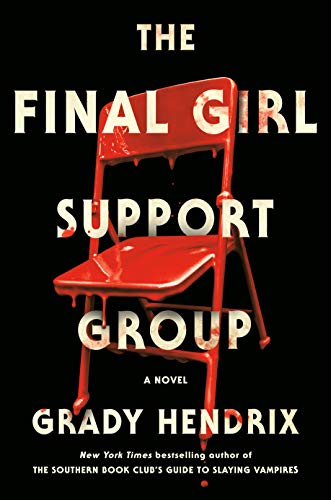
Book Review: The Final Girl Support Group by Grady Hendrix


The final Girls Support Group by Grady Hendrix

The Final Girl Support Group by Grady Hendrix

Berkley, 2021

ISBN-13: 9780593201237

Available: Hardcover, Kindle edition, Audible audiobook Bookshop.org |  Amazon.com )


The Final Girl is the lone survivor of horror movies. She fought valiantly, defeated the killer, and avenged her friends who were each gruesomely dispatched by the killer. But after the truck drives away, the sirens fade, and the credits roll, what happens to our heroine, other than the potential for franchise sequels? We find out in Hendrix’s new novel, The Final Girl Support Group.

Hendrix, as with We Sold Our Souls and The Southern Book Club’s Guide to Slaying Vampires, displays an uncanny ability to write complex women. Combining this with the concept of the Final Girl works quite well. Twenty-two years ago, Lynnette Tarkington survived a harrowing massacre. For more than a decade, Lynette and other women meet in the Final Girl Support Group led by their therapist, Dr. Carol Elliot. Lynette keeps herself locked safely in her home with her best friend, a houseplant named Fine. She has no identification paperwork or ID, no social life, and keeps her head on a swivel when she does gather up her strength to go outside, usually to the support group. In the support group, we meet Adrienne Butler, the first Final Girl; Dani Shipman, who along with her partner Michelle owns a rescue ranch for abused and abandoned horses; Heather DeLuca, whose life has gone off the rails with bad decisions and jail time; Julia Campbell, the talkative and angry paralyzed survivor of her own story; and Marilyn Torres, the wealthy wife of a CEO, who is a recovering alcoholic and activist in the community. When one of the women doesn’t show up for their regular meeting, Lynnette’s paranoia kicks in full-bore. Someone knows about the Final Girl Support Group and wants them all to suffer, and then die. The suspect knows where they live and congregate, and what they do. It comes to light that someone in the group has written a tell-all book about the women in the group. Who betrayed the Final Girl Support Group? Lynette sets out to find the killer and expose the truth.

There is so much going on in this book, I had a hard time putting it down. If you like the slasher subgenre and have ever wondered what happened when the Final Girl’s story ended, pick up this book. Interspersed throughout the book are articles and reports about the Final Girls, which add that extra touch to each character. Highly recommended.


Contains: violence, gore, body horror, descriptions of torture

Reviewed by Lizzy Walker
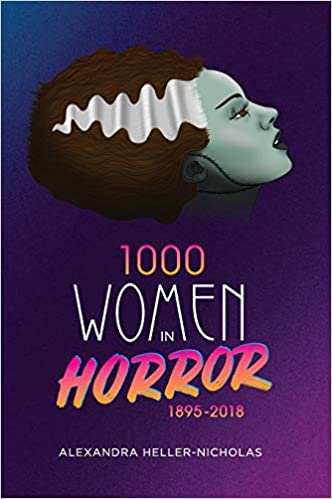
 

Book Review: 1000 Women in Horror, 1895-2018 by Alexandra Heller-Nicholas

cover art for 1000 Women in Horror

1000 Women in Horror, 1895-2018 by Alexandra Heller-Nicholas

BearManor Media, 2020

ISBN-13: 9781629333861

Available:  Hardcover, paperback ( Bookshop.org )


1000 Women in Horror, 1895-2018 is a beautiful book that includes the stars and women behind the scenes who have molded the horror genre. Heller-Nicholas provides a global view of the “vast number of women who have worked in the creation of dark and spooky movies for well over a century, both behind and in front of the camera, and in films both widely known and comparatively obscure.” The author includes an incomplete, as she mentions, but still impressive filmography of full-length movies directed or co-directed by women in an appendix. Also included interspersed throughout book are interviews with Rutanya Alda, Tara Anaïse, Tonjia Atomic, Anna Biller, Axelle Carolyn, Aislinn Clarke, BJ Colangelo, Mattie Do, Julia Ducournau, Jordan Hall, Catherine Hardwicke, Katherine Kean, Karen Lam, Izzy Lee, Barbara Magnolfi, Marsha Mason, Donna McRae, Patrushkha Mierzwa, Hannah Neurotica, Alexandra Paul, Isabel Peppard, Cassandra Peterson, Debbie Rochon, Mia’Kate Russell, Gigi Saul Guerrero, Elizabeth Shepherd, Jen and Sylvia Soska, Brinke Stevens, Barbie Wilde and Silvana Zancolò.


Since this is more of a reference book with entries in alphabetical order, readers may not want to read it from cover to cover of course. However, having done so myself, it is wonderful to see how many women, and by no means a complete list of them, have had a direct hand in horror films. I found it particularly interesting that Heller-Nicholas chose to include those in front of the camera. As she points out in her introduction, acting “is a job” and often requires hard work, dedication, and time.  With WiHM, we so often focus on the filmmakers that the actors themselves tend to go unnoticed in their efforts.


Alexandra Heller-Nicholas, a film critic from Melbourne, Australia, holds a PhD in Screen Studies from the University of Melbourne and is an Adjunct Professor at Deakin University and a Research Fellow at RMIT University. She has written eight books on cult, horror and exploitation cinema with an emphasis on gender politics. Given the quality of the research and care that went into 1000 Women in Horror, 1895-2018, I will definitely be checking out her other work. I do hope that at some point in the future there will be a Kindle edition released for accessibility.


Highly recommended


Reviewed by Lizzy Walker

Editor’s note: 1000 Women in Horror, 1895-2018  is a nominee on the final ballot for the 2020 Bram Stoker Award for Superior Achievement in Nonfiction. 

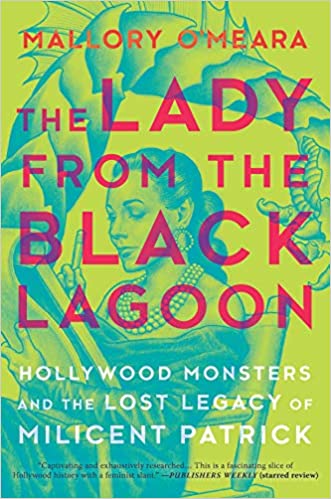
Women in Horror Month: Book Review: The Lady from the Black Lagoon: Hollywood Monsters and the Lost Legacy of Milicent Patrick by Mallory O’Meara

cover art for The Lady from the Black Lagoon by Mallory o"Meara

(  Bookshop.org  |  Amazon.com  )

The Lady from the Black Lagoon: Hollywood Monsters and the Lost Legacy of Milicent Patrick by Mallory O’Meara

Hanover Square Press, 2019

ISBN-13: 9781335937803

Available: Hardcover, paperback. Kindle, Audible audiobook


When Mallory O’Meara discovered that one of her favorite movies, The Creature from the Black Lagoon, featured a monster designed by a woman, Milicent Patrick, she knew she had to find out more. Sadly, there was little information available about this elusive figure. Through her research, O’Meara learned much about Patrick’s contribution to The Creature from the Black Lagoon and her eventual disappearance from film history. O’Meara, herself working in the horror movie industry, “set out to right the wrong and in the process discovered the full, fascinating story of an ambitious, artistic woman ahead of her time.”

O’Meara’s book is well-researched, using primary archival resources and interviews as a basis for her work. She describes pushback she received from different parties in her introduction. Similar to asking the question, “why is there a Women in Horror Month?”, she was asked why she was searching so much for a woman who was denied her craft for decades. O’Meara spends the bulk of the book answering this question.

The book isn’t strictly a biography of Milicent, but also of those closest to her. O’Meara includes biographical information on Milicent’s parents, William Randolph Hearst, Bud Westmore, and other people who had been influential in Patrick’s life. Interspersed in the chapters are the author’s discussion of her discoveries and “aha moments”, such as finding Hearst Castle as a clue to unveiling more of Milicent’s life, her time at Glendale Junior College, her eventual dropping out to attend Chouinard Art Institute, and Walt Disney hiring her on in the animation department of his humble studio. Milicent worked as an uncredited model, developing her own sense of style, something her father disapproved of. The author does not hide that some of Milicent’s life choices led to heartache and agony, her own as well as others. O’Meara discusses Milicent crossing paths with the infamous Bud Westmore and her time designing the Gillman, Universal’s monster in Creature from the Black Lagoon. The author also provides some great information on the history of special effects, and the ongoing gender inequality in the film industry.

A major criticism I have about the content is O’Meara’s exaggerated lack of understanding of the research process. She discusses her struggles with the process and, thankfully, credits those who helped her by providing her with clues or pointing her in the right direction. She seemed to be unaware of databases, or how to conduct oneself in an archival room. While such things are undoubtedly unknown to some people, including her own ignorance and gasping, and telling the reader she probably annoyed others in the research room of the archives, would probably be best left out. However, O’Meara’s conversational style of writing is appealing, to a point, and makes the pace of the book go quickly. Recommended.


Reviewed by Lizzy Walker