Home » Posts tagged "horror book reviews" (Page 49)

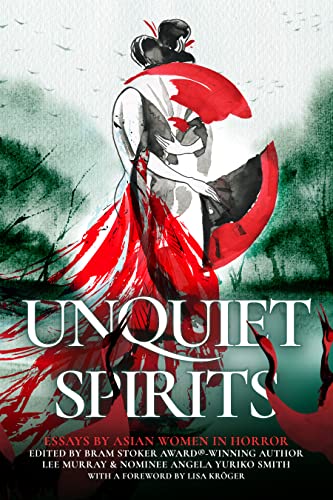
Book Review: Unquiet Spirits: Essays by Asian Women in Horror edited by Lee Murray and Angela Yuriko Smith, foreward by Lisa Kroger

Cover art for Unquiet Spirits: Essays by Asian Women in Horror edited by Lee Murray and Angela Yuriko Smith

Unquiet Spirits: Essays by Asian Women in Horror edited by Lee Murray and Angela Yuriko Smith, with a foreword by Lisa Kroger.

Black Spot Books Nonfiction, 2023

ISBN-13: 978-1645481300

Available: Hardcover, paperback, Kindle edition

( Bookshop.org | Amazon.com )


I read an uncorrected ARC of this book.


Unquiet Spirits is a collection of 24 personal essays by women across the Asian diaspora, grounded in the authors’ family history, relationship to their culture, and the supernatural.


One of the takeaways from reading this is that the Asian diaspora is far from monolithic. Each of the authors has a distinct background and set of circumstances: one certainly cannot speak for all.


Some of the authors include Nadia Bulkin, who is Javanese-American, Geneve Flynn, who is a Chinese-Australian born in Malaysia, Rena Mason, who is a first-generation immigrant to America of Thai-Chinese descent, and Tori Eldridge. who was born in Hawaii and is of Hawaiian, Korean, and Norwegian descent, all of whom approached their essays differently.


The diversity of the authors and their choices of what each individual focused on is what really drew me in. That I read almost 300 pages in tiny print on a PDF is a testament to the quality of the writing.


I learned a lot from these essays: in Lee Murray’s essay on displaced spirits I learned that Chinese immigrants to Australia expected to be returned to China for burial, or become hungry ghosts, and from Nadia Bulkin’s essay that the terms “amok” and “latah” originated in Indonesia, to name just a few. The authors wrote about growing up feeling out of place, feeling unwilling or unable to meet expectations about filial duty, marriage, and motherhood. They wrote about hungry ghosts, fox demons, and yokai
They wrote about finding and using their voices.


I read this a few essays at a time. There’s a lot to think about in each one, so I think that’s a good way to approach this book. I highly recommend taking the time to do so.


Reviewed by Kirsten Kowalewski

Graphic Novel Review: Abe Sapien: Dark and Terrible Volume 1 by Mike Mignola, John Arcudi, and Scott Allie, art by Sebastian Fiumara and Max Fiumara

Cover art for Abe Sapien: Dark and Terrible by Mike Mignola, Sebastian Flumara, and Max Flumara

Abe Sapien: Dark and Terrible Volume 1 by Mike Mignola, John Arcudi, and Scott Allie, art by Sebastián Fiumara and Max Fiumara

Dark Horse Comics, 2022

ISBN-13: 9781506733784

Available: Hardcover, paperback, Kindle edition, Comixology. (  Bookshop.org | Amazon.com )


Abe, a humanoid amphibious man and member of the B.P.R.D, after awakening from a coma and mutated, leaves the B.P.R.D. to search for his connection to the mutated monsters threatening to wipe out humanity. He just doesn’t know where to look, let alone if he is even asking the right questions.


Necromancer Gustav Strobl searches for his own answers when his deal with the Devil ends up falling apart after Hell collapsed in Hellboy in Hell. He is convinced that Abe has the answers to making a contract with the masters of the impending apocalypse.


In the first chapter, Abe finds himself in a small town hiding in a church for sanctuary, after fleeing an ordeal in a railway car. The priest is surprisingly welcoming, but Abe’s presence becomes known after a contentious sermon. The priest and a number of the congregants are among those who have mutated. The priest is dragged out for a lynching, and that’s when all hell breaks loose.


The B.P.R.D are in close range to help Abe, but they do not forget their mission to bring him back to headquarters.


In chapter 2, “The New Race of Man,” Agent Vaughn, killed by the creature the priest became in the previous chapter,  has been somewhat resurrected at the hands of necromancer Gustav Strobl. Abe flees to the Salton Sea and meets Judy, Barry, and Gene camping near giant eggs laid by enormous monsters. Judy and Gene, believing a newly hatched creature is the key to humankind’s next step in evolution, are met with frustration from Barry, and he threatens and injures Abe in the process.


The next day, Barry is found dead on the beach. Abe offers to investigate. As he digs deeper, he discovers what happened to the creature that emerged out of one of the giant eggs on the beach, as well as the truth behind Barry’s death. Meanwhile, Vaughn tells all he knows to Strobl about Abe and is offered a choice: to remain a traveling companion and be restored to full life, or be left as he was before Strobl found him.  


Abe makes it to Arizona in chapter 3, “The Shape of Things to Come,” and befriends a Mexican family along the way. He wonders why they aren’t afraid of him. Elena tells him the monsters they are used to coming across are all too human. Elena tires of being teased by those around her after telling Abe of her father being convinced he is a shapeshifter and fleeing to the desert. A mysterious goat saves them from being murdered at the hands of a white trigger-happy militia member.


In chapter 4, “To the Last Man,” Abe reports a car accident to the local police chief, J.J., who invites him to take part in the investigation of pustules found on the corpses of Sutton Ranch’s horses  that may cause more mutations if they aren’t taken care of. Zombie-like creatures are terrorizing the small town.


J.J. questions the recent squatters, and acts as though Suzy Alexander and Abe are putting too much pressure on him about further investigating them. He doesn’t know how right their instincts are. Strobl finds an old “friend” has returned.


Chapter 5, “The Garden (I),” is told from two angles, one from the Man who saved a Woman and another from the terrorized Woman being held captive by the Man. He stands guard on the roof, and shoots when he sees Abe coming. There is an interesting intertwining of the tales of the two people, previously unknown to each other, and Abe coming to the rescue. The last panel of the comic is simply an olive branch, which is a lovely touch.


After saving the Woman, Grace, from her imprisonment in the crooked house, Abe welcomes her as a traveling partner in chapter 6, “The Healer.” They meet up with a couple whose son is succumbing to the effects of mutation. The find a faith healer who says he has been surviving on the water from a creek and clay and reveals an old Jesus statue, who tells Abe he cannot be healed.


In chapter 7, “Visions, Dreams, and Fishin’,” Grace and Abe come upon an old woman in their travels. They find a place to camp, Abe dives for fish. He meets up with that old woman again to find something he wasn’t expecting, her own mutation. Abe and Grace come to some uncomfortable conclusions after dreaming their own nightmares.


In chapter 8, “Sacred Place,” Strobl continues his search for answers about the fish man and woman who creates fire. Abe and Grace travel to Rosario, TX, where Abe was shot. Reunited with Judy and Gene, they find B.P.R.D agents to take him home.


This volume includes a sketchbook of character designs, covers, and storyboards with notes by Sebastián Fiumara and Max Fiumara, and collects Abe Sapien paperback volumes 3-5.


The opening image of Abe crouched in a confessional is reminiscent of one of Bernie Wrightson’s illustrations of Frankenstein’s creature hiding in a shed. It really sets the tone for the entire book. Abe feels lost in his own skin, especially when he is confronted with those who see him as a monster. Reading Abe’s storyline is much different from Hellboy’s, since Abe is more subdued and just a different personality. The artwork provided by Sebastián Fiumara and Max Fiumara is well executed, especially regarding high tension and action panels. I recommend this for fans of the Mignola universe, not just Hellboy and the B.P.R.D. Abe is front and center, and his journey may not suit everyone’s storytelling tastes. Highly recommended.


Reviewed by Lizzy Walker
Book Review: Man Made Monsters by Andrea L. Rogers, illustrated by Jeff Edwards

Cover art for Man Made Monsters by Andrea L. Rogers and Jeff Edwards


Man Made Monsters by Andrea L. Rogers, illustrated by Jeff Edwards

Levine Querido, 2022

ISBN-13: 9781646141791

Available: Hardcover, paperback, Kindle edition  (  Bookshop.org  |  Amazon.com )


Cherokee writer Andrea L. Rogers makes her YA debut with Man Made Monsters with this 18-story anthology that traces one Cherokee family across time. She starts in the 1830s with the tribe forced off their land and the monster that follows them, and carries the family through to the future with a science fiction story. There are stories of commonly told supernatural monsters, like werewolves and vampires, but also monsters from the Cherokee tradition, such as Deer Woman, one of my new favorite legends. There are also very human monsters. Suicide, domestic violence, racism, school shootings, sexual assault, and indigenous dispossession are heavy topics in this book. Cherokee artist and language technologist Jeff Edwards includes fascinating artwork that accompanies the stories in this anthology.


While each of the stories in this anthology have something unique about them, a few of them became my favorites. “Man Made Monsters,” written as a series of letters, concerns a man playing Dr. Frankenstein looking for a means to create life from death. With the death of her little brother looming, Suzanna takes the man’s notes and research to heart. Something common for Victorian-era Gothic novels, Rogers uses this series of letters well to drive this story. I have a soft spot for Gothic novels, and I would have read a whole volume on this storyline alone.


In “Homecoming,” Rabbit Wilson’s older brother Joseph is slated to come home from the war with the other wounded “Cherokee boys.” While there is a ghost in this story, the most haunting vision is when Joseph arrives home.


“Me and My Monster,” set in 1969, centers on the short-lived relationship between the Goat Man and Gina after he saves her from being assaulted by a bad date. While I would not consider this a horror story, their tale ends in a tragedy of sorts.


In “Shame on the Moon,” another story set in 1969, Jimmy King is a self-conscious teenage werewolf football player. His sister, turned into a vampire by a rich white kid from an opposing team, led to his accidental transformation by an old friend. Something locally interesting for me is the mention of the song “Wichita Lineman.” I am a transplant to Wichita, and a few friends here have talked about the song in passing. Seeing this show up, I took the time to listen to it. I reread the story then, and it seemed to add that much more desperation to Jimmy’s search.


Sissy and Jisdu are stuck out in the cold in “Snow Day,” set in 1979. When they make it home after a difficult and painful trek, they are able to get into the old Cadillac in the closed up garage, where they turn it on, thinking the heater will keep them warm. While Jisdu sleeps, Sissy sees the ghost of her cousin, who tries to save their lives.


“Deer Women” is a new twist on the legend of Deer Woman. When Sali’s friend Lisa doesn’t show up for school, she and their other friend, Quanah, get worried. The trio is working on an art project centered around the legend of Deer Woman when she goes missing. After some expert sleuthing, they track Lisa who emerges from a drainpipe where she had been hiding. The girls may have discovered why other Native girls in the area have gone missing, and why it won’t happen again.


One of the futuristic stories, “I Come From the Water,” set in 2029, is told through multiple perspectives. In the story that comes just before this one, the band The Toadies are mentioned, and the title of this story is one of their songs, and one that happens to be favourite of mine. Rogers includes little things like this in her stories that are just genius. I recommend listening to the song after reading this one.


An interesting aspect of this book is that with the space in between the chapters, the reader can put together what happened with the family as the next story picks up. It’s an ingenious way to drive the overarching story. I thought it would be difficult to follow, given the massive time span, but it was surprisingly coherent, and I was never confused. It helped that at the beginning of each story, Rogers included pertinent names and dates. I think even without those added, I would have been able to follow the plot. Each story flows well into the next. Rogers is an author I will keep my eye on. She graduated with an MFA from the Institute of American Indian Arts in Santa Fe, and her work as been published in literary journals; in You Too? 25 Voices Share Their #METoo stories from Inkyard Press; in Approved: Intertribal Stories for Kids, and more.


I am not sure if the artwork created by Jeff Edwards was in their final versions as I read an ARC copy of Man Made Monsters, but I liked what I saw. Edwards is an award-winning Cherokee graphic artist and is a language activist who has worked for the Cherokee Nation for over 20 years. He attended Haskell Indian Nations University in Lawrence, KS, and deceived an Associate’s Degree in Liberal Arts and completed his Bachelor of Arts in Graphic Design at Northeastern State University in Tahlequah, Oklahoma.


Highly recommended.


Reviewed by Lizzy Walker