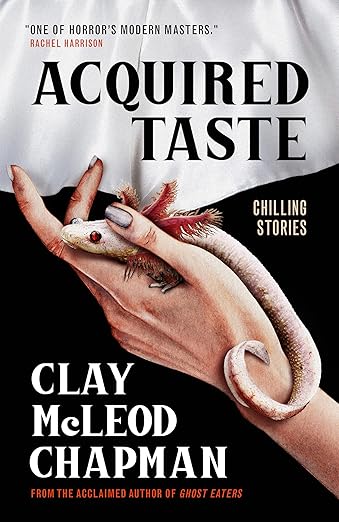

In January, I had the opportunity to interview Clay McLeod Chapman, author of Whisper Down the Lane, Ghost–Eaters, Acquired Taste, and more heart-wrenching, spinetingling horror. His recent short story collection Acquired Taste, YA novel Shiny Happy People, comics, and body snatchers are only a few of the topics we discussed. Here is our conversation. Enter, if you dare.
Lizzy: Thanks for talking with me, Clay.
Clay: Uh-oh, you’re still talking to me. Okay. [laughs]
Lizzy: I read Acquired Taste and was disturbed, intrigued, all of the things. I remember [the panel on transgressive horror] at ALA Becky [Spratford] mentioning something about baby carrots, and I was sitting there wondering…we’ll just jump into it. With some of these short stories, especially “Baby Carrots,” how did you come up with that?
Clay: I mean, it’s so funny because I think it’s quite bland, but like, I’m a parent now. I’m the dad of two sons, and nothing terrifies me more than watching them go out into the world, and the most mundane kind of pedestrian things suddenly become their own kind of horror shows. You know, don’t eat that or don’t touch that. Everyday there’s just this something that kind of poses some sort of threat, whether it’s physical, emotional, existential, or all of the above.
Lizzy: Right.
Clay: I’m honestly just casting my kids in my own private horror shows every day and just writing them out of my system so that anybody who wants to read it has to deal with it. You know, my kids haven’t read it, probably won’t read it for a few more years. So, I’m buying myself some time before the inevitable. Just like, you know, Dad, what were you thinking?
Lizzy: Sure. Where did this come from? I have 3 Guinea pigs, and part of their daily routine is baby carrots. So, I look at the carrots now, like…okaaaaay.
Clay: Yeah. Oh, I’m so sorry. I mean, it’s going to make me sound like a stoner, which I am not, but I feel like when you have a bag of baby carrots or you’re just looking at a baby carrot and just even saying the words baby carrot, it elicits within me a form of, I don’t know if it’s curiosity, I don’t know if it’s wonderment, but if there was like a two-word Horror Story competition, I would just submit ‘baby carrot.’ Because to me that just feels very unnerving. And I think for me, I just had that day where I was just thinking a little bit too long about baby carrots, and you know what they are. I do have these very kind of simple rather silly epiphany points where I’m just like, oh, I wonder what would happen if there was a bad batch of baby carrots. Like, that’s a bad batch of baby carrots.
Lizzy: Thinking about those epiphany points that you’re talking about, what other stories in Acquired Taste came from that?
Clay: I’m going to say for the most part, like 50%, just as a kind of guesstimate, are silly epiphanies of like, huh, I wonder. I wonder if the fireplace was haunted, or I wonder if these Labubus were evil, you know?
Lizzy: I was going ask about “Knockoffs.”
Clay: The other half is honestly just reading the newspaper. For me, I try to imbibe the news of the world, subscribe to the local newspaper, sift through the Internet like we all do, click on links every so often and it can lead to some stories that are, at first blush you would just say there’s no way this could possibly be true. But then you do a little digging and you’re like, oh my god, this is, this is real. As a writing assignment to myself, I always…if I’m reading a newspaper article that kind of strikes my curiosity or my imagination. I assign myself a perspective. I pick the perspective of someone kind of related or involved within the scope of the news story and then try to tell their side of it. That’s how these stories tend to come about.
Lizzy: Okay. So that that made me think about another short story in the book, “The Spew of News,” with the parents turning into…things. I also recently listened to the Quiet Part Loud podcast.
Clay: Oh, wow. That’s amazing. Thank you.
Lizzy: The story is great. The voice actors are amazing. You got Christina Hendrix as a voice actor. I love her!
Clay: It’s mind boggling. It’s so hard not to geek out and just be like, “you’re from Mad Men!”
Lizzy: Yes!
Clay: Really!
Lizzy: So, I know I’m bouncing everywhere. I’m just seeing so many links there between Quiet Part Loud and then that particular story [“The Spew of the News”] in my mind.
Clay: There you go. Yeah.
Lizzy: Is political or government driven horror something that you’d want to do more of? Or have I missed some?
Clay: Well, you know, it’s funny that you mentioned it because last year, god, we’re in 2026 already. In 2025, I had a novel come out called Wake Up and Open Your Eyes. At first blush, it’s definitely a political novel, but I think kind of on a grander, more global view. It speaks more to how we’re succumbing to false information regardless of where you get your information from. I don’t want to shy away from social horror and it’s a strange point to make and a tough needle to thread but, I am a person who lives within this world, you know, a citizen of this world we live in, and it scares me. There are days when I feel the weight of the world, and it crushes down a little bit more. I’m choosing to write from a place of like what scares me. What scares me is losing family members to cable news networks, or the kind of indoctrination of family members by way of our 24-hour news cycle. That’s something that I’ve written a lot about. Quiet Part Loud is kind of a similar kind of the weaponization of fake news and how we as a culture succumb to lies, regardless of who’s telling them and where they’re coming from. I think it’s something that, regardless of which end of the political spectrum you are on, it’s something that is affecting us all now. I think it’s too easy to kind of point a finger to one side or the other, and I do it all the darn time anyway.
Lizzy: Yeah.
Clay: Yeah, it’s inevitable. But what I’ve noticed over the course of the last year or so is that the waters are so muddy now, that no news source seems kind of pure in its intentions, and a fact has to come with an asterisk now. It used to be easier, I think, to kind of delineate where information came from. And that’s just not the case anymore. So, I don’t know, I don’t want to get hand wringy and finger pointy, but with social horror I think there is an order to speak to these cultural fears, release them with the catharsis of writing about them where, in all honesty, all I’m doing is, I feel like I’m screaming into the void and seeing if anyone wants to scream back at me.
Lizzy: Yeah. The first book that I read of yours was Whisper Down the Lane, and I felt like that novel has some of that too, where it was all of this sensationalism coming out around the Satanic Panic and everything. Then, this child grows up and finds out what was actually going on.
Clay: Yeah. That was 2021 when that book came out. I would wholeheartedly take the naive cultural panic of that moment over where we’ve been for the last however many years. My God, Whisper Down the Lane, it feels like a kind of leisurely stroll through the park now, where the horrors of today, just to the very day that we’re recording this, is like, uh, fine.
Lizzy: Yeah. And it’s only been five years between.
Clay: Yeah.
[I think at this point we were both having an existential crisis.]
Lizzy: Oh, my god. Sorry. I’ll compose myself. It’s okay. We’re all good. Let’s move to this beautiful gem, Shiny Happy People.
Clay: Yeah. It’s okay. It’s okay. We’re in the same space.
Lizzy: I got this for myself for Christmas, and I love it so much.
Clay: Oh, thank you.
Lizzy: You’re so welcome, and thank you for writing it. The eco-horror part of it is amazing with the description of Kira’s anxiety so appropriate with a kind of anxiety ivy. She’s a really interesting character. Talk about the book for a little bit. How did you come to write this?
Clay: Totally. Well, Shiny Happy People is kind of my personal riff on the body snatcher trope. The Invasion of the Body Snatchers is honestly one of my favorite science fiction horror films, particularly the 1974 Donald Sutherland version. I absolutely love it. I love the original novel, the original 50s black and white film, but I have a soft spot for the 90s film. I have a soft spot for The Faculty. Give me a good body snatcher story and I am there. And this was my riff on it, thinking specifically of like, well, what’s the body snatcher story trope like today in a world where pharmaceutical companies are kind of exploiting goodwill and kind of, you know, what am I trying to say? Pharmaceutical companies may not necessarily be telling the truth, or being as open about their kind of products as one would hope, and Snapchat and the kind of need that social media kind of tethering us all together but still kind of isolating us at the same time. All of these kinds of elements really went into what I thought would be an interesting spin on the body snatcher trope. The project came to me by way of someone saying, would you be interested in writing a YA sci-fi horror novel in this kind of vein? And I was like, yes. If anyone ever asks you a question like that, the immediate answer has to be heck yeah. I came up with Kira and the kind of idea of someone who has been kind of othered by way of her own kind of familial circumstances, and the kind of isolation and anxiety that creates. Then dropping that character in the middle of this body snatcher crisis, you know?
Lizzy: Nice. I will recommend it for my library.
Clay: That’s amazing. I can’t honestly thank you enough, Anytime I get to talk to a librarian, and meet a librarian who’s wanting to kind of spread the word, like, that’s all I’ve got. I mean, at the end of the day, you know, I’m here and you’re there, and I feel like you’re at the front lines and that’s huge, so thank you.
Lizzy: I work at an academic library, and we have a great juvenile/YA selection in our library. I want to make sure that we have this one in the collection as well.
Clay: Love it. Love it. Thank you.
Lizzy: Thank you. Okay. I feel like I kind of my brain went off the rails a little bit there. So, these are the rails.
Clay: No, these are the rails. These are great rails.
Lizzy: You talked about your love of body snatchers. Is there a a horror sub-genre that you also kind of gravitate towards, but you haven’t touched on yet that you want to?
Clay: You know, it’s funny because I think for a while, there was this slasher boom, you know, like Stephen Graham Jones and Brian McAuley. Lindy Ryan has one called Dollface that’s coming out this year. Slashers are having their moment, and I’ve always kind of question of what kind of slasher would I do? I have yet to come up with the the right idea or the right story to kind of dive in. But I’ve always been like what would that be like?
Lizzy: Sure.
Clay: I’m kind of curious about that.
Lizzy: I do like a good slasher.
Clay: I don’t want to be that guy, but, I really love old slashers. Like what we’re talking about with body snatchers, with zombies, with vampires, like these, these tropes, these, these kind of monsters, they’re just metaphors for something that’s happening in that moment, in the cultural consciousness. But you know, it’s tough to say what do slashers do today? What do they do now?
Lizzy: True.
Clay: They always have a certain level of nostalgia. They’re like the most nostalgic horror subgenre. It’s hard to push them forward or root them in the moment because what do they have to say other than let’s slice and dice some teenagers?
Lizzy: Yeah. Now I’m thinking what would what would a modern day slasher exist for?
Clay: Yeah. I mean, yeah, don’t do drugs, kids, don’t have sex.
Lizzy: Yeah, still the allegorical kind of thing, yeah.
Clay: I don’t know, it’s a tough balance to strike, I think.
Lizzy: Yeah. True, I understand. Do you want to talk about your comic book writing?
Clay: Yeah, I get to write comics, which is super cool. Every so often I’ll get an opportunity to write for Marvel, a few indie publishers like BOOM! [Studios], Dark Horse, Skybound, Vertigo, you know, it’s just really cool. Comics are great because it’s a visual medium. You get to be the kind of architect of story, you get to collaborate with some amazing artists, and, I don’t know, like I geek out when I get to hold a comic that I wrote. It’s just the coolest feeling.
Lizzy: Between your novels and your comics, what has been your favorite to create from the start of the process to the end of publishing?
Clay: I mean, if you’re going to make me choose, the publishing of a novel or a book has a gratifying end there. There’s something about it that just feels like, oh my god, I did this. There are a lot of people who collaborate within the production and the assembling of a novel, but with comic book writing, you’re relenting a lot of control and kind of giving it over to a more collaborative process. Because of that, you’re never as in control of the outcome of the end result. So, they’re different in the sense that with a novel, you’re working with your editor, your beta readers, your ‘reader’ readers. There’s still a certain level of collaboration within the process, but it still feels very kind of quiet and singular, and comic book writing doesn’t end with the writer. It has to extend beyond, kind of move on and become something other than the part that I contribute, and therefore there’s a certain kind of alchemy to it.
Lizzy: Sure.
Clay: So, if I had to pick, I would say novels. When I write a novel and it’s like, oh wow, we did it, where with comic book writing, it’s kind of like, I wonder what it’s gonna be, you know?
Lizzy: Right. Have you ever thought about doing a comic series or a graphic novel based on one of your novels or short stories and extending it?
Clay: You know, I haven’t, only in the sense that it hasn’t been an inclination for me. Kiersten White recently adapted her novel, Mr. Magic, and I’m really curious to see what the experience of reading that is, how that is different than reading the novel.
Lizzy: Are there any projects coming up that you can talk about?
Clay: Yeah, absolutely. This year I’m really lucky. I have two different books coming out. The first one comes out in April and it’s a novella. It’s called Bodies of Work. It’s a dark fantasy, serial killer, psychological ghost story. It, you know, it’s a lot. I don’t know how people are going take it. So, I’m kind of bracing myself a little bit for that one. In August, I have a horrormance novel coming out called Devil Inside. It’s a demonic possession love story. Boy meets demon and you know, romance and complications ensue. Because it’s with Harlequin, it’s a straight up horror romance. It’s exciting to just have the opportunity to kind of tell a different style of story.
Lizzy: Oh, wow. That’s cool. I’ll make sure to check them out. Are there appearances that you’re going to be making anywhere that you want to talk about?
Clay: I’ll be at Authorcon in Williamsburg, VA, which is a part of a non-profit that raises funds for burn victims, Scares That Care, and they do some amazing work. I’m really excited to do that, and then more and more as the year goes, but it’s just always on the road.
Lizzy: I think that is all for now. Thank you, Clay!
Clay: Thank you!




Follow Us!