Home » Posts tagged "grief in fiction"

Book Review: Ghost Girls and Rabbits by Cassondra Windwalker

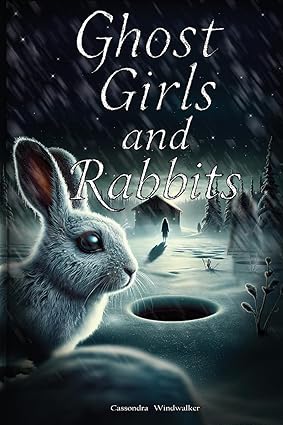
Ghost Girls and Rabbits by Cassondra Windwalker

Polymath Press, 2025

ISBN: 9781961827097

Available: ebook, paperback

Buy: Bookshop.orgAmazon.com


Noni Begay, a young Athabascan woman, has just been elected as the United States senator for Alaska when she disappears. Her campaign manager, Mary Nelson, has a daughter, Ryska, who has been missing for 10 years, and thinks Noni’s disappearance, as a beautiful, popular politician from the powerful Athabascan tribe, can be used to bring renewed attention to Ryska’s case. She is certain Ryska is still alive, and as Noni’s campaign manager and friend she is able to keep media attention on them. But keeping Ryska’s story in the public eye means Noni can’t reappear until Ryska is found. Alaska’s a big state, though, and Mary has a cabin in the woods that is off the beaten track.


Mary tortures Noni, starting with burial alive, to prevent her from attempting escape, and dehumanizes her by thinking of her only as “the seal pup”.. Mary is compartmentalizing, still publicly playing the part of  Noni’s grieving friend and campaign manager and working as a political operative, but that can’t last forever, and slowly she crumbles inside, with only the “seal pup” and life in the cabin to comfort her. I’m not sure why Mary wasn’t questioned more after Noni’s disappearance or how she could have gone back and forth so frequently without notice. But maybe the lack of treatment for mental illness or support for grieving parents, and even the lack of notice of her trips back and forth, illustrate the invisibility of indigenous women.


Noni’s struggle to preserve her identity and sanity, and even plan for the future in the midst of isolation, uncertainty, terror, and Mary’s erratic behavior, plays with storytelling, imagination, language, and mythology. Windwalker’s poetic writing flows here.


Windwalker approached the issue of missing and murdered indigenous women and girls from an unexpected angle, with one indigenous woman kidnapping and tormenting another to draw attention, as typically the crimes against these women are committed by white men. :This is not an easy read– unreliable narrators force the reader to question what’s going on, and it does get very dark at times– but it has moments of magic as well.  Highly recommended.


Reviewed by Kirsten Kowalewski


Book Review: Cure by Kali Metis

Cure by Kali Metis

Running Wild Press, 2022

ISBN: 9781955062312

Available: Paperback, Kindle edition

Buy:  Bookshop.org  | Amazon.com


Cure is an entertaining, fresh take on werewolves in today’s world.  It isn’t the standard “bite and claw” wolf-fest, but focuses more on their place in the present.


The plot is the best part, due to the nature and overall scope.  Luna Auber is an expert confectioner at a specialty bakery.  She has a normal life, except for the nerve problems and shaking she occasionally experiences.  Her brother’s suicide and last request lead her to Sweden, where she learns of her lycanthropic heritage, which explains her shakes– they’re the first step of her transformation.


The tale expands into a country-wide story involving two different werewolf societies, and that’s a big part of the book’s appeal.  This isn’t just one wolf or pack running wild, decimating an area.  Instead, the focus is the competing philosophies of the two groups, and how they believe werewolves should behave in the modern age.  Luna is the lens the reader sees both groups through as she learns more about them, and she  eventually has to choose a path.  This is a bit like a political thriller: it’s an unusual and intriguing way to write a werewolf story.


Luna’s character, with her unpredictability and her own doubts, drives the story effectively, She isn’t an anti-hero, but isn’t a fighter for justice either– at least not all the time.  She is emotional, impulsive, and makes some stupid decisions with her newfound abilities, like most people would probably do.  She sometimes uses her powers for her own benefit, without respecting the gift (or curse) she has been given.  This goes a long way towards making her a realistic character, and fits well with the overall narrative.


Some minor quibbles: the chapters are VERY short, and there is a lot of back and forth between two timelines in the first half of the book.  That might be good for the short attention span that so many younger people seem to have, but I found it frustrating.  There are also times where the sentences seem fragmented.  Tweaking that would have helped the flow of the reading.


Cure is a good story that takes the old  ‘howl at the moon’ model of werewolves and does something different with it. It’s worth reading. Recommended.


Reviewed by Murray Samuelson


Book Review: His Unburned Heart (Selected Papers from the Consortium for the Study of Anomalous Phenomena #1) by David Sandner

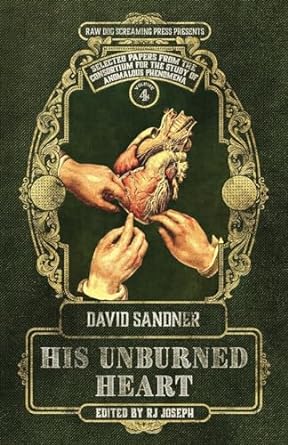
Cover art for His Unburned Heart by David Sandner

His Unburned Heart (Selected Papers from the Consortium for the Study of Anomalous Phenomena #1) by David Sandner

Raw Dog Screaming Press, 2024

ISBN-13 ‏ : ‎ 978-1947879768

Available: Paperback

Buy: Bookshop.org  |  Amazon.com


His Unburned Heart is the first in a series of novellas connected by a frame story of being published by the fictional Consortium for the Study of Anomalous Phenomena. Monster Librarian has previously review volume 2, 12 Hours, and volume 3, Asylum. They’re all very different in tone, topic, and style: what they have in common is that each is about an inexplicable change to reality.


The first half of His Unburned Heart is a novella of the same name, and a reasonably straightforward piece of historical fiction. Prior knowledge of the people and events is helpful in providing context. Mary Shelley is well known as the author of Frankenstein. She lived an unconventional life as a young woman, marrying the notorious Romantic poet  Percy Shelley.. He and a friend set off sailing into a major storm over Mary’s objections, and disappeared. Their bodies were washed ashore much later. Italian laws about contagion meant that Percy’s body would have to be burned, but Mary, as a woman, was not allowed to come. Instead, his publisher Leigh Hunt, and their friends Edward Trelawney and Lord Byron attended. After the body had burned, Trelawney saw that Shelley’s heart had not burned away and pulled it out of the ashes. Leigh Hunt left with Shelley’s unburned heart. Those are the facts.


Sandner’s novella has Mary determined to witness Percy’s cremation regardless of what the law says. She goes to her friend Mrs. Mason, who disguises her as a man, allowing her to pose as one of Lord Byron’s footmen (Lord Byron sees through the disguise but says nothing). On seeing that Leigh Hunt has kept Percy’s heart, she visits and demands it back, but he refuses, so Mary enlists her stepsister Claire into helping her break in and steal the heart (Mary had a complex relationship with Claire, with a history that is only obliquely referred to: Sandner captures this in just a few lines). Sandner’s spare style uniquely draws characters whose thoughts can’t be guessed, such as Lord Byron.


The second half of the book is titled “The Journal of Sorrow”. In it Mary first recounts the weeks and days before Percy left on his trip, including a vivid description of a miscarriage where she nearly bled to death before a doctor could arrive at their isolated home, Percy’s intervention of bathing her in freezing water saved her life. The  depiction of her miscarriage, bleeding, and freezing, is terrifying and has a visceral impact.


This prologue is followed by a series of dreams or imaginings of Percy’s last hours: In her journal, Mary writes, “Some stories cannot be told except as fragments, as dreams, fits… I hold them out to you–dead leaves to quicken some new birth…” These short fragments all approach his drowning and death from different imagined angles, and somehow this unconventional, stream-of-consciousness style of writing becomes not only a series of strange encounters with Shelley and the deep, but a shape of Mary’s feelings about him. I found The Journal of Sorrow and its intense, brief, and dreamlike writing to be an incredibly powerful expression of imagination, guilt, grief, anger, regret, and love.


His Unburned Heart does require background knowledge to be fully appreciated, but this is a perfect Valentine’s gift for the horror lover, and for those readers especially interested in the lives of Mary and Percy Shelley this is a treat. Recommended.


Reviewed by Kirsten Kowalewski