Both movies and books lend themselves to new interpretations of existing works- some that can be taken more seriously than others. Dracula, the classic novel by Bram Stoker, is an excellent example of this. In the original novel, and in early movies based on the story such as Nosferatu and Universal Studios’ Dracula (reviewed on our Monster Movie Month page in the section on Vampires, women are depicted as passive victims, but more recent versions (such as the novel Dracula in Love by Karen Essex, reviewed here, and Francis Ford Coppola’s movie Bram Stoker’s Dracula, ) suggest that they may be more independent both in their thinking and in their sexuality. It’s worthwhile, I think, to consider how the horror in the story, or at least the way it’s perceived, has changed with the times. Krista Cox addresses this in a paper published in the journal New Views on Gender, titled “The Blood is the Life: How Bram Stoker’s Dracula Puts Life Back in Women’s Hands”, and she offered to share her take on the differences between the original novel and the Coppola movie. Agree or disagree, it’s clear that there’s a lot of room for new visions of this classic tale in many forms. Fair warning: Krista writes pretty explicitly about sex and blood-drinking…. so you might want to make sure you don’t have a nosy kid attempting to look over your shoulder. Or skim down to the bottom for some Dracula-related links. And now, here’s what she has to say.
The Blood is the Life
Sexy vampires are “in” these days, but they’re nothing new. The sexual themes in Bram Stoker’sDraculaare impossible to miss; the novel has several scenes with vivid sexual imagery, fangs are phallic in shape, and the act of vampirism is literally penetration. Joseph Valente writes in his 2003 introduction to the novel that blood in Dracula is “a metaphor of sexual fluids,” vampirism “a metaphor of sexual appetite,” and vamping “a metaphor of sexual conquest.” If vampirism is an allegory for the surfacing of repressed sexual desires, Valente contends that the efforts of Van Helsing and the four men who love Lucy and Mina to rescue them from Dracula are “the enforcing of orthodox Victorian constraints on female sexuality.” In short, the women must be saved from becoming sexually-driven beings so that they can remain pure, as expected of them by their men. To show what’s expected of a lady in Dracula, Stoker completely desexualizes the female characters. Lucy wins the love of three of the men in the novel. But even in their private journals, the men don’t write a single sexual word about her. Even more dramatically, Mina is completely desexualized and is seen, even by her husband, as an odd combination of mother and child. The women can’t help but welcome Dracula’s vampiric advances, though. After she is bitten, Mina recalls, “I did not want to hinder him.” Lucy actively participates in the vamping, sleepwalking to the most likely location for vampiric intercourse and repeatedly removing the garlic necklace meant to repel Dracula while she slept. Ultimately, Lucy becomes undead herself, and begins not only accepting vampiric advances, but initiating them herself. Lucy is violently punished for this conversion to undaunted sexuality. The men take savage delight in driving a stake through her heart and decapitating her, and the scene is full of vivid sexual imagery. Lucy’s fiancée must thrust the stake again and again, “deeper and deeper,” as Lucy moans and writhes. When he finishes, he collapses, gasping and sweaty, reminiscent of post-orgasmic relief. Lucy returns, suddenly, to the pristine, virginal creature she was before. The men send a clear message that sexuality is reserved for them, alone by “saving” Lucy from sexuality. It’s not just sexual dominance, though, that the men wish to reestablish. Vampirism is the means by which vampires procreate. The mingling of blood creates a new vampire, blood in the novel is a symbol for sexual fluids, and the mingling of sexual fluids creates a new human. Vampirism and intercourse are both acts of passion and procreation. This allegory becomes even more interesting when you consider that blood plays an indispensable role in human procreation. Just as blood is sustenance to the vampires, blood is a life-giving fluid for humans, providing oxygen and nutrients to a fetus in utero. Without the blood of a mother, human procreation is impossible. This gives women a very particular, special role in human procreation. In human women, the blood is the life. By controlling female sexuality, the men of Dracula seek not only to control women, but to control the creation of new life. The film Bram Stoker’s Dracula, directed by Francis Ford Coppola, clearly embraces Valente’s theory of vampirism as a symbol of sexuality. In fact, it lifts it out of metaphor and makes vampirism an actual act of sex. In the film, every act of vamping is accompanied by an explicit sexual act. Coppola departs from Stoker’s message of male dominance over female sexuality and the creation of life, though. Rather than being desexualized, the women in the film are overtly and independently sexual. They speak freely about the pleasures of sex and openly pursue their suitors. Mina even willingly participates in infidelity with Dracula. By contrast, the men are presented as bumbling, inept fools, rather than the dashing saviors of the novel. When Lucy becomes a vampire in the film, her offing is dramatically different from the novel. In the novel, the undead Lucy is “more radiantly beautiful than ever,” but the undead Lucy of the film is unattractive and asexual. The destruction of the undead Lucy carries none the sexual undertones of the scene in the novel; she lies perfectly still as the stake is driven into her heart, and her killer does not collapse in post-coital exhaustion after the deed is complete. There is no sense that Lucy is being punished for her sexuality; rather, it would appear she is being punished for her departure from it. The power and control of women in Bram Stoker’s Dracula is further reinforced by Mina’s relationship with Dracula. When they first meet, she coldly rejects him. Later, as he confesses that he is soulless, he cowers away from her, weak and filled with shame. In the novel, Dracula forces himself upon Mina, but in the film, Mina consciously chooses to drinks his blood despite his protests. Like Lucy, Mina is in control of her sexuality and in control of the men in her life. While the finale of the novel sees the men gallantly “saving” Mina from the fate of a life of “voluptuous wantonness” as a vampire, the finale of the film is the ultimate display of feminine mastery of life. When Mina selflessly sacrifices her love, Dracula, she is released from the life of the undead. Further, she releases Dracula from his prison of immortality to join his first love in eternal life. From what was undead, she created life. Dracula made heroes of those who pursued Dracula to preserve the paternalistic construct that gave them power over female sexuality and the creation of life. Bram Stoker’s Dracula rejected that construct, making women the ultimate controllers of both female and male sexuality. It made a hero of the woman who embraced her power and sexuality and allowed no man to claim them – even Dracula. In Bram Stoker’s Dracula, Mina created life where the men in Dracula only destroyed it.
*******************************
Are you intrigued enough to try out additional interpretations of Dracula? Here’s a good Dracula filmography from PBS’ Masterpiece Theatre. Want to try a book instead? Check out our reviews of adult vampire fiction here, and our reviews of young adult vampire fiction here (including Kate Cary’s excellent novel Bloodline, loosely based on Dracula). We have some graphic novel adaptations of Dracula on ouryoung adult graphic novels page, and if that doesn’t satisfy your appetite, you can visit our YA vampire fiction blog Reading Bites. Be warned, though, when making recommendations, that Dracula doesn’t sparkle. Stoker’s novel, and its children, have sharp teeth.
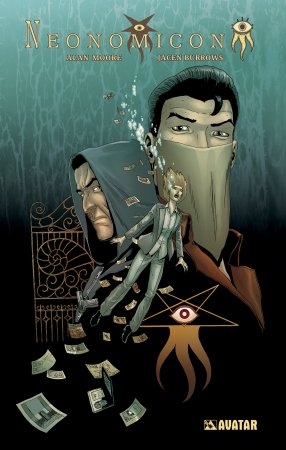 Well, here we go again. Alan Moore’s graphic novel Neonomicon has been removed from the shelves of the Greenville Public Library in Greenville, South Carolina after a parent challenged it (The parent in question apparently thought from looking at the cover that it was a child’s murder mystery. WHAAT? In my wildest dreams I would NEVER guess this was the cover of a child’s murder mystery). But wait, there’s more to this story. The library’s internal review committee voted to keep it on the shelves. Access Manager Barbara Yonce was quoted as saying “it was purchased on the basis of being an award winner and on the reputation of the author, but then with further consideration, we decided that those qualifications were outweighed by some of the disturbing content of the item.” The library director, Beverly James, decided to overrule the committee’s recommendation based on her own personal reaction, and told the media the removal was based on the committee’s recommendation. Her words (from the Greenville Journal):



Follow Us!