Home » Posts tagged "epic fantasy"

Book Review: The Court of Pe’kar (Lost Carcosa #4) by Joseph Sale

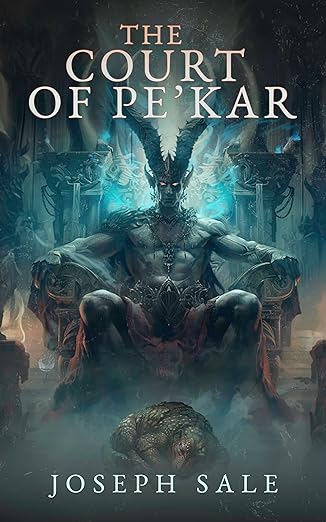
Cover art for The Court of Pe'Kar by Joseph Sale

The Court of Pe’kar, by Joseph Sale

Blood Bound Books, 2024

ISBN: 9781940250687

Available: Paperback, ebook edition


The Court of Pe’kar is the penultimate story in Joseph Sale’s riveting Carcosa series, and it does an outstanding job setting the stage for the final volume, while being an excellent addition to the series based on its own merits.  


This fourth volume has more of the feel of the first two in the series: quick pacing, tangible enemies, and good head-crushing, stomach-tearing battles.  The third volume, while good, took the series in a more cerebral, introspective direction, where the adversaries were contained within the characters themselves.  With The Court Of Pe’kar, it’s back to the prior approach, as Alan Chambers, Queen Cassilda, and their companions, complete the journey to the City of Demons to face off with Pe’kar the Demon King, and Cassilda’s traitorous sister Cali. 


While most of the chapters focus on the protagonists, some of the earlier chapters feature Cali.  The author makes the most out of these chapters, using them to sow doubt about Cali’s final intentions toward Pe’kar, when it appeared that she was previously in league with him.  The story takes a somewhat similar turn with Pe’kar, as his intentions towards Alan and his party, as conveyed by his minions, are not at all what the group expects.  That’s what the narrative does best in this volume.  The actions of some of the characters cause some of the others to view their own intentions with a level of dubiousness, making for an exciting, yet unpredictable story.  It’s best exemplified by a meeting between Cassilda and Cali towards the end, which may be the best part of the book.  Alan’s group may have been united in their quest to eliminate Cali, but as she and others become unpredictable and show other facets of themselves previously hidden, the heroes have to question if the desired result would benefit the land of Carcosa, or themselves.  In all fairness, although Alan Chambers was the driving force behind the series in the beginning, it’s a bit more about Cassilda and Cali, and their relationship as sisters and mortal enemies, which is now the focus.  Of course, that may very well change in the final volume, as the author has proven adept at surprising readers.  


Worth noting also, the final battle in this book is a thrilling collage of bloodshed: it’s almost as good as the epic battle that closed out volume two.  


While it’s kind of sad when you can see the journey start to end as the series nears its conclusion, it’s been a hell of a ride getting there, and still is.  We probably won’t see another fantasy series this good anytime soon. Most definitely recommended!


Reviewed by Murray Samuelson


Book Review: Saint Death’s Daughter by C.S.E. Cooney

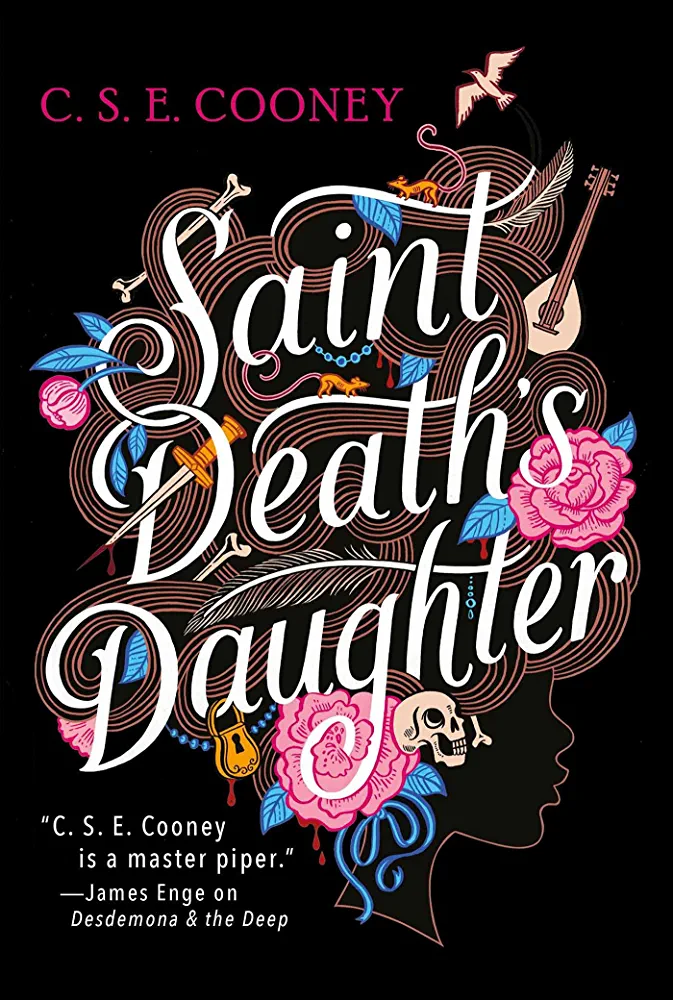
Cover art fo Saint Death's Daughter by C.S.E. Cooney

Saint Death’s Daughter by C.S.E Cooney.

Solaris, 2022

ISBN-13: 978-1786184702

Available: Hardcover, paperback, Kindle edition, audiobook. ( Bookshop.org  |   Amazon.com )


Miscellaneous Stones, born into a family known for its violence in service to the crown of Liriat, is a teenage necromancer with an allergy to violence that opens “echo wounds” when violence is done or described. When her parents die, her family is left indebted to a banker’s family with connections to Liriat’s enemy, the Blackbird Bride.


Lanie’s sister Nita returns to renegotiate the debt, and does so by agreeing to work for the Queen of Liriat to kill all 24 of the Bride’s consorts. Nita has returned with an unwilling fiance, a gyrgard, who can shapeshift into a falcon and usually has a soul-bonded partner. The gyrgard, renamed Mak, attempts to poison himself rather than stay with Nita, but Lanie, unwilling to experience the echo wound that would be caused by his suicide, brings him back by calling on Saint Death, one of the 12 Lirian gods.


In order to prevent having his memories wiped, Mak swears loyalty to Nita, and they have a child, Datu, who is raised primarily by Lanie and Mak, while Nita assassinates the members of the Bride’s parliament. Finally, the Bride kills Nita, pronounces a death sentence on Datu, and tries to seduce Lanie into joining her court. Lanie, Mak, and Datu, along with the family revenant and the entrapped ghost of Lanie’s necromancer grandfather, flee to hide in the city of Liriat Proper to protect Datu.


In the city, Lanie, Mak, and Datu make truly good friends willing to help with their problems. Lanie also has a romance with Canon Lir, second son of the queen, and a priest to the many-gendered god of fire. Then Lanie has a serious echo wound in public that reveals their location to the Blackbird Bride, and Mak and Datu flee. Lanie has made a promise to her family’s revenant she must follow through, protect Datu, and bring down the Bride.


I know Harrow the Ninth is the big name in literary necromancers right now, and she’s a much more horror-tinged character, but Lanie is my favorite necromancer character ever. Compassionate and loving to the living, dead, and undead, sometimes unwise, she honors her goddess.The allergy to violence and refusal to enthrall others, and her relationship with Lir, make her unusual.


This is a long book, but with surprising twists, fascinating world building, great character development, and beautiful prose. Highly recommended.


Reviewed by Kirsten Kowalewski


Book List: Black Authors of Speculative Fiction

This is not so much a book list as a list that will lead you to books.


I like to browse at the library (a pastime, unfortunately, that is on hold for the time being) and have discovered a lot of interesting authors that way. The new books section there is how I discovered Nnedi Okorafor, Rivers Solomon, and C.L. Polk. While I was encountering these authors for the first time, there was also a push for readers to deliberately work on including more diverse writers in their reading material.  Both then and now there’s an argument made that readers should just read what they want, without considering the race of the author.  It is valid to read just what you want to read, or to read the same kind of thing (or the same book) over and over– as Ranganathan says, every reader his book. But why not push your boundaries a little? If what you’re looking for is a good story, there are a lot of good stories you might miss out on if you aren’t deliberately seeking out Black authors. There is frequently a different aesthetic to their books, and the stories can catch you in ways you don’t expect. This difference leads to looking at speculative fiction genres through a new lens. In the case of Black people in the African diaspora, that aesthetic is generally referred to as Afrofuturism, a term first coined by Mark Dery. Nigerian writer Nnedi Okorafor recently differentiated that from the writing of Black Africans, which she identifies as Africanfuturism (you can read about that on her website, which I’ve linked to below, just scroll down to her name). Definitely, not everything Black writers come out with falls into this aesthetic. Considered althogether, Black speculative fiction covers a broad range of approaches to science fiction, fantasy, folkloric, and fluid fiction (a term coined by literary theorist Kinitra Brooks).  If you haven’t tried it,  look up some of these authors. I think you’ll find something you like.

I’m going to note that these are extremely brief and incomplete summaries, and it is a far from complete list. To learn more about these authors and their books click on the links. Enjoy!


Steven Barnes (Goodreads):  Barnes writes alternative history, science fiction. horror, nonfiction, sometimes with Tannarive Due or other co-authors.

Tannarive Due (author website) : Due writes horror and nonfiction, sometimes with Steven Barnes. Due is an academic who teaches and writes about Black speculative fiction, particularly horror.

Jewelle Gomez (author website) : Jewelle Gomez is best known as the author of The Gilda Stories, about a black lesbian vampire. She has written poetry, plays, and essays.

N.K. Jemisin (author website): N.K. Jemisin writes Afrofuturistic science fiction and fantasy. Jemisin won three consecutive Hugo awards for Best Novel for the books in her Broken Earth Trilogy.

Walter Mosely (author website): mysteries, science fiction, nonfiction.  Mosely is best known for his Easy Rawlins mystery series but has written in a variety of genres.

Samuel R. Delany (author website): science fiction, LGBTQ+ fiction, nonfiction. Delaney is the first Black person to be recognized as a modern science fiction writer.

Wrath James White (publisher website). interviews at Monster Librarian : extreme horror. Click on these links to see our reviews: Yaccub’s CurseSucculent PreyThe ResurrectionistSacrificeSloppy Seconds,and Vicious Romantic

Sumiko Saulson (author website): horror, graphic novels, nonfiction on black women in horror. In addition to writing fiction, Saulson is the compiler of 100 Black Women in Horror (click here to see our review)and editor of the anthology Black Magic Women: Terrifying Tales by Scary Sisters. 

Octavia Butler (official website of the Octavia Butler Estate): science fiction, alternative history, dystopian fiction Butler was the first recognized black woman author of modern science fiction and an inspiration for many Afrofuturist authors. See our review of her Earthseed Trilogy, which includes Parable of the Sower and Parable of the Talents here.

Tomi Adeyemi (author website) : YA Africanfuturist fantasy. Adeyemi is the bestselling author of the Legacy of Orisha series.

Evan Winter (Goodreads)interview at Tor.com: Africanfuturist epic fantasy.

Nnedi Okorafor (author website), Goodreads: Okorafor is an award-winning Nigerian-American science fiction and fantasy author who defines herself as an Africanfuturist and Africanjujuist (visit her author website for her explanation)

P. Djeli Clark (author website): Clark is an academic who writes nonfiction on Black speculative fiction, as well as a writer of Black speculative fiction, including alternative history, science fiction, and fantasy.

Victor LaValle (author website): Lavalle teaches at Columbia University. He writes horror, science fiction, and fantasy. Lavalle has won the Bram Stoker Award for his novella The Ballad of Black Tom (for our review click here) and the graphic novel Victor Lavalle’s Destroyer (for our review, click here).

Nalo Hopkinson (author website): Born in Jamaica, Nalo Hopkinson describes herself as a writer of fantastical fiction. She’s written nine books, including the award-winning Brown Girl in the Ring. She’s a professor of creative writing at the Univeristy of California Riverside.

Alaya Dawn Johnson (author website): is the author of YA and adult urban fantasy and speculative fiction, including the Andre Norton award-winning Love Is the Drug at the Nebula Awards.

C.L. Polk (author website): C.L. Polk is the author of the Kingston Cycle, a fantasy which takes p;ace in a steampunk-like setting similar to Edwardian England. The first book, Witchmark, won the World Fantasy Award and was nominated for the Lambda, Nebula, Locus, and Aurora awards.

Daniel Jose Older (author website) : Daniel Jose Older’s writing includes historical fantasy for middle-graders, the award winning YA Shadowshaper series, and adult urban fantasy .

C.T. Rwizi: C.T. Rwizi is originally from Zimbabwe and Swaziland, lived in Costa Rica and the United States, and now resides in South Africa. His debut fantasy novel, Scarlet Odyssey, was just released. Read our review here.

L.L. McKinney (author website): McKinney is the author of the YA Nightmare-verse dark fantasy books, beginning with A Blade So Black.

Rivers Solomon (author website): Solomon’s first book, An Unkindness of Ghosts, was a finalist for the Lambda, Tiptree, Locus, and Hurston/Wright awards and won a Firecracker Award. Their novella, The Deep, a collaboration with the musical group Clipping (which includes Daveed Diggs, formerly of Hamilton) is an outstanding work of Black speculative fiction. Read our review here.

Valjeanne Jeffers (Goodreads), (author website): Jeffers is the author of the Immortals series. She has published fantasy, science fiction, and erotica, particularly in Afrofuturist subgenres such as steamfunk and cyberfunk

Justina Ireland (author website): Ireland is the author of the YA alternate history horror novel Dread Nation and its sequel, Deathless Divide. She has also written other YA fantasy novels and writes for the Star Wars franchise.

Nicky Drayden (author website): Drayden writes Afrofuturist science fiction and fantasy.

Andrea Hairston (author website):  Hairston is a playwright, novelist, and professor of theatre and Africana at Smith College. She is a feminist science fiction writer who has published novels, plays, and essays. Her book Redwood and Wildfire won the Tiptree and Carl Brandon Society awards.

Rebecca Roanhorse (author website): Roanhorse is an award-winning speculative fiction writer who has both Ohkay Owingeh Pueblo and African-American heritage. She has written post-apocalyptic urban fantasy and middle-grade fantasy, and writes for the Star Wars franchise.