Home » Posts tagged "Dracula" (Page 2)

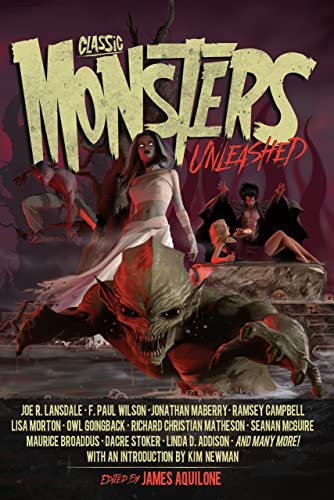
Book Review: Classic Monsters Unleashed edited by James Aquilone

Classic Monsters Unleashed edited by James Aquilone

Black Spot Books, 2022

ISBN-13: 9781645481218

Available: Kindle, Audible, paperback, hardback Bookshop.org | Amazon.com )


Classic Monsters Unleashed includes one poem that opens the anthology, followed by twenty-nine stories featuring, well, classic monsters. Dracula, the Invisible Man, Frankenstein, the Mummy, and the Wolf-man are included in this homage to classic monsters. The list does not end there. Nosferatu, Captain Kronos, the Headless Horseman, the Blob and more, all find space in this anthology. I have narrowed my favourites down to my top ten, but that was difficult. Each story deserves its own time in the spotlight, really.


In Jonathan Mayberry’s “Hollenlegion,” Nazis search for the allegedly abandoned island of Dr. Moreau. Simon Bestwick’s “Mummy Calls” is one of the best, and most humorous, stories in the collection. Written as a submission letter to the anthology editor, Simon explains the story of the “Manchester Mummy” and how real she actually is. Lucy A. Snyder gives us a unique story of the Phantom of the Opera meeting Jack the Ripper in “The Viscount and the Phantom.” I do not want to give anything away, so I will just leave it at that. In “Modern Monsters” by Monique Snyman, a whistleblower contacts the crew of paranormal reality show Modern Monsters to document a science experiment gone wrong. There is some body horror in this one, but not so much that it gets too gruesome. “Hacking the Horseman’s Code” by Lisa Morton is a modern day take on The Legend of Sleepy Hollow. Gil contracts a Headless Horseman AI for Halloween festivities, much to his wife’s chagrin. To mess with a political rival, he alters the AI’s programming, which backfires spectacularly. Maurice Broaddus gives us a unique vision with his “The Invisible Man: The Fire This Time.” Broaddus weaves his story through a societal racial critique that is well done and very powerful. Mercedes M. Yardley’s “The Picture of Doriana Gray” is an excellent gender-swapped take on The Picture of Dorian Gray. Crystal Sapphire, a popular social media influencer, makes a new friend who in turn influences her. In “Da Noise, Da Funk, Da Blob” by Linda D. Addison, we are presented with the Blob in a new light and Its purpose for landing on Earth. Leverett Butts and Dacre Stoker’s “Enter, the Dragon,” told through text chats, emails, YouTube transcriptions, and CCTV coverage in the shadow of COVID, tells the story of a man kidnapped by an underground group to resurrect Vlad Tepes. It’s Dracula with a dash of the X-Files. Rounding out the anthology is Joe R. Lansdale with “God of the Razor,” focusing on an antique dealer who unexpectedly meets with Jack the Ripper. 


Other authors who contributed great additions to this anthology include Gary A. Braunbeck, Ramsey Campbell, JG Faherty, Geneve Flynn, Owl Goingback, Michael Knost, Alessandro Manzetti, Rena Mason, Richard Christian Matheson, Seanan McGuire, John Palisano, Lindy Ryan, Carlie St. George, David Surface, Gaby Triana, Tim Waggoner, Paul Wilson, Kelsea Yu, Sean Eads, and Joshua Viola.


I would be remiss if I did not mention the incredible artwork. Artists include Zac Atkinson, Frank Frazetta, Jeremiah Lambert, Sam Shearan, and Colton Worley. 


Pick this up if you want an anthology that pays homage to both the traditional classic monsters, as well as ones that do not get much attention.  Highly recommended.


Reviewed by Lizzy Walker
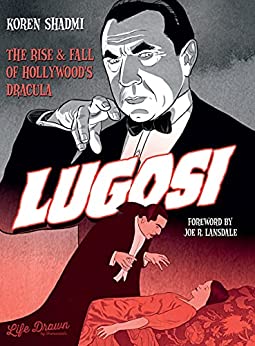


Graphic Novel Review: Lugosi: The Rise and Fall of Hollywood’s Dracula by Koren Shadmi

Cover art for Lugosi by Koren Shadmi

Lugosi: The Rise and Fall of Hollywood’s Dracula by Koren Shadmi

Life Drawn, 2021

ISBN-13: 978-1643376615

Available: Paperback, Kindle, comiXology Bookshop.org  |  Amazon.com )


Lugosi: The Rise and Fall of Hollywood’s Dracula is a graphic biography of one of the most recognizable men to portray Dracula, Béla Ferenc Dezső Blaskó, or simply Bela Lugosi. Shadmi tells the story of the young Bela fleeing Hungary after a failed Communist revolution in 1919. Upon coming to the United States, he “reinvents himself”, acting on stage and screen, eventually being cast as the titular vampire count in 1931’s Dracula. However, Lugosi’s constant vices and failed marriages haunted him throughout his career and beyond.


Shadmi did not hold back with Lugosi, opening with Lugosi in 1955 admitting himself to the Motion Picture and Country House Hospital in an attempt to defeat his heroin addiction. From there, we are taken to Lugos, Hungary in 1893 where a young Bela is acting in a field after becoming entranced by a traveling acting troupe that recently left. A group of bullies attack him, and then he returns home to his strict, banal parents. Soon after, Bela faces the death of his father and the hatred of his mother. At this point, he takes some of his possessions and leaves home. The story then switches back to Bela in the hospital where he is facing detox, hallucinations, and the physical and emotional pain that tortures him. The rest of the book follows in this manner, going from sepia colored modern day to crisp black and white telling of the past. More of Bela’s past is revealed, including affairs, drug addiction, arrival in the United States, struggles with Hollywood, his rivalry with Boris Karloff, acting for the notorious Ed Wood, Jr., and more, while Lugosi faces his demons in the hospital. It is a powerful biography fans of Lugosi should read.


Shadmi has become one of my favorite creators. Lugosi: The Rise and Fall of Hollywood’s Dracula will be another graphic biography on my bookshelf. Highly recommended.


Reviewed by Lizzy Walker
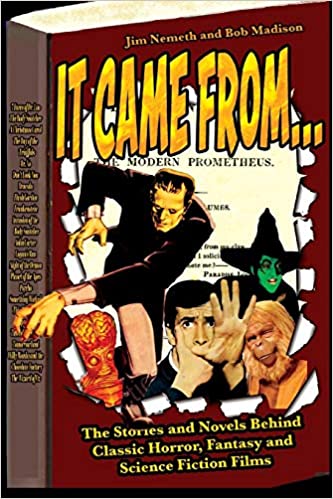
Book Review: It Came From: …The Stories and Novels Behind Classic Horror, Fantasy, and Science Fiction Films by Jim Nemeth and Bob Madison

cover art from It Came From... by Jim Nemeth and Bob Madison

(  Bookshop.org )

It Came From:  …The Stories and Novels Behind Classic Horror, Fantasy and Science Fiction Films by Jim Nemeth and Bob Madison

Midnight Marquee Press, Inc., 2020

ISBN-13: 9781644300916

Available: Paperback

In this book, critics Jim Nemeth and Bob Madison explore genre films and the written works that inspired their creation,  Each is presented in its own section, chronologically, and the written works that inspired them. While this book primaritly covered fantasy and science fiction films, this review will concentrate on the aspects of  the horror genre presented. The authors include information on the production of the films, as well as the differences between the texts and the movies. At times they also posit the view that the film may be better than the books, a controversial opinion among some audiences.

The author of the horror section introduction argues that horror is the most difficult genre to adapt because movies “that merely provides a book’s ‘Boo!’ moments are but empty shells, lacking the underlying background and context that frequently makes the literary piece the more satisfying experience” (p. 12). He then moves to his example of The Shining. While I do not necessarily agree completely with the author, he does make some interesting points. Films included in the horror section include The Body Snatcher, Invasion of the Body Snatchers, Night of the Demon, Psycho, The Day of the Triffids, and Don’t Look Now.

Two titles receive special treatment in that they each have a significant chapter devoted to them: Dracula and Frankenstein. The authors look at “several of the best, worst, and most popular of their cinematic incarnations” (p. 11). Dracula films covered range from Nosferatu (1922) to Bram Stoker’s Dracula  (1992), while the Frankenstein films range from the first film version of Frankenstein (1910) to Victor Frankenstein (2015).

My primary criticism of the book is focused more on the overall contents rather than specific chapters. The authors interject their own opinions into the chapters in a way that can be a bit heavy handed. For instance, when it comes to science fiction, one of the authors makes it abundantly clear that he does not like the gritty, darker, current sci-fi storylines. Additionally, while it seems that each chapter is written by an individual author, it is difficult to tell who wrote which one.

This could be a good resource for anyone interested in exploring the literature upon which genre films are based, as long as readers are aware that the authors’  strongly expressed opinions are interspersed throughout.

Recommended with reservations.


Reviewed by Lizzy Walker