Home » Posts tagged "dark fantasy"

Book Review: The Court of Pe’kar (Lost Carcosa #4) by Joseph Sale

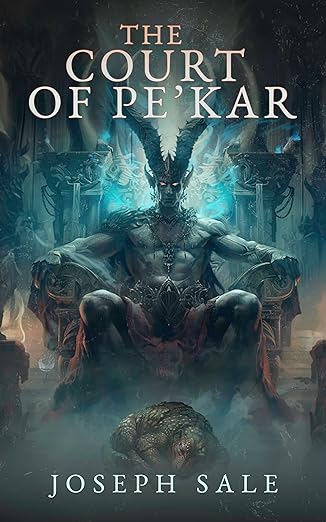
Cover art for The Court of Pe'Kar by Joseph Sale

The Court of Pe’kar, by Joseph Sale

Blood Bound Books, 2024

ISBN: 9781940250687

Available: Paperback, ebook edition


The Court of Pe’kar is the penultimate story in Joseph Sale’s riveting Carcosa series, and it does an outstanding job setting the stage for the final volume, while being an excellent addition to the series based on its own merits.  


This fourth volume has more of the feel of the first two in the series: quick pacing, tangible enemies, and good head-crushing, stomach-tearing battles.  The third volume, while good, took the series in a more cerebral, introspective direction, where the adversaries were contained within the characters themselves.  With The Court Of Pe’kar, it’s back to the prior approach, as Alan Chambers, Queen Cassilda, and their companions, complete the journey to the City of Demons to face off with Pe’kar the Demon King, and Cassilda’s traitorous sister Cali. 


While most of the chapters focus on the protagonists, some of the earlier chapters feature Cali.  The author makes the most out of these chapters, using them to sow doubt about Cali’s final intentions toward Pe’kar, when it appeared that she was previously in league with him.  The story takes a somewhat similar turn with Pe’kar, as his intentions towards Alan and his party, as conveyed by his minions, are not at all what the group expects.  That’s what the narrative does best in this volume.  The actions of some of the characters cause some of the others to view their own intentions with a level of dubiousness, making for an exciting, yet unpredictable story.  It’s best exemplified by a meeting between Cassilda and Cali towards the end, which may be the best part of the book.  Alan’s group may have been united in their quest to eliminate Cali, but as she and others become unpredictable and show other facets of themselves previously hidden, the heroes have to question if the desired result would benefit the land of Carcosa, or themselves.  In all fairness, although Alan Chambers was the driving force behind the series in the beginning, it’s a bit more about Cassilda and Cali, and their relationship as sisters and mortal enemies, which is now the focus.  Of course, that may very well change in the final volume, as the author has proven adept at surprising readers.  


Worth noting also, the final battle in this book is a thrilling collage of bloodshed: it’s almost as good as the epic battle that closed out volume two.  


While it’s kind of sad when you can see the journey start to end as the series nears its conclusion, it’s been a hell of a ride getting there, and still is.  We probably won’t see another fantasy series this good anytime soon. Most definitely recommended!


Reviewed by Murray Samuelson


Book Review: A Liar’s Twisted Tongue (The Fated Blood Trilogy #1) by Caroline Cusanelli

Cover art for A Liar's Twisted Tongue (The Fated Blood Trilogy #1)


A Liar’s Twisted Tongue (The Fated Blood Trilogy #1) by Caroline Cusanelli

Caroline Cusanelli, 2025

ISBN-13 ‏ : ‎ 979-8990027831

Available: Hardcover, paperback, audiobook, Kindle edition

Buy: Bookshop.orgAmazon.com


Desdemona’s community is barely surviving under the noses of the brutal Nepenthes. One day, Desdemona’s mother hands her a protection necklace and pushes her through a portal as the monstrous Arcanes descend on their home. The portal opens onto the grounds of Visnatus Academy, a school for the elites of Ilyria, Folkara, Eunaris, Draevia, and Nepthara, all of whom have different magical powers. Desdemona has a letter identifying her as the secret child of a famous Folk general that gains her probationary admission to the academy, but she just wants to go home to her mom.


Despite the letter, I wasn’t convinced that Desdemona, thrown headfirst into a disorienting situation she could not possibly understand, could have survived the brutal Visnatus Academy for even a few minutes without being caught out, or that she would immediately find allies despite her behavior and attitude. She’d need My Fair Lady levels of training, and she barely has a believable cover story.


Meanwhile, Lucian, crown prince of Ilyria, has had an unpleasant surprise: his marriage has been arranged with Princess Calista of Folkara, while his sister Lilac will be marrying Prince Kai, Calista’s brother. Lucian is resigned to doing whatever his abusive mother, Queen Isa, tells him to, as she has the magical ability to drain his life force, but misery over their impending marriages inspires him to throw a party in the woods. There,  he is drawn into Desdemona’s attempt to open a portal back to her mom. While she is traveling in the portal, Lucian has a vision of them in the Void, an empty dimension where the powerful, monstrous Arcanes are trapped. Desdemona is able to communicate with her mother through the vision, and Lucian decides he needs her power to take his revenge on the Arcanes, who murdered his real parents, leaving him at Isa’s mercy. Desdemona’s power is over fire, and she doesn’t know how to control it (leading to some terrifying situations). Lucian, whose power allows him to manipulate and influence other people, offers to teach her if she will help him.


Romantasy leans heavily on tropes, but in any credible love story the reader should be able to figure out why the romantic leads like each other. That just isn’t present here. Desdemona is consistently hostile, rude, manipulative, and ungrateful. Lucian is arrogant, reckless, manipulative, and sometimes cruel. Both are dealing with trauma and repressed memories, acting in survivor mode, but not with empathy toward each other. While they occasionally have a tender moment, the memorable scenes are the ones that cross between violence and  their magnetic attraction to each other. This was offered to me as a “dark academia romantasy” It certainly has the atmosphere expected of an ominous boarding school for elite students found in dark academia, but leans harder into the outside fantasy world than into academic obsession, and is more focused on the dynamics of the leads with each other.


Romantasy fans who like morally gray characters  with heightened emotions will enjoy the intricate world-building, the high stakes, and the developing relationship between the two main characters. The end held some intriguing surprises, and readers who like this can look forward to a sequel.


Reviewed by Kirsten Kowalewski


Book Review: The Demon by Victory Witherkeigh


The Demon by Victory Witherkeigh

BookBaby, 2024

ISBN-13 ‏ : ‎ 979-8350951110

Available: Paperback, Kindle edition

Buy:  Amazon.com


The Demon  is a sequel to The Girl, a coming-of-age story grounded in Tagalog folklore and mythology, about a Filipina-American girl whose family has promised her body to a demon on her 18th birthday as part of fulfilling an ancestral pact, but will have to choose whether to fulfil it. I haven’t had the opportunity to read it, but I suspect The Demon makes much more sense if you’ve read The Girl. 


The Demon starts with the demon, Hukloban taking over the physical body of the girl, who is nameless in the book. It isn’t an easy transition, and not only is the demon now overwhelmed with the physical sensations of her mortal body, but she has lost her memories and most of her demonic powers. Since Hukloban cannot remember anything, it’s unclear why the girl was taken over, what bargain she made, or who she is. Second-in-command to Sitan, the Master of Death, when he asks her she cannot remember why she wanted to be part of the mortal world. Thousands of years old, the demon will have to find her way in the human world, while satisfying her demonic needs and fulfilling her end of the bargain, made with Filipino hero Lapu-Lapu, to keep his bloodline prosperous. As in her previous book, it is a story about making choices, self-determination, and being human. How does a death goddess manage the body, mind, and emotions of a teenage girl?


I found this compelling, but also confusing. Witherkeigh has written an ambitious story and is juggling a lot of balls: Hukloban’s story as a college student in the modern world, trying to reconstruct herself; her relationships with the girl’s family (there are a lot of them), where the girl’s relationships are entangled with her dulies to fulfill the bargain; the far past, when she initially met Sitan (I didn’t realize they were part of the Tagalog pantheon); the confusion of her love affairs and friendships; her frustration about the benefit Lapu-Lapu’s bloodline has taken from colonizers and dictators because of the bargain; the lack of choice available to women. There are some very adult themes and conversations about death, as well as BDSM, addiction, abortion, toxic relationships, and grooming.


While I found The Demon to be an interesting book, it wasn’t an immersive one, as I had to keep stopping to look things up, and I found the ending unsatisfying. It was unusual enough that it kept me reading, but other readers may find it’s too much work. Witherkeigh is talented, though, and I know we will see more from her.


Reviewed by Kirsten Kowalewski