Home » Posts tagged "children’s books"

Book Review: Hall-Lore-Ween by Josh Spero, illustrated by TT Hernandez

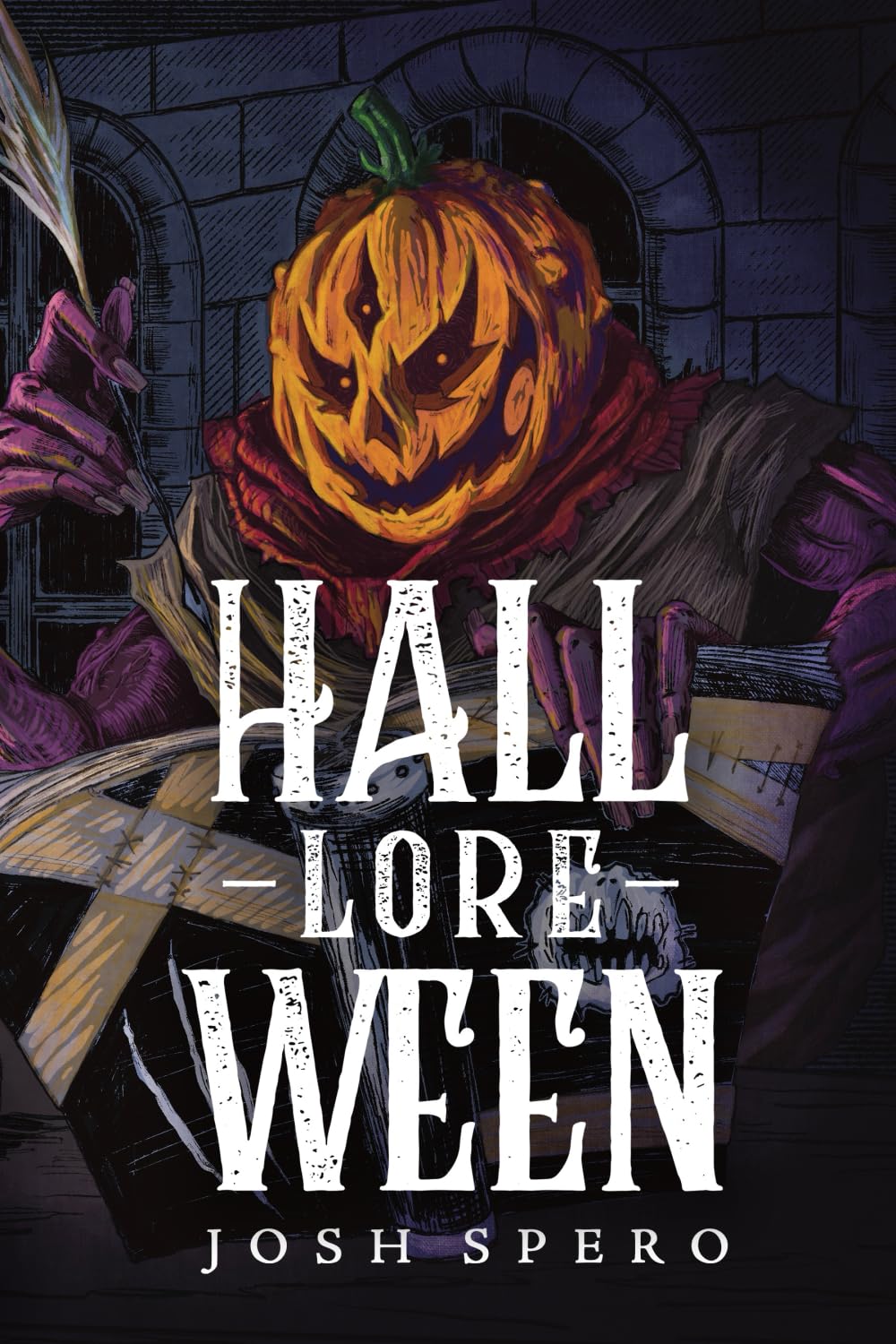
Cover art for Hall-Lore_Ween by Josh Spero

Hall-Lore-Ween, by Josh Spero, illustrations by TT Hernandez

Castle Bridge Media, 2024

ISBN: 9788989593477

Available: Paperback, ebook

Buy:  Bookshop.orgAmazon.com


A quick 98 page read with a few short stories, a few poems, and some really cool illustrations, Hall-Lore-Ween is the author’s attempt to create Halloween stories for little kids (as well as adults that never grew up, like me) and on that, he succeeds admirably. The stories are short with a bit of spook factor and a lot of charm, and they have (GASP!) happy endings! These would be great to read to your first through third graders, and the adults will get a kick out of them as well. Let’s break it down!


The stories: there are three of them, the first involving a possible heritage witch, the second a town with a Halloween tradition/curse, and the last with kids and werewolves. I definitely liked the second one best, and the ending was a real feel-good surprise. It kept me guessing the most. The first story was the closest to a traditional ‘scary’ Halloween story, and the ending wasn’t quite as happy as the others. The last story works with the idea of a new kid trying to find his place, and werewolves are involved. Adult readers will probably guess where the story is going, but remember, the target audience is kids, and they won’t see it coming. And again, a nice, cheerful ending. All the stories are well-done and utterly enjoyable. For me, especially, this is a nice change of pace from the material I am usually asked to review.


The poems: hey, I’m no poet, and I know it. Get it? That’s fellow reviewer Nova Hadley’s department. To me, good poems rhyme. These poems rhyme. I enjoyed Shel Silverstein’s poetry, and I enjoyed the Hall-Lore-Ween poems, especially the “Mr. Wolford” poem. OK, no more… I can’t pretend I know beans about poetry.


The illustrations: Oh boy, pictures! I like pictures! And these are really cool pictures! Again, I have no art knowledge, I couldn’t tell you the difference between a Jackson Pollock and a finger painting, but I did like the black and white illustrations. The one of the kid with an evil-looking pumpkin head on page 48 was my favorite, and the one of the witch in the first story is a close second. I would have liked two or three illustrations per story instead of only one: they really added to the stories.


Bottom line: you will like these, and your kids will probably love them. Purchase this one now, and save it till next October! Recommended.


Reviewed by Murray Samuelson
Book Review: The Girl Who Builds Monsters by Brian James Freeman, illustrated by Vincent Chong

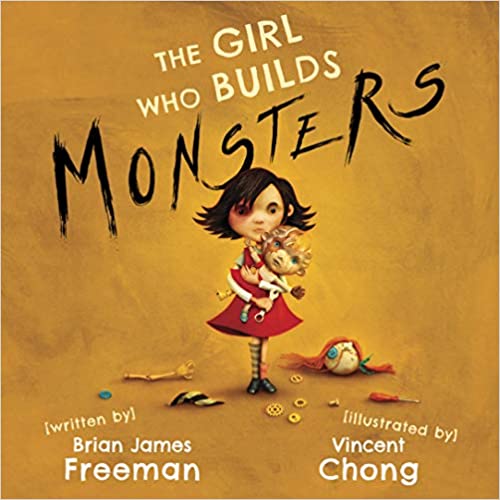
cover art for The Girl Who Builds Monsters by Brian James Freeman, illustrated by VIncent Chong

Bookshop.org  |  Amazon.com )

The Girl Who Builds Monsters by Brian James Freeman, illustrated by Vincent Chong

Cemetery Dance, 2020

ISBN-13 : 978-1587677656

Available: Hardcover


Emma is lonely. The kids in town think she is a monster because of the birthmark on her face. She lives with her  grandfather, who owns a doll factory where he designs and manufactures beautiful dolls, with perfect faces and bodies, for sale. One day, Emma finds a room of rejected and damaged machinery and doll parts, and starts to create dolls herself. They are imperfect, even monstrous, but Emma loves them, and takes them home, where she already has beautiful dolls her grandfather has made for her. At night, when Emma is asleep, all the dolls come alive. Unlike the kids in town, the perfect dolls welcome the monster dolls, and they all play together happily. The monster dolls are more adventurous and confident than the perfect dolls, though, and when robbers break into the house one night, the monster dolls come up with a plan to trap the thieves and protect Emma and her grandfather. Knowing they are supposed to keep their nighttime activites secret, the monster dolls charge the thieves, terrifying them into falling through a trapdoor in the hallway floor and saving the day. Looking monstrous on the outside doesn’t stop them from either being loved or acting out of love. On its own, it’s a sweet little story.

However, Vincent Chong’s illustrations really up the creepiness factor. It’s one thing to write about dolls, and another to draw them. I saw some aspects in the illustration, design, and use of font in the book that reminded me a bit of some of Dave McKean’s illustrations in The Wolves in the Walls. The people in the book are not realistically depicted, but the dolls seem much more real.  In sharing this book with my daughter, the absolutely creepiest moment for her was the two-page spread of the brightly drawn automated doll assembly line (although the monster dolls’ nighttime attack on the thieves was a close second), so it’s likely that the dolls’ uncanny nature may cause unease in some children, Emma herself is an adorable, if mostly sad, little girl. Chong shades her birthmark in while not letting it define her face or personality, and it is really wonderful to see her imagination at work as she takes ownership of turning damaged pieces into imperfect dolls that she can relate to. In Chong’s illustration of the dolls seen through Emma’s eyes, the monster dolls don’t seem monstrous.

For me, one of the things that makes this an absolutely outstanding book and a choice I would recommend for anyone working with elementary aged children is that it is one of the few picture books out there that depict disability in a positive and respectful way. Too often picture books about disabled people are educational texts describing a child’s disability for abled peers, and in the few fictional picture books, disabled people are rarely depicted as multifaceted individuals with positive characteristics. In fiction in general, disabled people are usually presented stereotypically, as either someone to feel sorry for (like Beth in Little Women), someone inspirational (think Auggie from Wonder), someone with “magical” abilities (Charles Xavier of the X-Men), or a villain. In horror in particular, villainy is frequently signified by disfigurement or masking (some of the classics in horror fiction include the Phantom of the Opera, the Invisible Man, and Dorian Gray ).  Brian James Freeman has done a great job at subverting the trope of disability and disfigurement as villainous and monstrous, and celebrating imperfection, and it’s really exciting to see this. Highly recommended for grades K+.

Book Review: Don’t Turn Out the Lights: A Tribute to Alvin Schwartz’s Scary Stories to Tell in the Dark edited by Jonathan Maberry

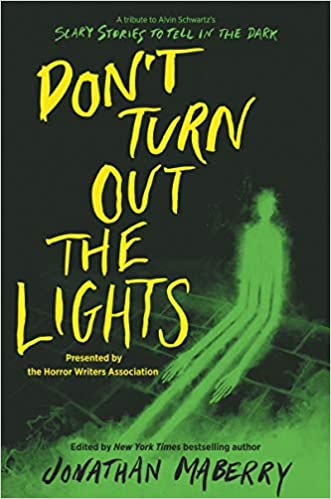
cover art for Don't Turn Out The Lights: A Tribute to Alvin Schwartz's Scary Stories to Tell in the Dark edited by Jonathan Maberry  ( Bookshop.org  |  Amazon.com )

Don’t Turn Out the Lights: A Tribute to Alvin Schwartz’s Scary Stories to Tell in the Dark edited by Jonathan Maberry

HarperCollins, 2020

ISBN-13 : 978-0062877673

Available: Hardcover, paperback, Kindle edition, audiobook


Don’t Turn Out the Lights is an anthology of stories by a variety of diverse horror writers, mostly of YA horror, inspired mainly by their nostalgia over Alvin Schwartz’s notable collections of urban legends and folktales, Scary Stories to Tell in the Dark (writers include Linda Addison, Amy Lukavics, Courtney Alameda, Tannarive Due, Kami Garcia, and R.L. Stine). Schwartz’s writing was spare, providing just the bare bones of the stories he shared, and Stephen Gammell provided terrifying black-and-white pen and pencil drawings to accompany each one It is unfortunate that the artist for the book is not credited, so far as I can tell. Nobody can be Stephen Gammell, but the interior illustrations suggest the artist studied his style. The artwork is outstanding and integrates well into the design of the book and the storytelling.

Unlike Schwartz’s collections, there aren’t a lot of jump-scares or gruesome rhymes: these are tribute stories rather than an attempt to recreate his work. As expected in a collection of 35 stories, each by a different author, some are better than others. Some stories stick closer to Schwartz’s style and choice of subject, with the feeling of a folktale, such as T.J. Wooldridge’s “The Skelly-Horse”, or “Jingle Jangle”, while others, like “The Funeral Portrait” were more reminiscent of Poe. A few manage to stick to the urban legend feel of the original while updating it for tweens today, like “Tag, You’re It,” by N.R. Lambert, which plays on social media anxieties, and “The House on the Hill”, which brings mystery emails and cell phones into play in a tale of peer pressure and surveillance in a haunted house. “The Neighbor” managed the fine line of evoking Schwartz’s tales in a contemporary context beautifully. Editor Jonathan Maberry’s introductory essay was very interesting, as he did not grow up with the stories but read them as an adult.

One of this book’s greatest faults is its length. The original Scary Stories books were relatively short in length, with plenty of white space and relatively large print on each page. Stories were usually very short and heavily illustrated. Don’t Turn Out the Lights is over 400 pages long, with most stories obviously intended to be read on the page instead of told at a campfire.  While the Scary Stories books are read by kids as young as third grade, the length of the book and of the stories suggests to me that Don’t Turn Out the Lights is aimed at a slightly older audience of tweens and middle-schoolers, and also the adult audience feeling the same kind of nostalgia for the Scary Stories books that the authors did. Recommended for grades 4+.

Contains: gore, violence, body horror, murder


NetGalley temporarily provided a review copy of this book.