Home » Posts tagged "Becky Siegel Spratford"

Book Review: Why I Love Horror: Essays on Horror Literature edited by Becky Siegel Spratford

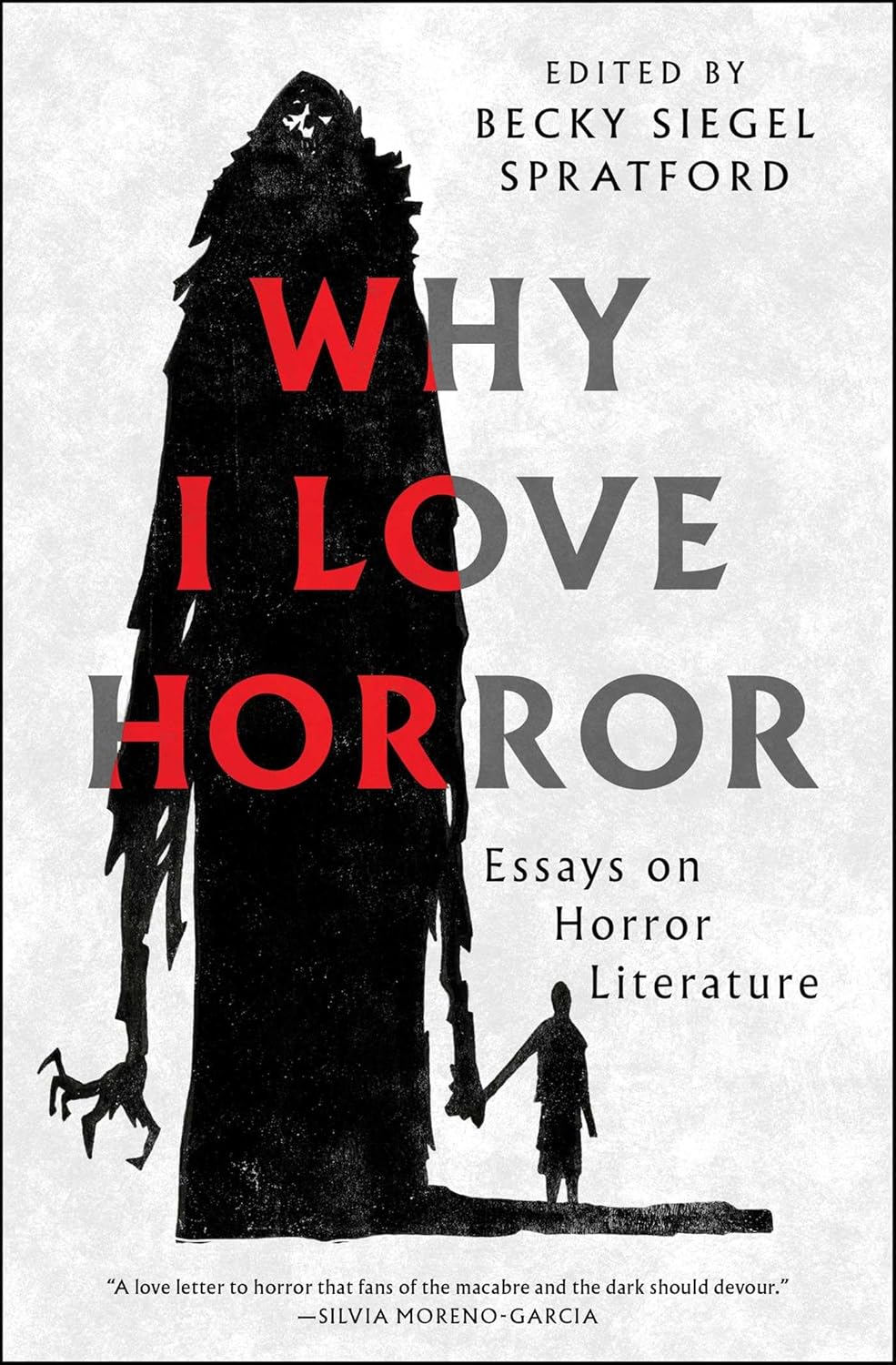
Cover art for Why I Love Horror edited by Becky Siegel Spratford

Why I Love Horror: Essays on Horror Literature edited by Becky Siegel Spratford

Saga Press, 2025

ISBN-13: 9781668205099

Available: Paperback, Kindle edition, audiobook, audio CD

Buy: Bookshop.org |  Amazon.com


Librarian Becky Siegel Spratford presents eighteen essays by current horror authors on why they love horror. The collection begins with a welcome to the reader by Sadie Hartman, followed by Spratford’s own essay, “Why Ask Why,” where she tells her story about how she found herself working with horror and curating this book full of talented horror writers. Before each essay, Spratford includes an introduction to the authors, a book recommendation to start with from their works, and a recommendation of an author in a similar vein.


My experience reading this was like opening a door to different times in my life where horror made significant appearances, despite having never really left me. Childhood memories and horror are foundational for some in this community. In “Brian Keene’s Giant-Size Man-Thing,” the author discusses his introduction to horror through comics and how horror helped him cope with dread and fear. John Langan writes of his childhood fascination with cryptids in “In the Bermuda Triangle with Sasquatch, Flesh Smoldering.” Jennifer McMahon’s “Monster Girl: How Horror Gave Me a Place to Belong” hit particularly close to home in terms of feeling out of place, being the weird girl who liked horror, and experiencing struggles at home. “My Mother Was Margaret White” by Cynthia Pelayo discusses abuse she experienced at home and at school, never feeling safe anywhere. Horror saved us both. “Permission to Scream” by Rachel Harrison and and “Tales From My Crypt” by Mary SanGiovanni specifically focus on girlhood and horror, both also speaking to similar experiences for me.


Horror providing comfort or a safe space is another thread that ties these essays together. Hailey Piper describes, in “The Giant Footprint of Horror”, how Godzilla introduced her to horror, and that there is joy in this dreadful genre. “My Long Road to Horror”, by Tananarive Due, describes horror as feeling. She writes a short but powerful history of her family and their personal horrors of racism and struggle.


Authors remind the reader that horror is more than a genre, it is an entire community. Alma Katsu’s “What You Can Learn from Horror: Don’t Run from Darkness; It’s Trying to Teach You a Lesson”, presents an essay questioning why people shy away from horror. A true crime writer I had a conversation with during my undergrad found it fascinating that there is a line in the sand between what his audience will and will not read: that line is fictional horror. Katsu states “I’m here to argue against running away from darkness,” (52) and provides personal information regarding past employment with government agencies as an intelligence analyst. Gabino Iglesias, in “Horror is Life: A Blood-soaked Love Letter,” discusses his life in Puerto Rico and discovering horror, which turns into a moving statement on how horror changed his life. In “A Day in My Psychedelic World,” Nuzo Onoh, dubbed the Queen of African Horror, reminds us there is horror for everybody.


There are so many great essays in this book. Other authors who contribute are Josh Malerman, Paul Tremblay, whose piece is accompanied by his daughter Emma, Grady Hendrix, Clay McLeod Chapman, Victor LaValle, David Demchuk, and Stephen Graham Jones. This would make a great addition to a general library collection, as well as essential reading for a course on horror. Highly recommended.


Reviewed by Lizzy Walker
Book Review: The Readers’ Advisory Guide to Horror, Second Edition by Becky Siegel Spratford

Since Monster Librarian has been around for quite some time, we actually reviewed reader’s advisory reference books in horror before there were many reader’s advisory books on the horror genre and even before social media became all-consuming. Most of these are on a page on our original website titled “Librarian Resources”. It’s pretty sparse, because anything published after 2014 will be found on this blog instead of the original site, and there really wasn’t much in existence then. What was once a fairly restricted community of readers and writers has grown like crazy, and the past few years have really boomed in terms of providing all kinds of helpful resources.

So it was a very big deal when Becky Siegel Spratford wrote a second edition to The Readers’ Advisory Guide to Horror, which was published in 2012. This month I saw her announce that the third edition will be coming out next year (wow!) so I’m republishing our review of the second edition now. She has kept it updated through her blog  RA for All: Horror.  If you visit now, Becky is counting down the days until the announcement of the titles for the HWA’s summer reading program, Summer Scares, for 2020.

With the horror genre having expanded its reach and audience considerably I will be curious to see the changes in the third edition!


rahorror

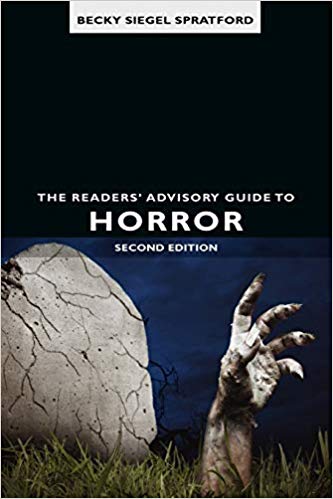
The Reader’s Advisory Guide to Horror, Second Edition by Becky Siegel Spratford

American Library Association, 2012

ISBN-13: 978-0838911129

Available: Paperback, Kindle edition


The Reader’s Advisory Guide to Horror, Second Edition, is the updated version of The Reader’s Advisory Guide to Horror, part of the American Library Association’s Reader’s Advisory series on genre fiction,. That is, the major professional organization for librarians endorses this as the authoritative text on reader’s advisory in the horror genre. The author, Becky Siegel Spratford, is a reader’s advisory librarian with a particular interest in the horror genre, and in promoting horror in the library– and is someone I admire very much. Updates for this edition can be found at her blog, RA for All: Horror. 

        The Readers’ Advisory Guide to Horror, Second Edition is an important book for a couple of reasons. First, because it’s published by the American Library Association, it is likely to reach a wide audience of librarians, and because it’s part of an established series on readers’ advisory, it has credibility as a resource for librarians who may not know much about(or like) the horror genre that other resources may not have. That opens a door for connecting a lot of people to books they may like. Spratford does a nice job of providing a concise history of horror, introducing some prominent authors, and addressing the classics. Spratford also mentions that many horror readers prefer to read only within one subgenre (such as werewolf books), and has set up the book to provide annotated lists for recommended titles in popular subgenres,. She also includes a chapter on horror resources and marketing, which does a very nice job of offering tools and strategies for growing and promoting library horror collections, not just during October but throughout the year. This is a topic that really needed (and needs) to be addressed– horror readers don’t just read horror as Halloween rolls around, and if your horror novels are shelved with the rest of the fiction they may not even know what the library has. I’m glad that Spratford specifically addressed this in her book.

        However, there are aspects to the book of which librarians should be aware. Spratford chose to define horror as “a story in which… unexplainable phenomena and unearthly creatures threaten the protagonist and provoke terror in the reader”.  That’s a very narrow definition. I recognize that for purposes of writing a reader’s advisory guide it’s necessary to set limits of what qualifies as belonging to a genre, but reader’s advisory librarians attempting to serve horror readers should be aware that many horror readers don’t require there to be a supernatural or unexplainable element in their reading. Because of the way she defines horror, Spratford’s breakdown of subgenres is sometimes problematic. For instance, in her chapter on “shape-shifters”, she included not only werewolf titles but killer animal books, and these two types of books appeal to different audiences. Many killer animal books have no supernatural aspect at all, such as Cujo, Stephen King’s novel about a rabid dog terrorizing his neighborhood (Spratford writes that Cujo “comes under the spell of demonic forces”, but that is not the case). Her chapter “Monsters and Ancient Evil” also combines in one list books that will appeal to different audiences- Lovecraftian fiction and more modern monster novels. In addition, Spratford leaves out the notable category of human horror. Books in this category aren’t literary novels of psychological suspense- they display the worst of human nature, without needing to employ the supernatural. Usually they have graphic gore, violence, and sexual situations (such as in the work of Wrath James White). This category doesn’t fall under Spratford’s definition of horror, and so it isn’t addressed in the book. Spratford  is covering a huge amount of territory in a limited number of pages, but it would really have benefited users, and readers, to have these particular issues dealt with, and hopefully we will see that in the next print edition. In addition to covering a wide variety of authors and subgenres, Spratford addresses whole collection reader’s advisory and mentions several categories of books outside the genre that horror readers might also enjoy, I especially appreciated her mention of nonfiction, as there are a lot of appealing nonfiction titles that horror fiction readers will probably never find on their own.

        Horror is a very difficult genre for both collection development and reader’s advisory. It doesn’t get much respect, or even recognition. The Reader’s Advisory Guide to Horror, Second Edition, although not a perfect tool, does a great job providing resources to librarians serving horror readers. Highly recommended for purchase by public and academic libraries.

Review by Kirsten Kowalewski


Women in Horror Month: “She’s a librarian, ok?”

Hi, my name is Kirsten Kowalewski, and I am a librarian.

I am currently living in a state where the governor just attempted to use tax dollars to start a state-run news service and is recommending cutting library funding. The past two weeks have also been the culmination of a year of hostility from the governor and the state board of education toward our elected Superintendent of Public Instruction, who is, like me, trained as a librarian and school media specialist and is a certified teacher.  The state legislature is stripping her of her powers and assigning them to the state board. When Indiana Senate president David Long was asked about it, he implied that she wasn’t up to the job. “She’s a librarian, ok?” This has left me steaming.

The Librarian Avengers are putting you on notice, Mr. Long.

So, what’s all this got to do with women in horror?

A number of awesome librarians have contributed to promoting the horror genre and keeping this website alive. Many of them are women, and all of them are amazing. I have been lucky to work with Becky Siegel Spratford (author of The Reader’s Advisory Guide to Horror Fiction), Patricia O. Mathews (author of the reader’s advisory guide Fang-tastic Fiction), Lucy Lockley (also known as the RAT Queen), Kelly Fann, Julie Adams, and others, and to connect through the site with Heather Whiteside Ward. If you want horror fiction to thrive, and its audience to grow, you’ve got to have the librarians on your side, and (whether it’s right or not) a lot of librarians are women.

In conclusion, I give you Evie Carnahan, Librarian Most Likely To Break A Mummy’s Curse:


Don’t underestimate the librarian. It could be your last mistake.