Home » Posts tagged "Alma Katsu"

Book Review: Why I Love Horror: Essays on Horror Literature edited by Becky Siegel Spratford

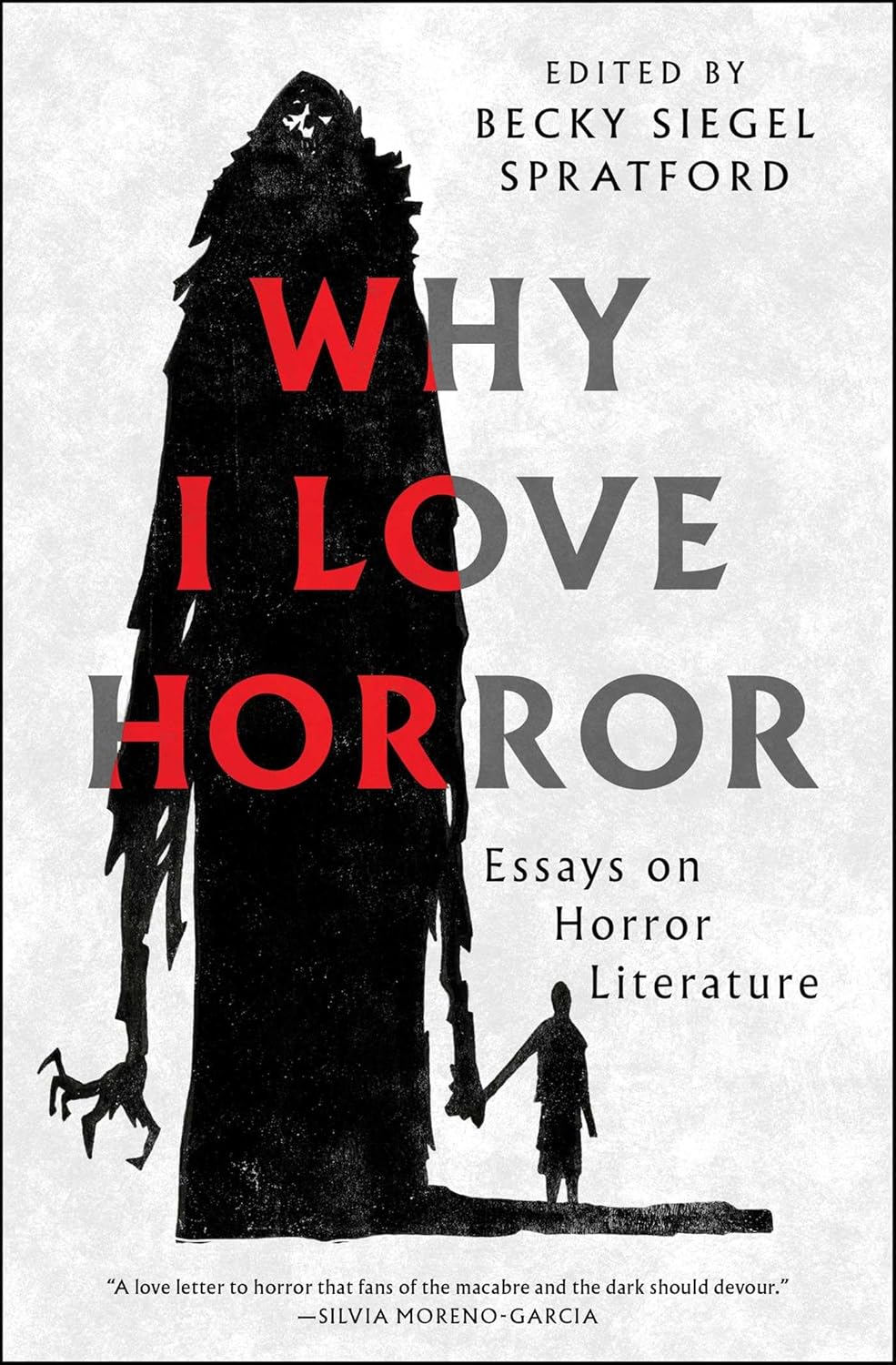
Cover art for Why I Love Horror edited by Becky Siegel Spratford

Why I Love Horror: Essays on Horror Literature edited by Becky Siegel Spratford

Saga Press, 2025

ISBN-13: 9781668205099

Available: Paperback, Kindle edition, audiobook, audio CD

Buy: Bookshop.org |  Amazon.com


Librarian Becky Siegel Spratford presents eighteen essays by current horror authors on why they love horror. The collection begins with a welcome to the reader by Sadie Hartman, followed by Spratford’s own essay, “Why Ask Why,” where she tells her story about how she found herself working with horror and curating this book full of talented horror writers. Before each essay, Spratford includes an introduction to the authors, a book recommendation to start with from their works, and a recommendation of an author in a similar vein.


My experience reading this was like opening a door to different times in my life where horror made significant appearances, despite having never really left me. Childhood memories and horror are foundational for some in this community. In “Brian Keene’s Giant-Size Man-Thing,” the author discusses his introduction to horror through comics and how horror helped him cope with dread and fear. John Langan writes of his childhood fascination with cryptids in “In the Bermuda Triangle with Sasquatch, Flesh Smoldering.” Jennifer McMahon’s “Monster Girl: How Horror Gave Me a Place to Belong” hit particularly close to home in terms of feeling out of place, being the weird girl who liked horror, and experiencing struggles at home. “My Mother Was Margaret White” by Cynthia Pelayo discusses abuse she experienced at home and at school, never feeling safe anywhere. Horror saved us both. “Permission to Scream” by Rachel Harrison and and “Tales From My Crypt” by Mary SanGiovanni specifically focus on girlhood and horror, both also speaking to similar experiences for me.


Horror providing comfort or a safe space is another thread that ties these essays together. Hailey Piper describes, in “The Giant Footprint of Horror”, how Godzilla introduced her to horror, and that there is joy in this dreadful genre. “My Long Road to Horror”, by Tananarive Due, describes horror as feeling. She writes a short but powerful history of her family and their personal horrors of racism and struggle.


Authors remind the reader that horror is more than a genre, it is an entire community. Alma Katsu’s “What You Can Learn from Horror: Don’t Run from Darkness; It’s Trying to Teach You a Lesson”, presents an essay questioning why people shy away from horror. A true crime writer I had a conversation with during my undergrad found it fascinating that there is a line in the sand between what his audience will and will not read: that line is fictional horror. Katsu states “I’m here to argue against running away from darkness,” (52) and provides personal information regarding past employment with government agencies as an intelligence analyst. Gabino Iglesias, in “Horror is Life: A Blood-soaked Love Letter,” discusses his life in Puerto Rico and discovering horror, which turns into a moving statement on how horror changed his life. In “A Day in My Psychedelic World,” Nuzo Onoh, dubbed the Queen of African Horror, reminds us there is horror for everybody.


There are so many great essays in this book. Other authors who contribute are Josh Malerman, Paul Tremblay, whose piece is accompanied by his daughter Emma, Grady Hendrix, Clay McLeod Chapman, Victor LaValle, David Demchuk, and Stephen Graham Jones. This would make a great addition to a general library collection, as well as essential reading for a course on horror. Highly recommended.


Reviewed by Lizzy Walker
Book Review: Fiend by Alma Katsu

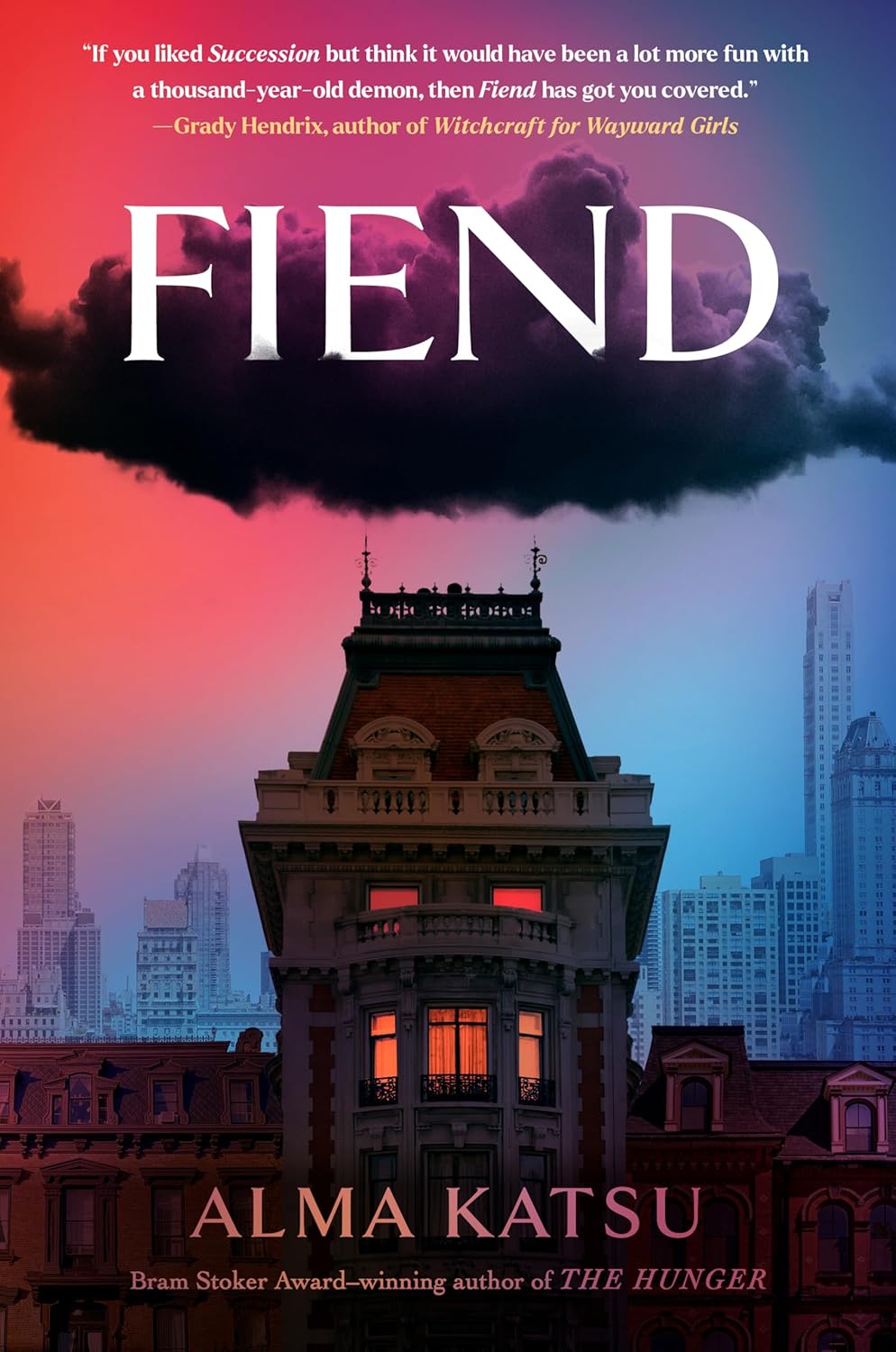
cover art for Fiend by Alma Katsu

Fiend by Alma Katsu

G.P. Putnam’s Sons, 2025

ISBN-13 ‏ : ‎ 978-0593714348

Available: Hardcover, Kindle edition, audiobook

Buy: Bookshop.orgAmazon.com 


Not being wealthy or influential myself (though I would be somewhat, if you pick up this book based on this review), it’s fun to read about wealthy, ruthless families getting their comeuppance. The only reason why I am not on a superyacht right now is because I have not made a pact with any supernatural force to acquire immense wealth beyond what I can spend in my lifetime, oppress the working class, and wreak havoc on the environment.


Fiend centers around the Berisha dynasty. The clan has existed for over a thousand years, and through arranged marriages and corrupt business practices, has kept the Albanian bloodline and family fortune flourishing. Zef is the cruel and unscrupulous head of household and your stereotypical super-powerful rich guy. Then there’s Olga, his beautiful, unassuming wife, a Melania Trump figure, who stays out of her husband’s politics but is complicit in what she does know. Dardan, the eldest, is weak and ineffectual, but has been primed to take over the family business. He is probably the most empathetic character in the family because he wants to break away from the hold the family has on him, but at the same time,  he won’t totally give up his money and privilege. Next there is Maris, the ambitious daughter who has all the horrible characteristics of her father, Zef, and seems to be the most logical replacement. But Maris can’t compete with Dardan since Dardan’s crowning achievement is being born with a Y chromosome, and she is expected to follow in the Berisha female tradition of keeping house and siring more Berisha babies. Finally, there is Nora, the unstable emo socialite who would rather party than have anything to do with the Berisha empire.


The novel goes back and forth (“Then” and “Now”) of memories the Berisha children have of growing up in a house seemingly possessed by a supernatural force, a fiend known as The Protector, which keeps the Berisha clan rich and powerful while their competitors are suspiciously afflicted with horrible diseases and accidents. 


Under strange and mysterious circumstances, Maris is finally given the chance to break away from her Jan Brady status and the “Dardan, Dardan, Dardan” shadow to take over the business, and, in effect, the whole Berisha legacy. Little does she know that there are responsibilities that she will inherit that are not in her official job description. 


Fiend is a deliciously fun book to devour after a day of business meetings, synergizing, estimating bandwidth and defining deliverables, doing deep dives but still picking low hanging fruit, and talking about circling back to things that you know will never be addressed. Alma Katsu is known for her historical fiction novels such as The Hunger (based on The Donner Party) and The Deep (based on the sinking of the Titanic). Fiend is instead inspired by the television series Succession, about Logan Roy, the patriarch of the powerful and dysfunctional Roy family and owner of a NYC based global media conglomerate and the power struggle by his four children to take over as his health declines. Katsu reimagines the characters and their background and throws in a splash of her signature supernatural, horror talents to create an entertaining novel that will make readers forget all the tech debt that their company has pushed aside until it’s all hands on deck when the whole system comes crashing down. I think I have been working too much because a book about corporate greed and demonic possession makes perfect sense. Recommended. 


Reviewed by Lucy Molloy

Book Review: The Fervor by Alma Katsu

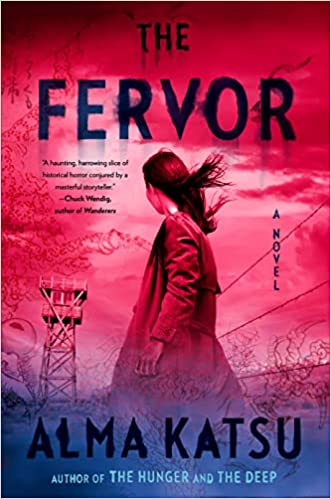
Cover art for The Fervor by Alma Katsu

The Fervor by Alma Katsu

G.P. Putnam’s Sons, 2022

ISBN-13 ‏ : ‎ 978-0593328330

Available: Hardcover, paperback, Kindle edition, audiobook

( Amazon.comBookshop.org )


The Fervor takes place during World War 2 and alternates between five points of view. Meiko Briggs is a Japanese immigrant married to a white man, Jamie Briggs, a pilot in the army. She and their daughter Meiko are living in the Japanese internment camp Camp Minidoka, where residents are becoming infected with an illness that makes them violent and murderous. Archie Mitchell is a pastor who saw his pregnant wife and several children killed in an explosion thought to have been a Japanese bomb, who was friends with Jamie and has now gotten entangled with local white nationalists. Fran Gurstwold is a Jewish woman reporter who witnessed a similar explosion and decides to investigate locations where she suspects other explosions have happened. These alternate with journal entries from 1927 by Mieko’s father, Japanese scientist Wasaburo Oishi, who discovered poisonous spiders related to the yokai jorogumo, that cause the illness now spreading through the camps and nearby towns. The story follows Mieko, Aiko, Archie, and Fran as their stories intersect and begin to make sense in the context of Oisho’s writings, while dealing with a coverup by the government.


Katsu notes that this book differs from her previous ones because rather than portraying a specific historical event she was using a wider lens to explore the bigotry and violence against Asian-Americans in the past as a way to deal with it in the present, so while period details are correct , events and places may have been moved around for plot purposes.


This was a fascinating book, and better than The Deep. I am a fan of yokai whenever I see them, and I enjoyed the way Katsu incorporated this into the book. The portrayal of Archie as a person who is drawn into a white nationalist group due to weak character rather than malice, was accurate and well-written. Unfortunately, there continue to be too many people like him today.


Contains: racial slurs and violence


Reviewed by Kirsten Kowalewski