Home » Page 8

Book Review: Somewhere Quiet, Full of Light by Henry Corrigan


cover art for Somewhere Quiet, Full of Light by Henry Corrigan

Somewhere Quiet, Full of Light by Henry Corrigan

Slashic Horror Press, 2025

ISBN: 9781763725607

Available: Paperback, Kindle edition

Buy:   Bookshop.orgAmazon.com


Somewhere Quiet, Full of Light will probably get categorized as just another haunted house tale, but it is a good deal more. The reader watches a strong family unit disintegrate, due to the influence of a house with its own abilities and desires. It’s a smartly written tale that shows that Corrigan is an author to watch. He creates real tension throughout, while using very simple elements. Corrigan realizes that real scares often come not from fear of the supernatural, but from what people fear in each other– and themselves. This is a story that will stick with you long after the final page is turned.


The plot itself is simple enough: Mike and Joe Tillman want to move their two young kids away from the city, but have limited funds. They buy a fixer-upper in a remote location, planning to turn it into their dream home, but the house has other ideas. 


Corrigan is very adept at building tension without going over the top. No shrieking banshees or flying body parts with buckets of blood are needed: he keeps it straightforward. That’s very difficult to do, and it works beautifully. Just an occasional shadowy figure, a creak in the house here, a movement there…small stuff, but due to Corrigan’s writing style, very effective and unsettling. The story isn’t about creating big scares (although the ending is a real banger) but instead creates a constant feeling of dread that lingers throughout the pages.


Right when the family first arrives at the house, you’ll feel that something is distinctly off with the whole situation, but it won’t be shown to you in any obvious way. Throughout the entire book, the suspense level increases like a tightly-wound string, that finally snaps in the last few pages. Writing suspense and keeping it constant is not an easy task, but Corrigan does it with ease.


The house itself plays a large role in the story, and that gives the book a decidedly different flavor. It’s like a living, breathing entity, and a number of chapters are written from the perspective of the house itself. You’ll feel its pain as it goes through renovations, and its joy at seeing parts of itself repaired. When the house has to move something by itself, be it a floorboard or panel, it feels like an immersive experience. It’s another of the reasons the book is a cut above the rest.

Bottom line: just read this one: you won’t be disappointed. Hopefully, the author will write a full length novel at some point. As good as this story was, at just 150 pages I wanted more. Definitely a case of a great story that most readers would have wanted to continue longer. Most certainly recommended!


Reviewed by Murray Samuelson

Book Review: That Very Witch: Fear, Feminism, and the American Witch Film by Payton McCarty-Simas

cover art for That Very Witch by Payton McCarty-Simas


That Very Witch: Fear, Feminism, and the American Witch Film by Payton McCarty-Simas

Luna Press Publishing, 2025

ISBN-13: 9781915556608

Available: Paperback, Kindle edition

Buy: Bookshop.org | Amazon.com


Payton McCarty-Simas’ That Very Witch: Fear, Feminism, and the American Witch Movie analyzes the cinematic witch’s evolution and relationship to feminist movements from the 1960s to the 2020s. Using historical, social, and feminist models for basis of analysis, they examine how the witch became viewed as both the feminist representation of empowerment and fear. McCarty-Simas’ analysis of the witch film reveals how the witch has been portrayed over time, reflecting significant changes in American culture and politics.


A brief history of early European witches, and their associated witch hunts, or “crazes,” driven by bigotry, misogyny, and racism, creates the basis for the contents of the book, as these are central to the concept of the witch. The author addresses the concept of the witch as a symbol in feminist circles, what can be learned from various witch cycles through history, whether witches through time can be considered feminist figures, and more, in their analysis of witch films.


In Part 1, “Season of the Witch: The Countercultural Witch Films of the Long Sixties,” the author explores witch films from 1960 through 1973, including the birth and death of the witchsploitation film in the context of the sociopolitical climate of the era. Part 2, “Unpleasant Dreams: Feminism, Satanic Panic and the Witch Films of the 1980s,” takes the reader through the rise and decline of the Satanic Panic. McCarty-Simas expands on how this era’s witch films responded to the earlier witch cycle film, the Panic’s effect on the figure and evolution of the witch and Satan, and antifeminist rhetoric pushed by conservatives that the role of working women, as well as the innovation of home video technology and the VHS, were to blame for Satanic cults lurking around every corner. Particularly interesting in this section is that McCarty-Simas highlights the “Satanic Panic specials,” framing them as horror comedies. For readers who have seen clips or the full version of such shows, you know why the author includes these as horror comedies. Over-the-top “reporting,” alleged experts on Satanic Ritual Abuse who spread disinformation, and decrying explicit material in horror movies while in the same show describing in great detail what happened to alleged victims, are just a few of the reasons the author correctly includes them here.


“Interlude: Notes on the Postfeminist Witch Film (1990-2013)” focuses on the witch film in terms of Third Wave feminism, Riot Grrrls, girl power, the commodification of witches to teenagers, and the bitchification of the witch. The author presents an insightful analysis of
The Craft a
nd its overall failure at intersectionality, and discusses girl and women witches in the Harry Potter franchise. The author includes some television series from this time period as examples of dark fairy tales, highlighting American Horror Story: Coven and its successful portrayal of feminism, race, and intersectionality.


Part 3, “Gender, Genre, Psychedelics, and Abjection in the 2010s ‘Witch’ Horror Cycle,” examines 2010s witch films, tying the “demonic woman” to the cycles in previous chapters. A major visual the author uses as a tool for analysis is the smile of the heroine or final girl at the end of horror films, comparing them to how the meaning of this expression can be interpreted on the face of a witch at the end of her film.


I would be remiss if I did not address a significant issue with the text, that being the “Works Cited” section. There are links that point the reader to academic library databases where an account is needed to access the articles or books, Google Books links, and broken links, rather than using DOIs (digital object identifiers) or stable URLs. Correct citations bolster the text and provide readers with further information. This includes directing readers to the resource itself.


Regardless of the problems with the citations, That Very Witch would be a good resource for readers interested in the history of the American witch film in terms of particular political climates, social movements, and historical context. It provides an extensive film and mediography that has increased my watch list. Recommended.


Reviewed by Lizzy Walker

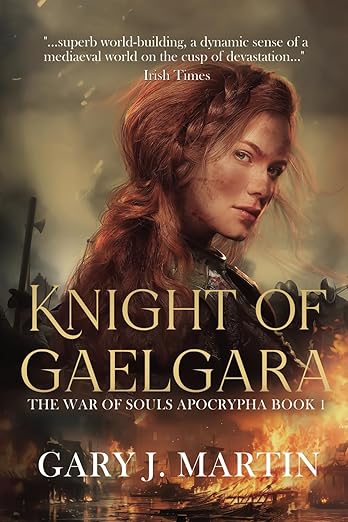
Knight of Gaelgara: War of Souls Apocrypha Book 1 by Gary J. Martin

Cover art for Knight of Gaelgara by Gary Martin

Knight of Gaelgara: War of Souls Apocrypha Book 1, by Gary J. Martin

Temple Dark Publishing, 2024

ISBN: ‎ 9781738467617

Available: Paperback, audiobook, audio CD

Buy: Amazon.com | Bookshop.org


Knight of Gaelgara is yet another stunning debut to a series published by Temple Dark Publishing. It’s firmly set in the realm of medieval fantasy and contains some of the elements that made the Game of Thrones series so enjoyable. With a layered narrative, numerous characters, and a feeling true to life of the medieval period, this is one the Thrones fans will not want to miss.


A simple synopsis of a complex plot is that Sir Rosalind Radsvinn, newly anointed knight, returns to her home, the portside city of Akkson. The city is ruled by her father, Baron Feylan Radsvinn, on the continent of Gaelgara. In a torrid 48 hours, the city is torn apart by the combined assault of invaders from the outside, and the internal strife and rebellion of the people of Akkson.


There is a LOT going on in the book, but I don’t want to give it away. The story is written in third person, but told from the perspective of multiple narrators, each with their own agenda for the city of Akkson. That’s where the plot complexity comes in: few of the characters are united in how they view things, and that keeps the narrative engrossing. There are loyalists, flat-out traitors, and those on the fence, and the author makes sure to provide reasons for each. The main turncoat out to destroy the Baron’s family may be a bad guy, but he certainly has some justification for what he does, even if you don’t agree with it. Many of the characters are written in shades of gray, and it’s what keeps the story so interesting. The Baron’s family alone is a study in dysfunction. Rosalind remains loyal to her father, Baron Radsvinn, although he hasn’t done a good job of running the city, while her brother, Ulrik, is an opportunist who may swing to either side, depending on how it benefits him. From the top-level characters to the basic foot soldiers, all the characters are complex and feel true to life. Thankfully, there is a character appendix at the beginning of the book for readers who start to feel overwhelmed by the scope of it all.


As far as the writing, this is seriously immersive stuff that will make you think the author must have lived through the period. It feels real, from the trebuchets and ballistae being used to destroy the city walls, to the hard, messy, and ugly battles. These are not glamorous battles like in movies: people get stabbed through the armpits or under the chin through the skull, the kind of places a warrior would actually target, since they are unprotected. It’s the same with the characters that use war-hammers: they go for the joints, and crush them. It’s a good reminder that medieval warfare was hardly honorable. It was unpleasant and a bloody mess. Interesting note: poison gas is actually used as a siege weapon in the book, a very creative touch. There are also some well-written naval battles in the book, something medieval fantasy writers rarely include. Truth be told, these might have been my favorite battle scenes of the book.


What also sets this one apart from the others are the original touches in terms of humanoids. The character Thorn is a cougari, a cat-man humanoid, and the Whale Riders are water-breathing humanoids who live in the ocean and ride into battle on whales decked out in armor. Those races add an interesting new element to the medieval style. Let’s hope the Whale Riders keep playing a role, as they were one of the best parts of the book

.

Bottom line: for the readers that felt a void in their lives when it became apparent that the Game of Thrones series will probably never be finished, fear not. Gary J. Martin is here, and continues the genre in his own spectacular, original, fashion. This one makes my list of “can’t miss” titles for the year, alongside Ishmael Soledad’s Diathesis, Christopher Micklos’s Tick Town, and J.R. Konkol’s The Guardian’s Gambit. Now, let’s hope we don’t have to wait ten years for the next installment in this series! Beyond highly recommended.


Reviewed by Murray Samuelson