Home » Archive by category "Uncategorized" (Page 40)

Graphic Novel Review: Wingbearer (Wingbearer Saga #1) by Marjorie Liu, art by Teny Issakhanian

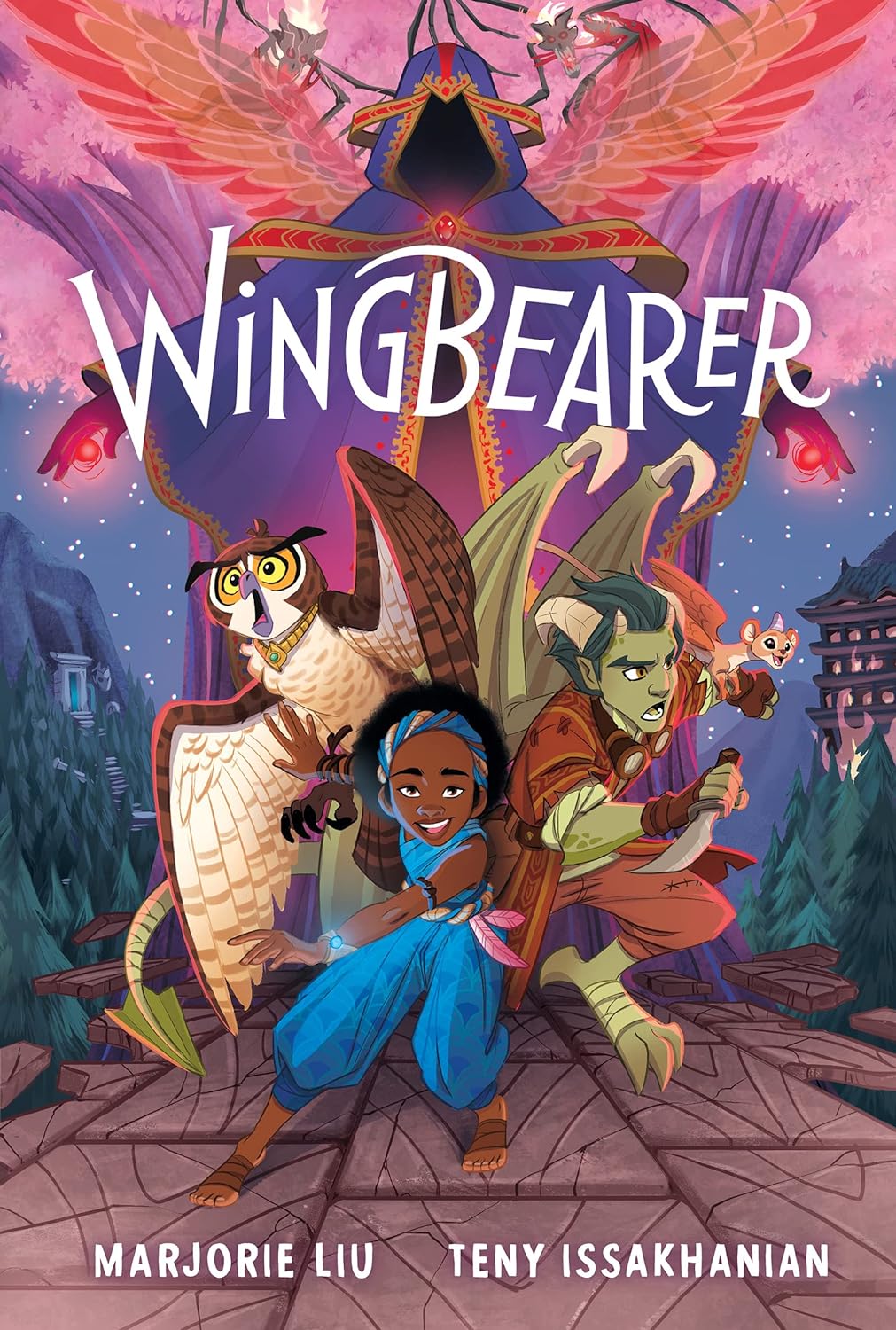
Cover art for Wingbearer (Wingbearer Saga #1) by Marjorie Liu

Wingbearer (Wingbearer Saga #1) by Marjorie Liu, art by Teny Issakhanian

Quill Tree, 2022

ISBN-13: 9780062741165

Available: Hardcover, paperback, Kindle, Comixology

Buy: Bookshop.org | Amazon.com


Marjorie Liu takes a step away from horror and dark fantasy with her middle grade graphic novel, Wingbearer. Zuli, raised in the Great Tree by mysterious bird spirits, is unique. She doesn’t look at all like the bird spirits, and she has never seen anyone like her. She has never left the safety of the branches of her home. When an evil magic begins to affect the new growth of the tree and bird souls are not returned to its branches for rebirth, Zuli sets out to spread her wings with her guardian owl, Frowly, to discover the problem and return the bird souls home. Zuli is also on a quest to discover who she is and where she comes from. Along the way, she meets new friends and foes, and perhaps comes face-to-face with her biggest threat or salvation, the Witch-Queen.


Upon seeing the world beyond the Great Tree, she finds the land ravaged, broken ruins everywhere. Her first encounter with any other living creature is when she is  attacked by giant spiders. She discovers this world is not what she was hoping and dreaming about in the safe branches of her home. Throughout her journey, she also finds that not everything is black and white: there are grey areas that she must grapple with.  A memorable scene is when she becomes distraught after she sees other goblins in her friend Orien’s camp chopping tree branches for building materials and fuel. She does not understand why the destruction of even one branch of a tree is necessary for others to live. Zuli grapples with other philosophical and identity-related themes, as well as having to learn new things.


Liu’s creative power is in her world building, and Wingbearer does not disappoint. She creates a complex world without bogging down the story with too much detail, and everything is cohesive and well-constructed. As with her Monstress series, she fills the world with compelling and driven characters, each with their own motivations and personalities shining through. For instance, Zuli’s friendship with the goblin Orien progresses in a very real way, with philosophical and cultural conflict, as well as learning more about each other.


Teny Issakhanian, an Armenian-American artist, provides lush and beautiful illustrations. She really brings the characters to life, the emotion in their facial expressions is so powerful. The bird spirits are particularly beautiful. Her previous work includes DreamWorks TV Animation, Disney TV Animation, and the Jim Henson Company.


Reading Wingbearer was like revisiting past Dungeons and Dragons games for me. High adventure, magic, good and evil butting heads, interparty conflict…all the great stuff from RPGs. For parents wanting to introduce their kids to the fantasy genre, Liu and Issakhanian would be a great first read. This is the first of the series, and I am very much looking forward to the second volume. Highly recommended.


Reviewed by Lizzy Walker
 

Book Review: Dracula of Transylvania by Ricardo Delgado

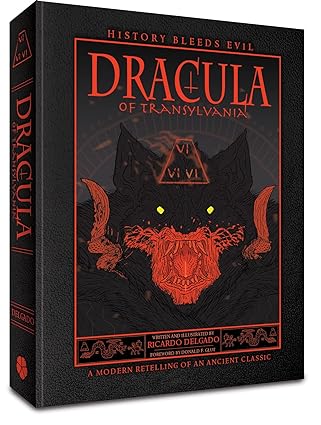
cover art for Dracula of Transylvania by RIcardo Delgado

Dracula of Transylvania by Ricardo Delgado

Clover Press, LLC, 2021

ISBN-13: 9781951038229

Available: Hardcover, paperback

Buy:  Bookshop.org |  Amazon.com


Ricardo Delgado has an impressive resume. He is an American-born artist and writer of Costa Rican descent, and a graduate of, and teacher at, the Art Center College of Design in Pasadena, California. He has worked as a film illustrator on Star Trek: First Contact, Jurassic Park 3, The Matrix Reloaded, Revolution, and others. He has also worked on designs for animated films such as The Emperor’s New Groove, WALL-E, How to Train Your Dragon, and more. His creative endeavors don’t end there. He created the acclaimed comic series Age of Reptiles for Dark Horse, wrote Sam Specter and the Book of Spells, and the hard-boiled science fiction noir Warhead. He decided to take on the subject material of Dracula of Transylvania in a new vision of the classic tale.


Young solicitor Jonathan Harker, headstrong and curious natured Mina, newly engaged Lucy, brave Arthur, timid but honorable Ian, drawling gunslinger Quincy, and old professor and friend Van Helsing brave the supernatural and mundane in their quest to stop the Son of Satan, Dracula of Transylvania, and his three wives, Andromeda, Petra, and Venus, from destroying all of humanity.


I’ll start by discussing the pros of Delgado’s epic retelling. First, the characters are much more fleshed out than they are in Stoker’s work. While Delgado took liberties with such things as character backgrounds (e.g. Jonathan is from America in this version), the changes do not distract from the story. There is much more focus on Mina and her point of view, and frankly, she is my favorite character out of all of them. The reader gets a better feel for the characters and, truly feels invested in what happens to them. Van Helsing is well-developed, and his influence can be felt throughout the journey to find Dracula, even when he is not present in the pages. Even side characters, like the villagers fearing for their lives but wanting to provide Harker and the others with as much aid as they can, come across as being very real and more than merely bit players.


Then, there are the villains of the piece. Dracula, of course, is portrayed as an imposing, cruel master and conqueror, but he is not alone in his travels. His wives follow him wherever he goes, but not out of any love or familial devotion. Andromeda, Petra, and Venus each have distinct personalities and histories, and are welcome improvements from Stoker’s original novel. The reader only gets a glimpse of them in Stoker’s tale, and then they are practically forgotten. In Delgado’s revision, while they are treated as concubines by Dracula, the author gives them more than a passing mention. Another addition to Dracula’s entourage is the skeleton army led by the Roman-clad warrior Primus, also a skeleton, and an ever present swarm of rats. The hulking figure of Renfield is terrifying, and Delgado gives him a backstory that tells the tale of the source of his mental illness, as well as adding a dash of a legendary serial killer who roamed Whitechapel into the mix. War time is hell, and Renfield, Van Helsing, and the other parents were not immune to the trials they experienced.


The pacing is fantastic. Delgado’s action scenes are incredible, and when the characters need to slow down and take a breath or plan their next move, it does not feel forced. It almost feels like it is a break for the reader to catch their breath! Delgado provides ample footnotes throughout the novel that describe Biblical passages and various facts to further embed the reader in the Victorian era.


Now, I’ll discuss the negatives. While there were illustrations between the chapters, they were all black and white. The artwork included in the back of the book were in colour, and gorgeous. I think if Delgado used the same colour palette for the other pieces they would have been more striking and effective. Another aspect that was interesting to begin with but gradually became a distraction and quite daunting was the use of different languages followed by translations that Delgado admits came from using Google Translate. Since I do not read any of the languages used, I cannot determine their accuracy. I know in my own experience using the translation feature can result in terrible mistakes, so I am hoping that Delgado consulted with people who could properly translate to verify accuracy. It would have also benefited the book for another round of editing. There were grammatical, spelling, and punctuation errors throughout that could have been spotted by a careful editor.


Despite the negatives to the book, the story was solid and well executed. The danger of Dracula and his accomplices is much improved from the original story, as is the interaction and growth of the characters, and the action is much more intense and exciting. The accompanying artwork is a welcome addition, and we get a better sense of Delgado’s vision. I recommend this for readers who hoped for a more action packed, character driven story than the source material delivered. Recommended.


Reviewed by Lizzy Walker



Book Review: Christmas and Other Horrors: A Winter Solstice Anthology edited by Ellen Datlow

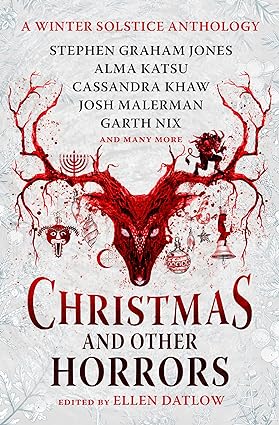
Cover art for Christmas and Other Stories: An Anthology of Solstice Horror


Christmas and Other Horrors:: An Anthology of Solstice Horror edited by Ellen Datlow

Titan Books, 2023

ISBN-13 ‏ : ‎ 978-1803363264

Available: Hardcover, Kindle edition, audiobook

Buy:    Bookshop.org  |  Amazon.com


Many people think of the Christmas season as a cheerful time of year, but it’s always been a time where sprits, gods, and terrifying creatures roam. Ghost stories set at Christmas abound: Charles Dickens and M.R James both published them every year. Coinciding with the winter solstice, it’s also a time of sacrifice. Christmas and Other Horrors draws on this tradition, with a wide variety of stories, ranging from folk horror to apocalyptic clifi.


There are several stories I found especially enjoyable.

In “The Importance of a Tidy Home,” ,by Christopher Golden, grotesque creatures local to Salzburg, Austria murder residents of homes that haven’t been tidied for the new year;

“The Ghost of Christmases Past”, by Richard Kadrey, describes Christmas Eve with Laura, who boards herself into her house every year to prevent the return of a cannibalistic witch who ate her brother in front of her, to her husband’s disbelief;

“All The Pretty People” by Nadia Bulkin, describes a Festivus party reuniting college friends, who are surprised when their friend Sam, who ghosted them months ago, arrives

“Cold”, by Cassandra Khaw, is an apocalyptic clifi story in which a saint, Brede, arrives every year on the winter solstice, asking if she can stay and sleep until spring… but what happens when spring doesn”t come? The figurative language and world-building in this story were fantastic.

In “Löyly Sow-na”,by Josh Malerman, Russell visits his Finnish girlfriend Hannele’s family, where he is trapped in a sauna with her father. I had no idea how this story was going to play out!

“Grave of Small Birds”, by Kaaron Warren, is a folk horror tale in which a bad-tempered reality show chef specializing in medieval cookery takes a job on a small British island with strange Christmas traditions. While it was fairly predictable, the setting was well-done. The main character was unlikable, so I found the ending very satisfying. This was a very atmospheric story, and descriptions of the island and its unusual traditions were excellent..


While the winter solstice and the Christmas season have passed, I can recommend this book for any time of year.


Reviewed by Kirsten Kowalewski