Home » Archive by category "Uncategorized" (Page 179)

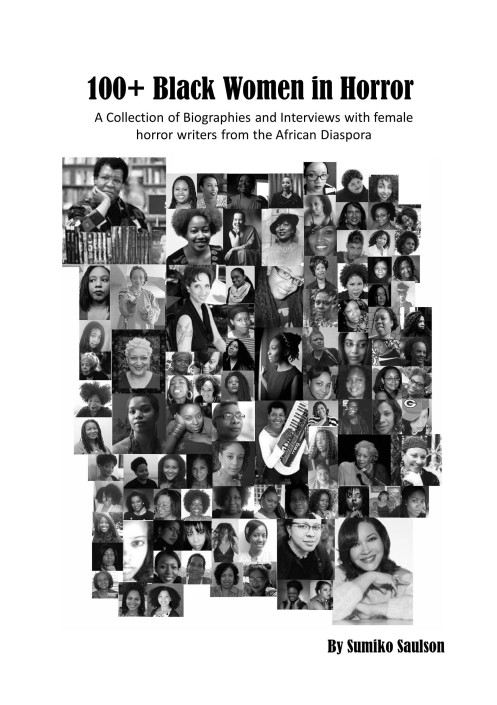
Book Review: 100+ Black Women in Horror Fiction by Sumiko Saulson

100+ Black Women in Horror Fiction by Sumiko Saulson

Iconoclast Productions, 2018

ISBN: 9781387587469

Available at Lulu.com in hardcover, paperback, and premium paperback, and on Amazon as hardcover, paperback, and Kindle edition.


February is both Women in Horror Month and Black History Month, and in 2014, author and blogger Sumiko Saulson compiled interviews and biographical sketches of black women writers who have written in the horror genre, composed for and shared on her blog, into a book titled 60 Black Women in Horror Fiction. Saulson published 100+ Black Women in Horror Fiction as an expanded edition in 2018. It includes additional, very brief entries on black women horror writers that Saulson uncovered after 2014. Entries are listed in alphabetical order and each is accompanied by website addresses for the author. Following the entries are interviews of 17 black women authors profiled in the book. Poet Linda Addison, Africanfuturist Nnedi Okorafor, and horror writers Lori Titus and Eden Royce, among others, are included in the interviews section of the book, and David Watson shares a short essay on L.A. Banks and Octavia Butler.

The book is clearly a labor of love, and even a list of black women writers of horror is needed, but unfortunately, the majority of entries do not include typical biographical information like date and place of birth, family members, and  background information. They do include a list of the author’s publications, specifically those related to the horror genre. I examined the Kindle edition, and the website links do work, but not all of them are current: a few of them are no longer in existence (unfortunately, one of them is a resource Saulson cited as using in researching and writing the book: darkgeisha.wordpress.com). It is clear that this is an expanded version– that is, new entries have been added– and not an updated one, after reading the introduction, but this is really a starting point for exploring these women’s work rather than a detailed biographical reference. There are unfortunately a number of typos and punctuation errors in the book, but they don’t interfere with the ability to understand and use what is still a unique book for reader’s advisory and for readers wanting to diversify their experience of reading horror fiction.

Saulson’s original work can also be found on her blog at sumikosaulson.com, and I highly encourage you to visit and explore her resources. There are more black women writers of horror than there were when Saulson started this project on her blog in 2013, but their writing, and recognition for it, is a part of the horror community that needs to continue to grow.

Saulson has also edited a companion volume of original short fiction by 18 black women writers of horror whose profiles are included in this book, which also came out in February of 2018, called Black Magic Women: Terrifying Tales by Scary Sisters. Stay tuned for a review later this month!


Magazine Review: Horror Scholar Volume 1, edited by Cecelia Abate

Horror Scholar Journal Volume 1 edited by Cecilia Abate

Horror Scholar, 2019

Available: free and online at https://drive.google.com/file/d/1-dPP15cficp5M8LxuSHz5K5TKLSqxo8J/view

This is a review for the first issue of Horror Scholar’s (Cecilia Abate) experimental themed literary magazine, Horror Scholar Journal, Volume 1. She launched the journal “in response to the intimidating process of pitching to formal literary magazines and the niche community of horror scholars looking to further their work” (p. 4). The focus of the first issue is American Horror Story.

Spinster Eskie, in the article titled “Coven’s Forgettable Witch”, discusses the blank canvas trope in horror, focusing on Zoe and how her role was “a safe bet for the series (white, boring, etc.)”. Rather than taking a chance on giving attention to Queenie or Nana would have rejected tradition, something the author argues that witches typically break.

In Dodie Miller-Gould’s article, “Gothic Representations of Mothers and Daughters in AHS: Freakshow“, uses Gothic tropes to discuss Elsa Mars and her mothering, or lack thereof, regarding Dot and Bette Tattler, and Barbara (Imma Wiggles).

Abate herself argues, in “The Pop-Horror Temporality of Cult and Apocalypse“, that these two seasons in particular stand out as being closer to the viewer than the others, as they address what was occurring and worrying people at that point in time. This is especially true of Cult and its political commentary.

The last article, Paula Ashe’s “Class Anxiety in Murder House“, presents good information, but is admittedly a dense read. Ashe argues that American Horror Story: Murder House is “an ideologically potent response to the realities of risk society colliding with the values of neoliberalism” (p. 25),  and that “at its heart, American Horror Story is a conservative morality tale about a neoliberal family in material crisis”(p. 22), making valuable points in that regard. Be prepared for a lot of information in this one.

I think the only criticism I have for this volume is that it could go through another edit, as I noticed a few typos, but other than that, this was a very solid first issue for Horror Scholar Journal. It is worth a read if you are interested in horror analysis, but be warned that if you have not viewed the seasons of American Horror Story that are discussed, there are spoilers ahead. I’m looking forward to the next issue. Highly recommended.

Contains: spoilers


Reviewed by Lizzy Walker

Book Review: The PS Book of Fantastic Fictioneers: A History of the Incredible (volumes 1 and 2) edited by Pete Von Sholly

cover

The PS Book of Fantastic Fictioneers: A History of the Incredible (volumes 1 and 2) edited by Pete Von Sholly

PS Publishing, 2019

ISBN-13: 978-1786364258 (volume 1)

ISBN-13: 978-1786364265 (volume 2)

Available: Hardcover


Fantastic Fictioneers is a two-volume set from PS Publishing of short essays, arranged alphabetically, meant to celebrate 120 people who have contributed to what creator Pete von Sholly describes as the “imaginative arts”.  This term covers individuals who have contributed to a wide swath of media, from children’s authors to comic book artists and writers, movie directors, animators, actors, publishers, and writers of science fiction, mystery, and horror. Some have passed away, like H.P. Lovecraft and Forrest Ackerman, and others are still with us, like Stuart Gordon and Ramsey Campbell. Each entry starts with a large illustration filling three-quarters of a page including the likeness of the entry’s subject accompanied by an illustration by von Sholly of what made them a prominent “fantastic fictioneer” (for example, the entry on Charles Addams pictures the Addams Family conjuring up Addams’ ghost in a seance; the background of Hiernomyous Bosch’s portrait contains creatures from his paintings; Ray Harryhausen’s face floats among his many models) followed by the first few paragraphs of a short essay. Some essays are detailed biographical entries, others are more personal accounts, and many are a combination. The entry on H.R. Giger includes musings and analysis on his work; the entry on Octavia Butler goes into detail on her life but includes a personal account; and Maria Alexander’s entry on Clive Barker is mainly a personal account of her experiences with him and his work.  Each essay includes many photographs of artifacts and artwork related to the work of the essay’s subject, as well as photos of the individual. Von Sholly was able to get some prominent names to write many of the essays, including S.T. Joshi on Lovecraft, J.D. Lees on Ishiro Honda, and Harlan Ellison on Frank Herbert. If you have the time, you could spend quite a while turning the pages and learning a little about the varied “fantastic fictioneers” included.

The entries aren’t consistent enough in their format and content for the books to be used reliably as a reference source of biographical information, but the collection of individuals profiled crosses many areas of the “imaginative arts” and there is information on individuals that might not be typically covered (I had never heard of Seabury Quinn before). Although it could have benefited from a little more diversity (very few women and minority “fictioneers” are covered), Von Sholly explains that, outside of a few “obligatory” entries, the majority are subjective favorites. As long as the set already is, ultimately choices about what would be included had to be made, and there is no doubting that Fantastic Fictioneers is a labor of love. Unfortunately, while it is a gorgeous volume, it lacks an index, and many of the images are not credited, which could be a detriment to a library purchasing it. Fantastic Fictioneers will appeal most to collectors and fans, and large libraries interested in adding specialized biographical reference materials to their collections.

Due to the variety of individuals covered, and the expense of purchasing the set (about $130 for both volumes), I’m including images of the table of contents of both volumes below. It really is a wide-ranging collection of entries! For those fascinated by all aspects of speculative fiction, this is a unique collection!

Editor’s note: I received a PDF file from the publisher for this review.

toc1

toc2