It wasn’t too long ago that we reviewed the graphic novel Archival Quality by Ivy Noelle Weir and Christina “Steenz” Stewart. Monster Librarian reached out to the creators, both professionally qualified librarians, through reviewer Lizzy Walker. Check out their interview, read our review, and then get your library card and check out Archival Quality!
Interview with Christina “Steenz” Stewart and Ivy Noelle Weir

Christina “Steenz” Stewart
LW: Tell Monster Librarian readers about yourselves.
CS: My name is Steenz! It’s short for Christina. I work at Lion Forge as the social media and community manager. I used to be a manager of a comic shop and a comics focused librarian. I live with my fiancé Keya and my cat Marko. We are currently going through Arnold Schwarznegger’s entire filmography.
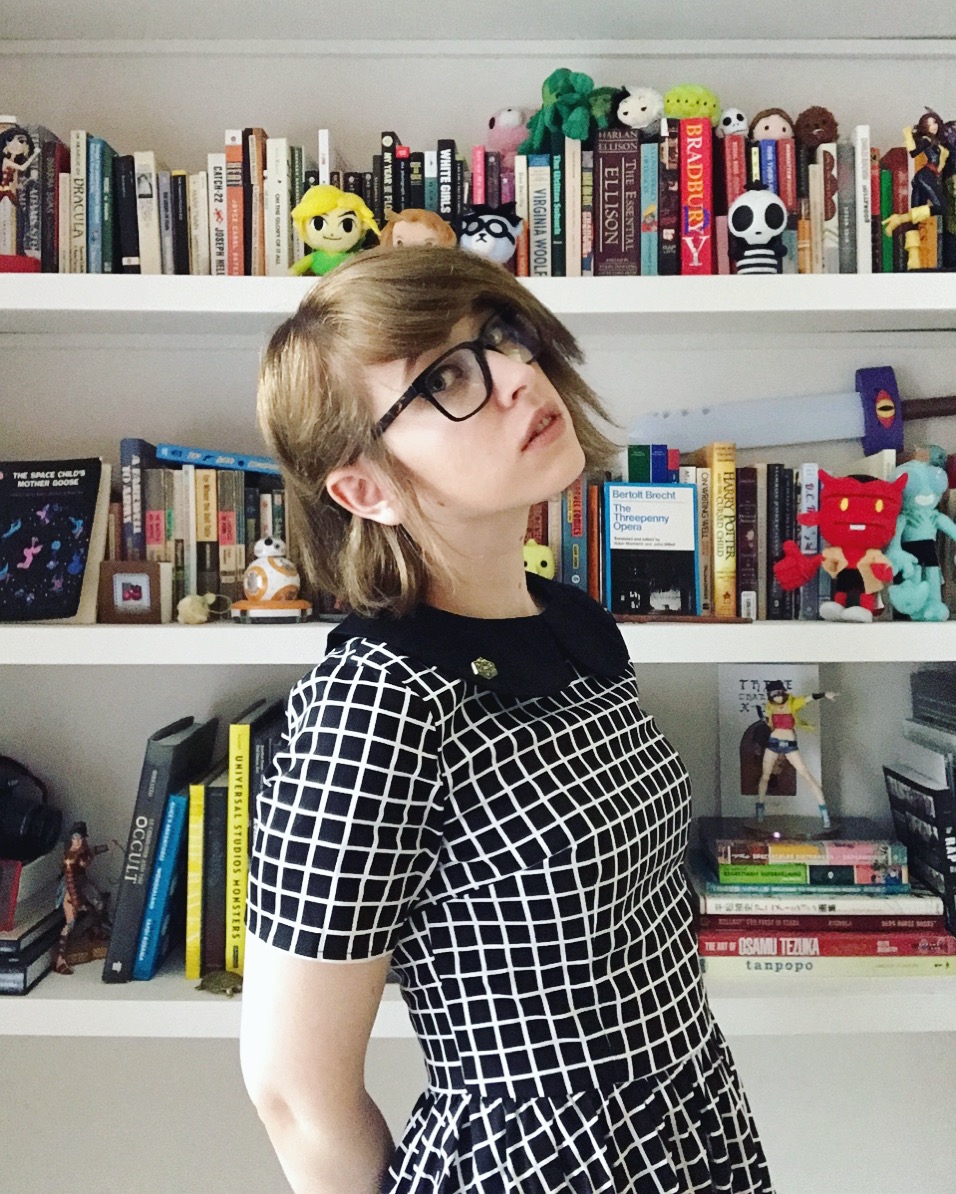
Ivy Noelle Weir
IW: I’m Ivy Noelle Weir, I’m a writer and an MLS-holding former librarian who now works in book publishing.
LW: What attracted you to working on this book?
CS: We became friends through The Valkyries. As I moved on to working in a library after comics retail, I reached out to Ivy to talk about the switch. And then we just started talking every day, every hour, from morning till night and became besties. It was soon after best friend status Ivy asked if I wanted to illustrate a webcomic with her and of course since I’d been itching to do a longform story for so long, I said yes! Also, the story is really good, so I was 100% on board after reading her summary.
IW: As Steenz said, we met in The Valkyries, and I just immediately loved her art from the moment I saw it. There’s a liveliness to Steenz’s art, her expressions are so lifelike and fun. I knew I wanted to work on something with her.
LW: What inspired you to create Archival Quality?
IW: It’s sort of a long story. I did my undergraduate studies in photography, and I became really fascinated by 19th century medical photography, and the ethics surrounding it. I took an internship in a historical medical archive, where I was working closely with images all day that were, to put it mildly, somewhat disturbing, but also deeply sad, isolating, lonely. While I was working there, I fell deeper and deeper into considering the ethics of archiving, what we preserve, and if it consents to being preserved. So, I started writing a ghost story about the ghost of an object in an archive, who doesn’t consent to being archived. Eventually, this turned from a prose novel to a comic script when I met Steenz, and now here we are.
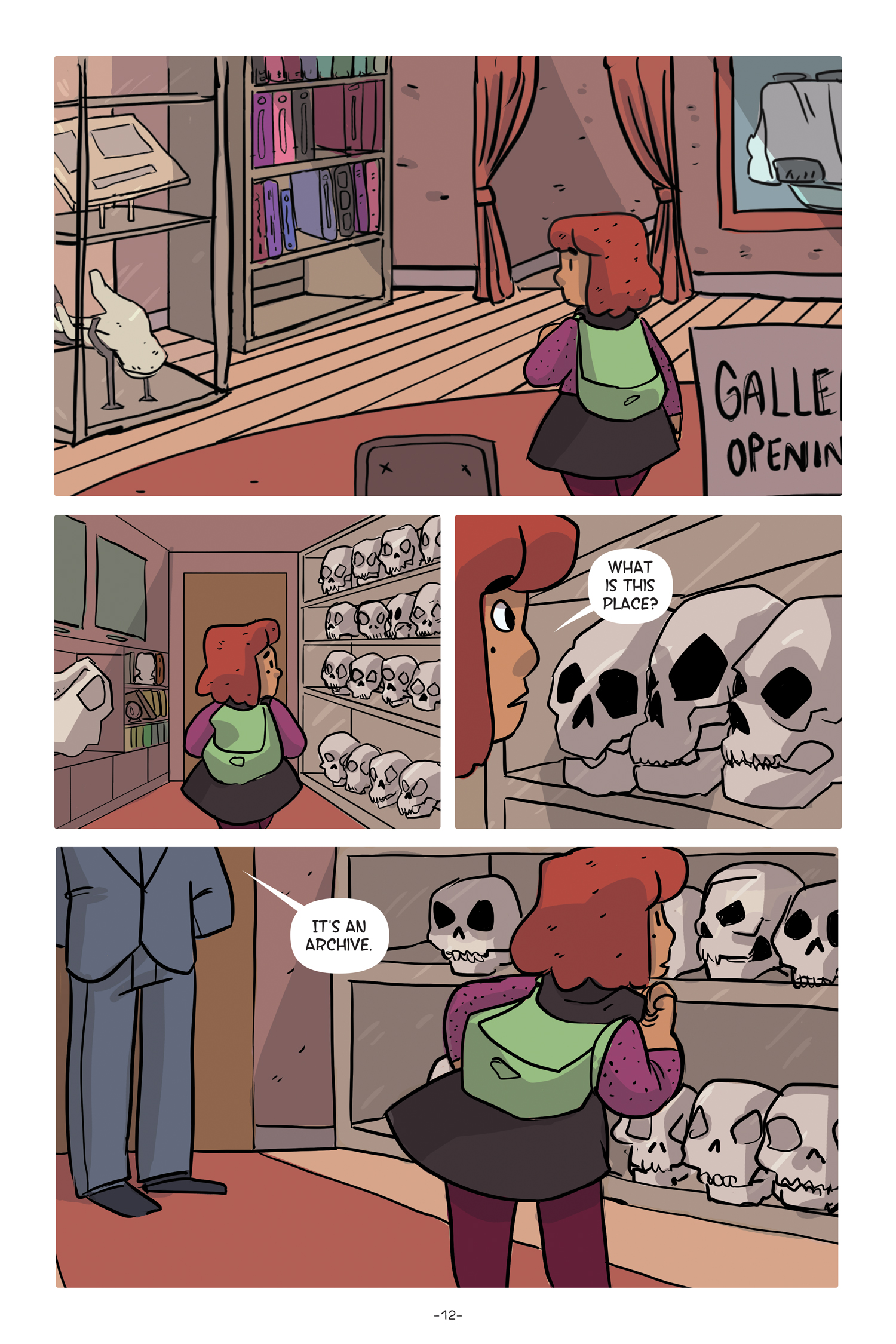 LW: Why did you choose to frame Archival Quality as a ghost story? What drew (ha) you to the horror genre? Are you a horror fan? Why or why not? Do you have recommendations for similar material?
CS: I’m ALL ABOUT horror. I love being scared. There’s something thrilling about watching a film and feeling uneasy afterwards. It’s kind of like a high. I recommend the Poughkeepsie Tapes if you don’t want to sleep for like two nights and Housebound if you’re looking for humorous horror.
IW: I’m a big ol’ horror nerd, and I always have been. I particularly love ghosts and haunted houses – I think they represent so much more than jump scares, they can be this pensive consideration of memory and trauma. The biggest influences on this story were Guillermo Del Toro’s The Devil’s Backbone, Mark Z. Danielewski’s House of Leaves, and Shirley Jackson’s The Haunting of Hill House. I think Jackson’s book in particular blends the concepts of the highly personal with horror in a really fantastic way.
LW: You tackle the subject of mental illness and care very delicately, while at the same time head on. How did you manage to craft such a powerful narrative and equally powerful artwork for this story?
CS: I think when it comes to the art, I read the story… and knowing Ivy as a person, I felt like I had a good idea of what she was looking for in terms of style. We were on the same page when it came to aesthetics for this story. A shared Pinterest helped me a lot. Also knowing that Ivy trusted me entirely with the design of the book and characters let me stretch my world building muscles.
IW: For the story, it was very important to me to show a realistic portrayal of mental illness as it exists for one person. I think when you try to generalize, and make a narrative that fits everyone, or has a “happy” ending where someone is cured or “fixed”, you come up with something that I don’t feel is as genuine or effecting. Depression doesn’t always mean being beautifully sad. Sometimes it means being a jerk to the people around you because you feel out of your own control. I know some people won’t relate to Cel – and I think that’s okay. Depression looks different on everyone, and everyone’s path to helping themselves is doing to be different, too. It was important to me to show someone who struggles with the concept of getting help, because I think a lot of people who struggle with their mental health can relate to that feeling.
LW: Are there any plans or desire to further develop Celine’s story?
CS: I think Celine’s story is done. Celeste on the other hand could have many more adventures and continued growth. But I think we both want to take a break from the world of AQ for a little bit before getting into that.
IW: No, I think she’s got what she needed.
LW: Steenz, your artwork is so unique. I particularly love Holly’s character design! I also follow you on Facebook and adore your kung fu poses. How did you achieve your art style? What tools do you use for your work?
CS: Thank you! I think when you’re learning to draw you subconsciously create your own style by fusing your interests with what your muscles naturally want you to do. I love Chris Sanders, Rebecca Sugar, and similar works. So, you can see the inspiration, but my style peeks through. I use a WACOM Cintiq, Manga Studio, and Photoshop. I’m hoping to get an IPad soon because all of my other comics friends has one and I’M HORRIBLY JEALOUS. Also, being able to work away from the desk is an amazing idea.
LW: Why should new graphic novel readers seek this out?
CS: Ivy and I both love reading works that aren’t just graphic novels. So, I think our work shows that. It has elements of cartoons, manga, and YA novels. So, if you like those things, there’s no way you won’t like Archival Quality.
IW: I think if you’re interested in haunted house tales, we’ve done something unique here in regard to the genre. And like Steenz said, we both brought techniques from a lot of the other media we consume to this book.
LW: Why should libraries be interested in Archival Quality?
CS: Well, we used to be librarians. And once a librarian, always a librarian. Support the homies, yanno?
IW: I think books that discuss the ethics of librarianship and archives in a conversational way are few and far between, and I hope Archival Quality offers libraries a way to engage with the topic while also getting spooked.
LW: What are some of your favorite books/graphic novels?
CS: Novels: The Lunar Chronicles, Six of Crows; Graphic Novels: Extremity, Daytripper, This One Summer, Batman: Detective Comics, Ms. Marvel, etc. I could go on for a really long time, but those came to my head first. Webcomics: On A Sunbeam, Agents of The Realm, Star Trip, Witchy
IW: Well, my favorite book is the previously mentioned The Haunting of Hill House. I just finished Night Film by Marissa Pessl and really enjoyed it. As for comics, I read pretty widely: I’m a big fan of Hellboy, Saga, Wicked + Divine…I also read a lot of manga – I’m loving The Girl from the Other Side right now.
LW: What other work have you done, separately or together?
CS: We’ve done work for anthologies together. Separately I’ve done work for the MINE! Anthology for Planned Parenthood and the ELEMENTS: Fire Anthology.
IW: We had a short story come out this month in Action Lab’s Princeless Charity Anthology!
LW: What else would you like librarians and readers to know about you?
CS: I tell everyone this, but GET A LIBRARY CARD. Also, I’ve spent many, many, many hours in libraries and I can guarantee you 100% that this is a book that you will want to curl up in a corner of your local library and read from beginning to end.
IW: I second Steenz’s urging for readers to get a library card. Libraries serve so many roles in their communities; your support is integral!
LW: What’s next for the amazing Ivy/Steenz team?
CS: We’re working on a pitch for another book! Can’t say much other than that. So, GET READY.
IW: We’re working on something new! Which I should really get back to writing.






Follow Us!