Home » 2021 (Page 22)

Book Review: Women Make Horror: Filmmaking, Feminism, Genre edited by Alison Peirse

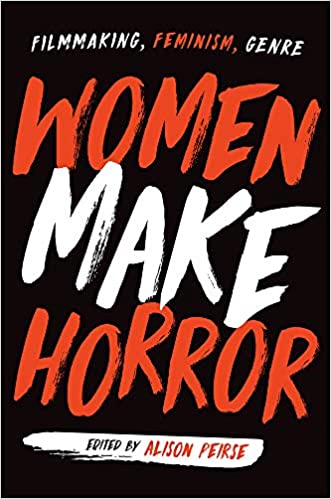
cover art for Women Make Horror edited by Alison Peirse

Women Make Horror: Filmmaking, Feminism, Genre edited by Alison Peirse

Rutgers University Press, 2020

ISBN-13: 9781978805118

Available: Paperback, Kindle edition Bookshop.org | Amazon.com )


Women working in the horror industry today are severely underrepresented. Although they have been making horror for centuries, many women have been cut out of that history and/or had their authorship and creative influence denied. What is more, women also enjoy consuming horror. Women Make Horror explores women’s creation and enjoyment of the genre through analysis of experimental cinema and filmmaking. The book includes seventeen essays, global in scope, discussing creatives, films, and festivals. While I think every one of these chapters deserve attention, I will highlight some that stand out.

“Women Make (Write, Produce, Direct, Shoot, Edit, and Analyze) Horror” by Alison Peirse provides a solid introduction to the text. Peirse discusses how she garnered and selected the texts for this volume. She asked three questions of the writers: why do women make horror; what kinds of stories do women tell in horror; and what makes a horror film a feminist film (p. 8-9). Every contributor has a unique perspective as to how they answered these questions.

“The Secret Beyond the Door” by Martha Shearer discusses Daria Nicolodi’s authorship and, subsequently, creative content of the original Suspiria. In “Why Office Killer Matters”, Dahlia Schweitzer provides valuable information on this film and argues that it is a film that not only restructures the representation of gender representation, but how horror films are expected to conform to specific tropes (p. 89). Donna McRae, in her chapter titled “The Stranger with My Face International Film Festival and the Australian Female Gothic”, discusses the development of this essential film festival, as well as “considers the influence of a female-centric genre filmmaking in Australia today” (p. 146) and how it has been a force for good in creative circles. Erin Harrington’s “Slicing Up the Boys’ Club” provides an excellent analysis of the existing state of anthology and omnibus films and their lack of diversity, as well as a discussion regarding the women-led anthology, XX. Harrington poses some good questions regarding representation for readers as well. “The Transnational Gaze in A Girl Walks Home Alone at Night” by Lindsey Decker presents an analysis through the lens of Hamid Naficy’s Islamicate gaze theory rather than the typical male gaze theory used so often in feminist film analysis.

In “Gender, Genre, and Authorship in Ginger Snaps“, Katarzyna Paskiewicz analyzes the film Ginger Snaps, which makes connections between a werewolf legend and a girl’s coming-of-age story. Paskiewicz describes her study as having two purposes. She seeks to answer how the film might be productively read through a lens that recognizes filmmaking as a collective art form” (p. 106), as well as wanting to “register the significance of women’s film authorship within the horror genre histories in which they have been traditionally overlooked” (p. 106). Early in the chapter, the author argues that directors are not the only creative voice in a film project. Editors, screenwriters, set designers, and more have influence over various aspects of a film (this is precisely why my colleague and I created Women in Film: A Film Index, to recognize other creatives in horror. That the sentiment is recognized in this seminal text is encouraging).

Other chapters cover directors such as Gigi Saul Guerrero, Lucile Hadžihalilović, and Alice Lowe. There are also chapters that focus on the New French Extremity, Korean horror cinema, fans as filmmakers, international films and events, and much more. The end of each chapter includes notes, and there is an extensive index at the end of the book.

Women Make Horror is a much-needed collection of feminist horror film criticism. Some of these essays, such as Molly Kim’s delve into Korean women-made cinema, are the first of their kind. and others showcase someone’s overlooked or misappropriated contributions, such as Alicia Gomez’s chapter on Stephanie Rothman’s The Velvet Vampire, a film originally credited to Roger Corman. Women Make Horror would be an excellent resource for horror scholars or even an addition to a film studies course on the genre. The general reader could enjoy it, but there are many chapters that read more like an academic work.  Highly recommended.


Reviewed by Lizzy Walker


Editor’s note: Women Make Horror: Filmmaking, Feminism, Genre is a nominee on the final ballot for this year’s Bram Stoker Award. 
Book Review: You Know It’s True by J.R. Hamantaschen

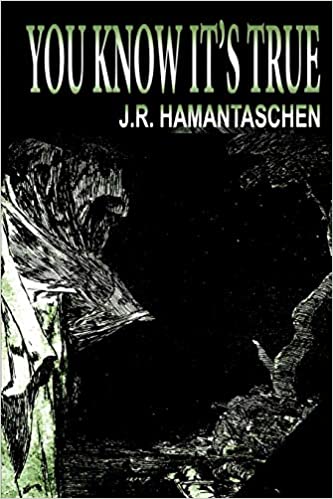
cover art for You Know It's True by J.R. Hamantaschen

You Know It’s True by J.R. Hamantaschen

Self-published, 2021

ISBN: 9798706071196

Available: Paperback, Kindle  ( Amazon.com )


A more fitting title for this collection of short stories would be The World’s Absolute Weirdest Tales.  These aren’t just out of left field: they leave left field, clear the Green Monster and land somewhere beyond Lansdowne St.


Readers who prefer stories that move from Point A to Point B in a  straightforward fashion will find that those are in the minority, although the ones included are real barn-burners.  “Short Bloom”, “Grab More Knives”, and ‘”More as a Keeper” are phenomenal, the only real letdown being that the last of them ends right when the story cranks into overdrive.  “Short Bloom” features an Earth where tiny holes open anywhere on the ground at random, and a fiber-thin appendage protrudes and painfully kills any living thing.  “Grab More Knives” is a brilliant and ironic look at what happens when people who justify vandalism and harassment under the guise of activism for a cause get a freight-load of payback, all due to a simple misunderstanding.  It’ll make some readers cheer, and others cry.  “More as a Keeper” is a look at what happens when the dead in purgatory get a chance for revenge.  It’s outstanding, and these three stories alone could probably justify the purchase of the book.


The other stories are more likely to appeal to fans of non-traditional stories, as some of them feel more like in-depth sketches or portraits of an individual.  The stories in this mold have a fully-developed character backstory, but then the actual story ends quickly, often with little resolve, and sometimes making no sense at all.  “Sad Life” is a good example.  Set at a wedding, it details a woman’s failed attempts and lack of desire for a standard relationship.  It’s well-written and detailed,  but then her face splits apart and the story ends.  This is what you have to enjoy to really like this book– excellent buildup, but a sometimes incomprehensible ending.  The stories “Night Devours My Days” and ” I Should Have Been a Pair of Ragged Claws/Scuttling Across The Floors of Silent Seas” also fall into this category.  The prose is solid, but the style may not be for everyone.


The last two stories, “It’s Always Time to Go” and “Beholden to the Past” are excellent ones that combine the above two story types.  “Beholden to the Past” is also notable for its unusual plot.  A college student has a serious addiction to whacking off, often to live online porn.  The catch?  When he has an orgasm, the person he was fantasizing about and/or watching dies.  It doesn’t get stranger than that, and seems a fitting final story for a very strange collection.  Overall, this book has a lot to recommend it, but enjoyment will depend greatly on the reader.  You Know It’s True defies categorization: there’s nothing else out there like it. Recommended for fans of unusual writing.


Contains: profanity, gore, murder, violence, sex, body horror, miscarriage, necrophilia, suicide, self-harm, and large doses of utter lunacy


Reviewed by Murray Samuelson

Book Review: To Dust You Shall Return by Fred Venturini

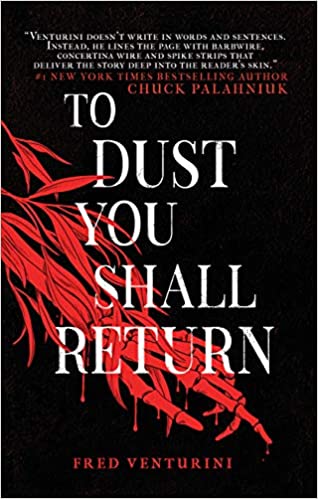
cover art for To Dust You Shall Return by Fred Venturini

To Dust You Shall Return by Fred Venturini

Turner Publishing, 2021 (release date June 21)

ISBN: 9781684426348

Availability: Paperback, Kindle Bookshop.orgAmazon.com )


If you only have the budget to purchase one book for the entire year, this is the one to buy.  To Dust You Shall Return is superior to everything else out there, might as well just hand the author the Stoker award for best horror novel of 2021 and skip the drawn-out nomination process.  It’s that good: other authors will be hard pressed to equal it.


Most of the story is set in Harlow, one of those Children of the Corn-type Midwestern towns you could drive through and not know if anyone actually lives there.  Curtis Quinn, an aging ex-Mafia hitman with a price on his head, is led there while on the trail of whoever butchered his beloved wife into pieces.  He suspects it’s a revenge hit to get to him, but what he finds in Harlow is much more sinister and terrifying than anything the Mafia could have dished out.  Harlow residents live in fear of the Mayor, a sadistic madman (or is he?) with inhuman powers.  The residents’ only hope is the legend of the Griffin, an outsider who may one day come to deliver the townspeople from the Mayor’s grasp.  Could Curtis, a cold-blooded killer, be that man, and is it somehow connected to his wife’s murder?


The story scores unbelievably high on every possible level, but the excitement and originality are the two best points.  After a brief prologue, the story shifts into high gear right away, and, in 352 pages, doesn’t let up.  There’s never a hint of a slowdown: this is the type of book you will keep reading well into the night, until exhaustion sets in.  For originality, Harlow itself is one of the most intriguing fictional towns ever invented; it’s an unusual cross between a communist community and Blake Crouch’s Wayward Pines.  Residents are provided for and given jobs, but the cost is never being able to leave the town, exceept for a forays lasting a brief hour or two.  The town is surrounded with razor wire and various traps to keep the people in.  If they do escape, rangers track them down and return them to Harlow, where they are ritually slaughtered in front of the townspeople in extremely painful and bloody ways.  This causes the book’s gore factor to run high at times, but it is always in service to the story, never gratuitous for the shock factor.  That said, some of the killings are as hardcore as anything Jack Ketchum ever wrote and will make readers cower in fear, praying to forget what they just read.


The characters and plot also sell themselves by their unpredictability: the story does not go where you would expect.  Numerous characters double-cross each other, and the book becomes a guessing game,  keeping the story engrossing.  The legend of the Griffin also helps drive the story’s unexpected twists and turns, as most stories with a creepy little town rarely use the “savior” angle.  It’s just another example of what sets this story apart from all the competition.  Bottom line: just buy this one, and prepare to be blown away.  You won’t be disappointed.  This is beyond highly recommended.


Contains: blood, gore, profanity, cannibalism, ritualistic torture.


Reviewed by Murray Samuelson